Launching a successful eyewear company in 2026 requires more than just a good eye for fashion. The global optical market is highly lucrative, but it moves incredibly fast. If you spend two years trying to engineer custom frames from scratch, consumer trends will pass you by before you ever make your first sale.
For entrepreneurs and retail businesses looking to scale quickly, the “Private Label” model (also known as ODM – Original Design Manufacturing) offers the ultimate solution. By leveraging existing, high-quality factory designs and customizing them with your own branding, you can bypass expensive tooling costs and slash your time to market.
Can you really go from a blank notebook to a fully stocked e-commerce store in just half a year? Absolutely. If you plan strategically and partner with the right suppliers, a six-month timeline is entirely realistic.
This comprehensive guide breaks down the exact monthly roadmap you need to follow to build a premium private label sunglasses brand and successfully navigate the logistics when you decide to start eyewear brand China operations.
Month 1: Market Positioning and Niche Selection
You cannot sell sunglasses to everyone. Before you spend a single dollar on inventory, you must define exactly who will buy your product. The most successful modern eyewear brands dominate a specific, tightly defined niche.
Spend your first thirty days researching the market and defining your brand identity:
-
Identify Your Niche: Will you sell ultra-lightweight TR90 running sunglasses to marathoners? Will you target the eco-conscious Gen Z demographic with sustainable bio-acetate frames? Or are you aiming for the luxury fashion market with bold, chunky geometric designs?
-
Analyze the Competition: Look at three competitors in your chosen niche. What do they do well? More importantly, where do their customers complain? Read their negative reviews to find gaps in their quality or customer service that your brand can fill.
-
Establish Your Pricing Strategy: Determine your target retail price. If you want to sell glasses for $150, you need to budget for premium materials like acetate, high-end spring hinges, and polarized TAC lenses. If you aim for the $30 fast-fashion market, you will need to focus on high-volume injection-molded plastics.
Month 2: Finding Your Manufacturing Partner
Once you know what you want to sell, you must find a factory capable of making it. When entrepreneurs look to start eyewear brand China sourcing, they often feel overwhelmed by the thousands of suppliers listed on platforms like Alibaba.
To filter out the trading companies and find genuine, high-quality manufacturers, follow these steps:
-
Focus on Wenzhou: Wenzhou is the eyewear manufacturing capital of the world. Factories in this region possess decades of specialized optical experience, established supply chains, and highly skilled artisans.
-
Demand Material Expertise: Ask potential suppliers specific questions. Do they use virgin TR90 or recycled blends? Do they source their acetate from reputable suppliers like Mazzucchelli or Jinyu? A professional factory will answer these technical questions instantly and transparently.
-
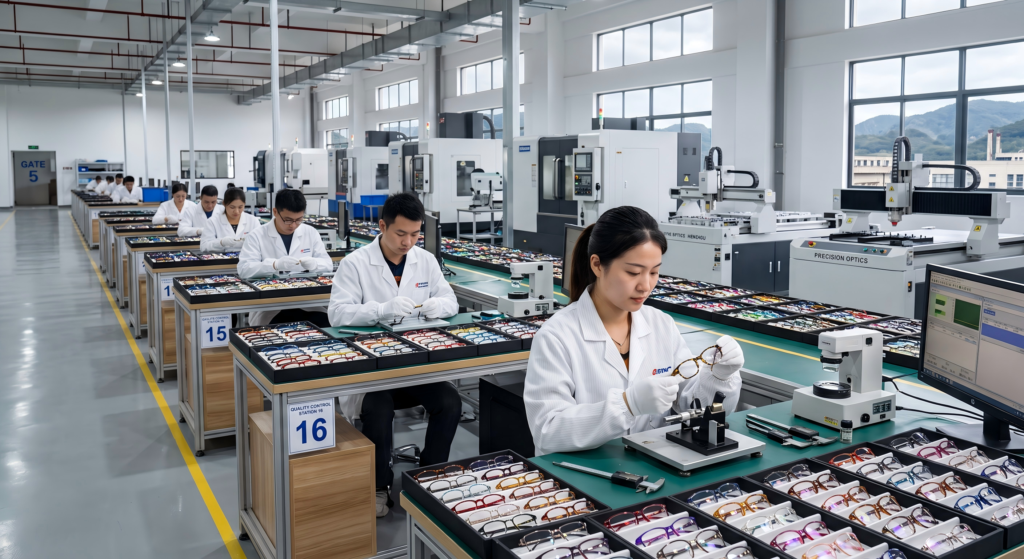
Request a Factory Audit (or Video Tour): Never wire money to a factory you haven’t vetted. Request a live video call on the factory floor. You want to see their CNC machines, their tumbling barrels, and their assembly lines in action.
Month 3: Sampling and the Private Label Strategy
Month three is where your brand becomes a physical reality. It is time to order samples.
Because you are building a private label sunglasses brand, you do not need to pay $1,000 for a custom steel mold. Instead, ask your chosen factory for their “Open Catalog.” These are premium frame shapes that the factory has already designed, tested, and engineered.
-
Select Your Core Shapes: Choose 3 to 5 versatile, strong-selling shapes from the catalog. A classic square, a modern pentagon, and a timeless cat-eye offer a solid foundation.
-
Customize the Finishes: This is how you make the factory’s open mold uniquely yours. Request specific colorways. Order one shape in a modern, pristine Clear finish, and another in a rich, vintage Tortoise pattern.
-
Test the Samples: When the physical samples arrive at your office, wear them. Bend the temples to test the spring hinges. Check the clarity of the polarized lenses. Leave them in a hot car to ensure the plastic does not warp. You must relentlessly test the product before you approve mass production.
Month 4: Branding, Packaging, and Compliance
While the factory perfects your frame samples, you must finalize the elements that elevate a basic product into a luxury brand experience.
Custom Laser Engraving
Send your final vector logo to the factory. In a private label model, the factory uses precision laser machines to etch your brand name onto the outside of the temples and print your model numbers and CE marks on the inside of the arms.
The Unboxing Experience
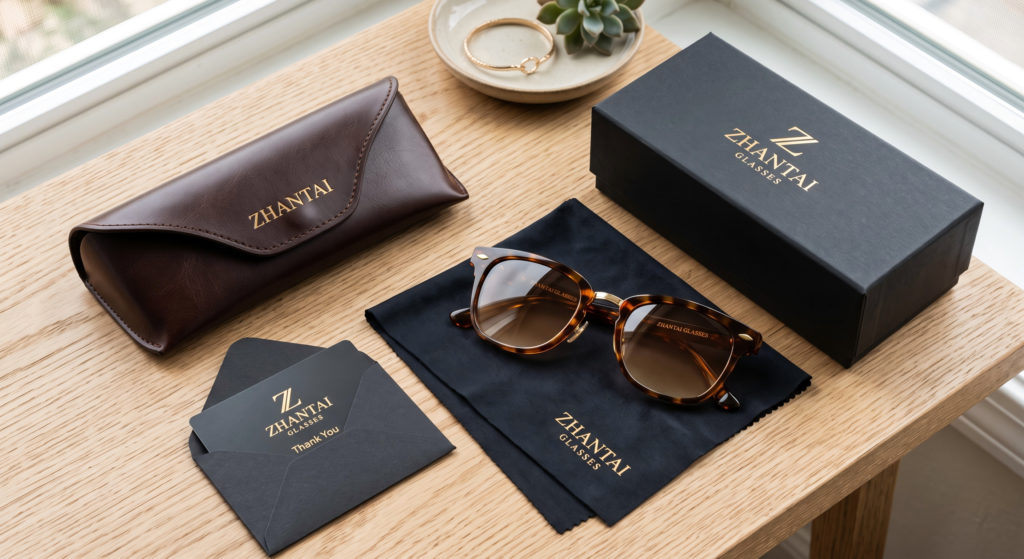
Do not treat packaging as an afterthought. Customers judge the value of your sunglasses the moment they hold the box. Source high-quality packaging to match your price point. A premium brand requires a rigid exterior retail box, a durable PU leather or EVA hard case, and a thick microfiber cleaning cloth debossed with your logo. Many eyewear factories maintain close partnerships with packaging suppliers and can coordinate this for you, bundling everything together before shipping.
International Compliance
If you sell in Europe, your sunglasses must carry the CE mark. If you sell in the United States, you must register your company and your manufacturer with the FDA. Ensure your factory partner understands these regulations and uses certified, drop-ball tested lenses that meet international UV protection standards.
Month 5: Mass Production and Quality Control
You approved the samples. You finalized the packaging. Now, you place your bulk order and wire the 30% production deposit.
For professional B2B eyewear manufacturing, expect a standard 1200-unit Minimum Order Quantity (MOQ). You can usually split this across one model in four different colors (300 units per color).
Mass production in the eyewear industry takes time. Even highly automated factories require 45 to 60 days to complete a bulk order.
-
Acetate Curing: If you ordered acetate frames, the material must rest in curing ovens to release moisture, preventing the frames from warping later.
-
Tumbling and Polishing: Frames tumble in wood-peg barrels for days to smooth out CNC machining marks, followed by meticulous hand-polishing by skilled artisans.
-
Quality Control (QC): Communicate your QC standards clearly. Before paying the final 70% balance, hire a third-party inspection agency (or demand extensive video proof from the factory) to check the batch for scratched lenses, stiff hinges, and color consistency.
Month 6: Logistics, E-Commerce, and Launch
Your frames look flawless and are packed into master cartons. In your final month, you execute the logistics and open your doors to the public.
Freight Forwarding
When you start eyewear brand China production, you must choose how to move your goods across the world.
-
Air Express (DHL/FedEx): Takes 5 to 7 days. It is expensive but highly reliable. Use this for your initial launch inventory so you can start selling immediately.
-
Sea Freight: Takes 30 to 45 days. It is drastically cheaper and the best option for your heavy, bulky packaging and your larger restock orders.
Digital Storefront and Content Creation
While your inventory flies over the ocean, build your digital storefront on platforms like Shopify. Book a local photographer and models to shoot lifestyle images. Consumers do not buy glasses; they buy the lifestyle the glasses represent. Ensure your product pages highlight the specific benefits you engineered in Month 3: the lightweight comfort, the premium spring hinges, and the flawless UV400 lenses.
When the boxes arrive at your warehouse, your website is live, your marketing campaigns are ready, and your inventory is strictly quality-controlled. You are ready to launch.

Conclusion: The Value of the Right Partner
Building a private label sunglasses brand in just six months requires relentless focus, swift decision-making, and an airtight supply chain. You cannot afford miscommunications, delayed samples, or unexpected quality issues.
Your success ultimately depends on the manufacturer you choose in Month 2. At Wenzhou Zhantai Glasses Co., Ltd., we built our factory on the principles of practical execution and rigorous craftsmanship. We do not just process orders; we act as your technical co-founders. We guide you through our extensive catalog of proven, high-converting designs, apply your branding with exact precision, and manage the complex production timelines so you can focus entirely on marketing and sales.
When you partner with a factory that masters the geometry of eyewear production and understands the urgency of modern retail, that six-month launch window becomes more than just a goal—it becomes a guaranteed reality.