TAC and PC polarized sunglasses differ in their supporting materials, manufacturing methods, and available lens constructions. Thickness describes a physical dimension, while layer count describes how the construction is explained. Neither number alone establishes polarization quality, UV protection, or durability. For buyers, the useful comparison is the complete specification: finished thickness, curvature, polarizing structure, coatings, frame compatibility, and relevant test results. Choose a documented lens configuration that suits the product rather than relying on a material label or advertised layer count.
Key Takeaways
A reliable comparison separates lens construction, physical dimensions, and verified performance.
- Thickness and layers are different measurements. A thicker lens does not automatically contain more functional layers or provide better polarization.
- Three-layer and seven-layer descriptions may count different things. Request the actual construction instead of treating either number as a quality grade.
- TAC 0.74 mm and 1.1 mm provide practical starting points for selection. The appropriate specification depends on the frame, curvature, assembly, and finished-lens requirements.
- Performance requires product-specific evidence. Material and thickness alone cannot establish protective-eyewear compliance or prescription suitability.
What Are TAC and PC Polarized Sunglasses?
TAC and PC identify materials used to support a polarizing element, rather than complete specifications for the finished eyewear.
TAC: A Laminated Lens Construction
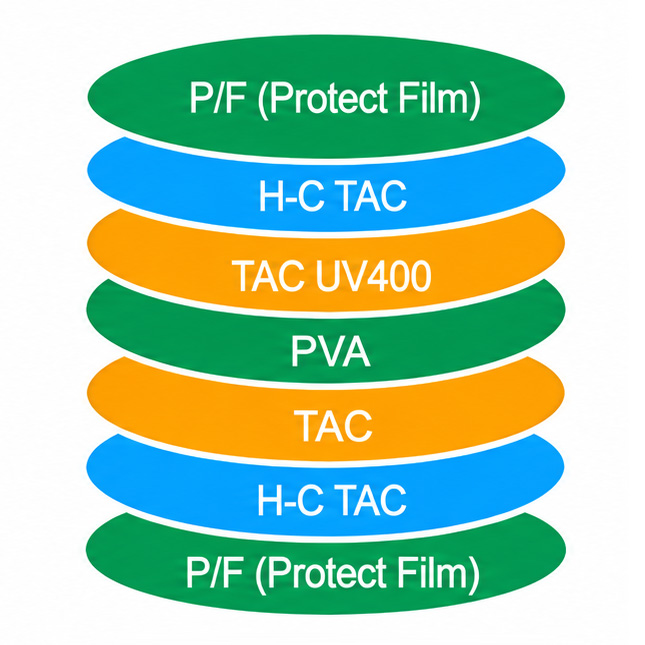
Manufacturers typically sandwich a PVA polarizing film between two cellulose triacetate layers to produce TAC polarized lenses. The PVA film reduces reflected glare, while the TAC layers support and protect it.
This TAC/PVA/TAC structure forms the basic core. Manufacturers may add bonding materials and surface treatments to complete the lens. Before ordering, ask your supplier to confirm the actual construction and specify which coatings the product includes.
PC: Polycarbonate Supporting a Polarizing Film
PC stands for polycarbonate. One manufacturing route combines a prepared polarizing insert with injected PC resin.
The insert is positioned in a mold, and the PC body is formed around or against it according to the product’s design. The supplier should identify the construction and processing route of the particular lens being quoted.
Separate the Performance Questions
Polarization, visible-light transmission, UV protection, and impact performance address different requirements.
A quotation that says only “PC polarized” or “seven-layer TAC” leaves important questions unanswered. Ask what the finished product must achieve and what evidence supports those claims.
Lens Thickness: Which Number Are Buyers Comparing?
A useful thickness specification identifies the finished dimension, measurement location, and acceptable tolerance.
Total Lens Thickness Versus Film Thickness
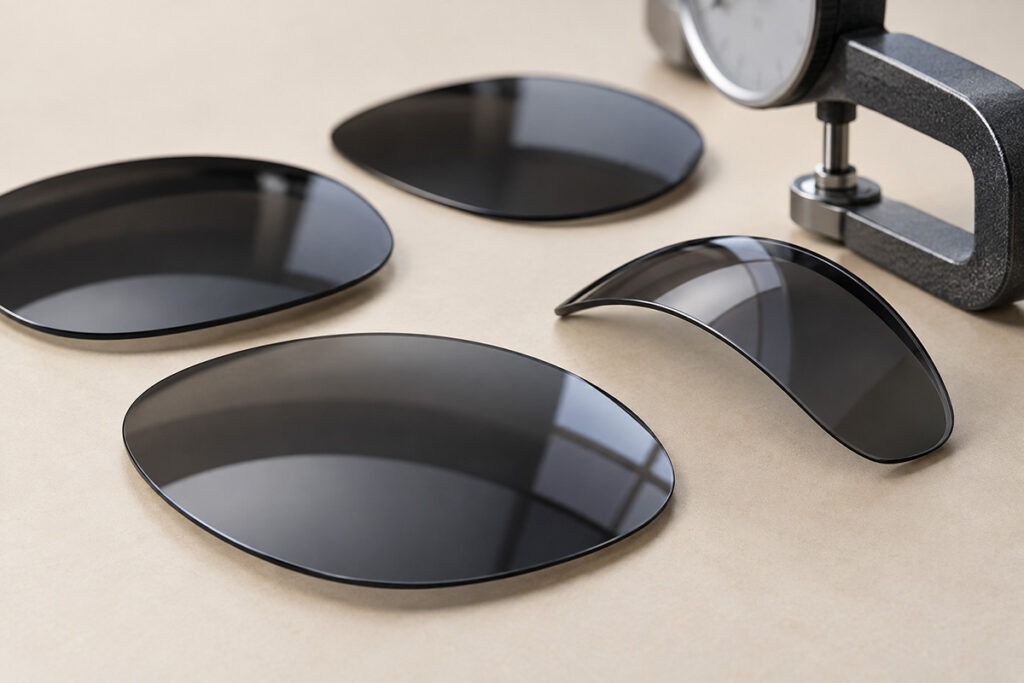
Suppliers typically specify finished-lens thickness in millimeters and individual film thickness in micrometers. These measurements describe different parts of the product.
A polarizing-film measurement covers one component. Finished-lens thickness covers the complete construction at a defined measuring point.
When a supplier provides layer dimensions, confirm whether they describe the finished lens or an intermediate film assembly. Do not combine values from different constructions to estimate a lens cross-section.
Ask your supplier for a confirmed construction drawing when you need individual layer dimensions.
Nominal Thickness, Measurement Location, and Tolerance
A nominal value is the specified target, not a complete measurement instruction.
Clarify whether thickness is measured at the center, edge, or another defined location. Also confirm whether the value includes surface treatments and whether it applies before or after forming.
Agree on the measurement method and tolerance before sample approval. Otherwise, two suppliers may quote similar numbers using different conventions.
Comparing TAC 0.74 mm and 1.1 mm
At Zhantai, TAC 0.74 mm and 1.1 mm are starting specifications for discussing suitable frame-and-lens combinations.
Check the lens groove, edge preparation, curvature, and retention after assembly. A thicker option may require a different groove or edge configuration, while a thinner option still needs secure retention.
A frame designed around one specification should not automatically receive another. Even when both can be fitted, each completed configuration requires assessment.
Confirming PC Thickness Options
PC sourcing discussions may include nominal specifications such as 1.0, 1.2, and 2.0 mm. Availability depends on the lens geometry, manufacturing process, and supplier’s product range.
Confirm the actual thickness, base curve, dimensions, and processing route for the project. Do not interpret a thickness value as an automatic impact-performance grade.
Three Layers or Seven Layers: Why the Descriptions Differ
Layer counts can differ because one description counts structural components while another includes functions or treatments.
Three Layers Describe a Simplified Core
The TAC/PVA/TAC model counts two supporting layers around a polarizing core.
It helps explain the basic arrangement. It does not establish whether a particular finished lens has additional adhesives, coatings, or other components.
Ask whether a supplier’s “three-layer” description refers to the core laminate or the entire finished product.
Seven-Layer Descriptions May Include Functions
A seven-layer description may include protective layers, hardening treatments, UV-absorbing functions, and the polarizing element.
These descriptions are not necessarily standardized. Some count temporary protective films, while others emphasize functions or permanent components. The arrangement must therefore be confirmed for the actual product.
A description can be useful without representing a universal cross-section. Problems arise when buyers compare different counting systems as though they describe identical constructions.
More Layers Do Not Automatically Mean Better Quality
Additional treatments may provide useful functions, but their effectiveness depends on execution and compatibility.
Instead of asking only how many layers a lens has, ask what each claimed layer does, whether it remains on the finished lens, and how its performance is evaluated.
A documented function and relevant test result are more useful than a larger marketing number.
TAC vs PC Comparison: Thickness, Construction, and Buyer Checks
TAC and PC should be compared through equivalent finished-product requirements rather than a universal material ranking.
The thickness values below are examples for specification discussions. Confirm availability and detailed construction for each quotation.
| Comparison factor | TAC lenses | PC lenses | Buyer check |
| Supporting material | Cellulose triacetate | Polycarbonate | Confirm material and construction |
| Manufacturing route | Lamination, forming, and cutting | Options include a polarizing insert combined with PC injection molding | Identify the actual process |
| Thickness examples | 0.74 and 1.1 mm | Specifications may include 1.0, 1.2, and 2.0 mm | Confirm measurement point, tolerance, and availability |
| Layer description | Simplified TAC/PVA/TAC core; other counting methods exist | Polarizing insert and PC body, with specified treatments | Request a construction statement |
| Frame compatibility | Depends on finished geometry and thickness | Depends on finished geometry and thickness | Assess assembled samples |
| Prescription route | Standard thin plano sheets are not prescription blanks | Purpose-designed prescription products are available | Confirm the blank and processing route |
| Coatings | Depend on the offered construction | Depend on the offered construction | Confirm treatment compatibility and evidence |
| Performance claims | Require product-specific evidence | Require product-specific evidence | Review relevant reports |
How to Use the Comparison
Begin with the intended frame and application. Then compare configurations that meet the same optical, cosmetic, and purchasing requirements.
For a conventional frame reference, review Zhantai’s OEM rectangle plastic sunglasses. Its published lens material describes that listed configuration; Alternative lens options require a separate discussion.
How Manufacturing Affects Frame Fit and Lens Selection
Forming and Cutting Laminated TAC Lenses
Laminated TAC material is formed and cut to produce the required lens geometry.
For procurement, assess the finished curvature, edge quality, dimensions, and assembly result. A material sample alone cannot demonstrate how the completed lens will behave in the intended frame.
Inspect the finished pair for fit and optical performance after assembly, rather than approving only the loose lens.
Insert Injection Molding for PC Lenses
In an insert-injection process, the polarizing insert and molded PC body become part of the finished lens construction.
Confirm that the offered geometry matches the frame. Also ask which surface treatments and processing instructions apply to that particular product.
The manufacturing route helps explain the product, but it does not replace finished-product testing.
Prescription Capability Depends on the Product
A thin finished plano lens is not the same product as a prescription blank.
Purpose-designed PC prescription products exist.
However, an existing thin PC sunglass lens cannot automatically be converted into a prescription lens. The available blank, optical design, processing route, and prescription requirements must all be suitable.
Adding thickness alone does not turn a plano lens into a prescription product.
Which Performance Claims Need Verification?
Polarization Efficiency and Axis Alignment
Ask suppliers to state the efficiency definition, test method, and acceptance requirement.
A percentage without a measurement method is difficult to compare. Likewise, a stated angular tolerance needs a clear axis convention and an explanation of how the finished pair is assessed.
Avoid converting a percentage into a glare-reduction ratio unless the calculation method is defined. Confirm both the individual lens orientation and the alignment of the assembled pair.
UV Protection and Visible-Light Transmission
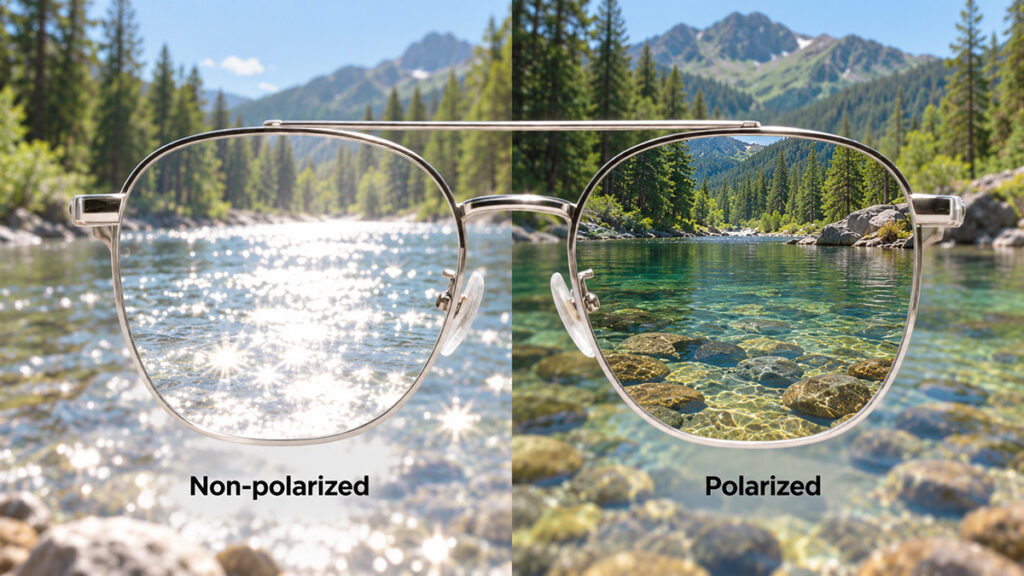
Polarization reduces reflected glare, but it does not independently establish UV protection. Lens darkness is also not proof of UV performance. UCLA Health’s sunglasses guidance
Request finished-lens transmission data and confirm the intended filter category. Do not assume that all products in either material share the same UV protection or visible-light transmission.
Impact Performance and Protective Claims
Material selection matters, but neither a PC label nor a 2.0 mm thickness automatically establishes protective-eyewear compliance.
Claims must match the specific tested configuration and intended application. Ordinary sunwear, occupational protection, and specialized protective equipment should not be treated as interchangeable categories.
Coating Durability and Environmental Exposure
Evaluate adhesion, abrasion, humidity, heat, and salt exposure according to the intended product requirements.
Ask which construction was tested and under what conditions. An accelerated exposure test does not, by itself, establish a fixed number of months or years of service.
For appearance planning, Zhantai’s guide to classic and fashion aviator sunglasses discusses lens and frame combinations. Confirm coating feasibility separately for the selected lens construction.
How to Specify TAC or PC Lenses in an RFQ
A useful RFQ defines geometry, construction, performance, treatments, and approval requirements clearly enough for comparable quotations.

Define Geometry and Construction
Include the material, nominal thickness, measurement point, tolerance, base curve, lens dimensions, and construction description.
State the intended frame and provide drawings or samples where available. Do not assume that matching the thickness alone establishes compatibility.
Define Performance and Treatments
Specify tint, transmission requirements, polarization, UV performance, and requested treatments.
Separate external and internal surface requirements where relevant. Confirm coating availability and supporting evidence before accepting the quotation.
Request Samples and Relevant Documentation
- Review the specification. Identify missing dimensions, construction details, and performance requirements.
- Obtain supplier confirmation. Confirm availability, processing route, tolerances, and treatments.
- Evaluate samples. Check geometry, appearance, frame fit, and assembly.
- Review reports. Confirm that relevant evidence covers the ordered configuration.
- Approve production criteria. Document the reference sample, acceptance requirements, and change-control process.
Confirm applicable standards and editions for the destination market. For example, ISO 12312-1 addresses sunglasses for general use; its scope should not be confused with every protective-eyewear application.
Discuss Your Lens Requirements with Zhantai
Start with TAC 0.74 mm and 1.1 mm
Discuss these options against your intended frame, price position, and application.
Confirm the detailed construction, frame compatibility, and required evidence for the selected configuration before approval.
Confirm PC Options Against the Project Brief
Share the intended frame, use, quantity, budget, and destination market.
Our team can discuss available options and development requirements. Confirm the exact PC specification and supply arrangement before treating a proposed thickness as an orderable product.
FAQ: Questions from B2B Buyers
Is a Seven-Layer TAC Lens Better Than a Three-Layer Lens?
Does a Thicker PC Lens Automatically Meet Protective-Eyewear Requirements?
No. Thickness alone does not establish compliance. Verify the relevant testing and documentation for the specific lens-and-frame configuration and intended use.
Can I Order TAC 0.74 mm and 1.1 mm for the Same Frame?
Yes, if the frame design and assembly requirements accommodate both. Confirm groove fit, curvature, lens retention, and optical performance through samples before approving either option.
Ready to specify polarized sunglasses for your next collection? Contact Zhantai for the latest catalog and a tailored OEM/ODM quotation. Share your frame reference, preferred thickness, lens requirements, quantity, and target market so we can help assess a workable configuration.