Bifocal sunglasses combine an upper viewing area with a lower reading segment, helping suitable wearers switch between looking around and reading close up outdoors. Manufacturers typically give ready-made sun readers a non-prescription upper zone and tailor prescription versions to individual correction needs. Reading power, segment placement, fit, and lens performance determine how well each pair works. Buyers should also check screen compatibility because polarized lenses can affect some displays. Test the finished product with the activities and devices your customers actually use.
Key Takeaways
A useful outdoor reading product combines appropriate optical zones, comfortable fit, verified sun protection, and practical usability.
- Two zones serve different needs. Ready-made models typically combine a plano upper zone with a lower magnifying segment; prescription versions require individual specifications.
- Fit determines access to the reading area. Segment position, frame stability, and wearing height must work together.
- Screen compatibility is not simply a TAC issue. Polarization, display construction, and viewing angle can influence visibility.
- Population ageing creates a reason to evaluate the category. Validate purchasing demand through customer feedback, channel requirements, and sales evidence.
What Are Bifocal Sunglasses?
How the Upper Zone and Reading Segment Work
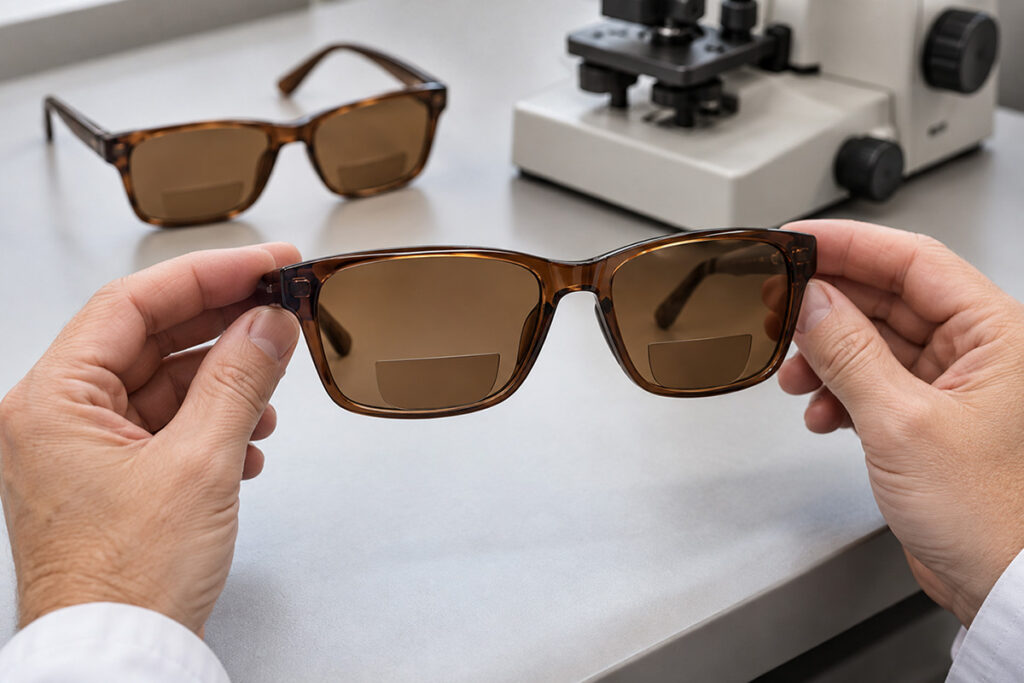
In a typical ready-made sun reader, the upper area has no corrective power. The lower segment provides magnification for close-up viewing.
This arrangement allows a suitable wearer to look ahead through the upper zone and lower their gaze to read.
However, a plano upper zone does not correct an existing distance prescription. Product descriptions should make that distinction clear.
Ready-Made Versus Prescription Options
Ready-made products offer standard reading strengths, commonly with the same nominal power in both lower segments.
Prescription versions are specified for the individual wearer. They may incorporate distance correction and a near addition according to the prescription and fitting requirements.
A standard reading-strength label is not equivalent to an individual prescription.
Bifocals Versus Full-Lens Readers and Progressives
Full-lens readers apply reading power across the lens rather than limiting it to a lower segment.
Bifocals provide two distinct zones. Progressive lenses use a changing power profile to provide additional viewing distances. These constructions serve different needs, so they should not be presented as interchangeable simply because all can support near viewing.
Where Bifocal Sunglasses Add Everyday Value

In the Garden: Looking Up, Then Reading Close Up
A gardener may look across a flower bed, then check a plant label or read instructions on a seed packet. A seated reader may alternate between a gardening book and the surrounding view.
These are useful examples because the task changes repeatedly while the person remains outdoors. Evaluate whether the reading segment is easy to access without lifting or repositioning the frame.
Ordinary sun readers should not be presented as protective eyewear for powered tools, flying debris, or other hazardous tasks.
At the Beach: Books, Menus, and Phone Messages
Consider a customer spending an afternoon at the beach. They may read a paperback, check a café menu, or view a phone message between looking around.
For this routine, near magnification is only part of the product. Bridge comfort, temple pressure, suitable lens tint, and secure storage also matter.
A frame that feels acceptable for a brief fitting may become uncomfortable during a longer outing. Include extended wear feedback when evaluating samples.
On Outdoor Trips: Maps and Small Details
Other examples include reading a printed map while stationary, checking a booking confirmation, or examining fishing tackle.
The same product will not suit every task equally. Reading distance, glare conditions, frame coverage, and segment placement all influence usability.
What They Do Not Replace
A reading segment does not automatically make the glasses suitable for driving, protective work, or every viewing distance.
Assess the intended use and relevant product requirements separately. Customers who need individual correction should not be led to expect that a ready-made product will address all their visual needs.
Reading Zones: Power, Position, and Usable Space
Reading Strength Must Match the Intended Task
Suitable reading power depends on the wearer and working distance. Stronger magnification is not automatically more useful.
For wholesale planning, distinguish the strength assortment from personal selection advice. Decide which powers to offer based on customer evidence and available specifications, while leaving individual prescribing decisions to appropriate eye-care professionals.
Segment Height and Width Affect Access
The segment must provide usable reading space when the wearer looks down.
If its position is unsuitable, the wearer may struggle to find it or experience interference with the intended upper view. Segment width also affects the available near-viewing area.
Specify the segment geometry rather than approving a product solely by its nominal reading strength.
Frame Fit Changes the Segment’s Position
A slipping frame moves the reading zone relative to the eyes. Bridge geometry, frame tilt, and wearing height can therefore change the experience.
Test the completed product on representative wearers. Record whether they can read comfortably and return to the upper zone without repeatedly adjusting the glasses.
Phones and Digital Screens: Polarization Matters
Polarized lenses can interact with some displays, making the screen appear darker or show color patterns at certain angles.

Why Screen Visibility Can Change
Display structure and viewing orientation affect the interaction. Samsung explains that screen visibility can change with viewing angle when wearing polarized lenses. Samsung’s screen-visibility guidance
Consequently, a product may work well with one device or orientation and less well with another. Avoid promising universal compatibility.
Why This Is Not Exclusive to TAC
TAC describes a supporting material, while polarization describes an optical function.
Changing from TAC to another polarized construction does not automatically remove screen interaction. Likewise, a material name alone cannot establish how a finished pair will perform with a particular display.
Compare the actual lens-and-device combination rather than treating PC as an automatic screen-visibility solution.
Test Normal Viewing Conditions
Evaluate representative phones, tablets, and e-readers where relevant. Check portrait and landscape orientations, ordinary head angles, and practical outdoor lighting.
Use normal operating brightness as part of the assessment. A product that requires an awkward viewing angle deserves attention even if the display becomes readable after rotation.
Balance Glare Reduction with Screen Use
Polarized and non-polarized options can support different priorities.
For customers who frequently check screens, compatibility deserves explicit evaluation. For activities involving reflected glare, polarization may be an important selection factor. Neither configuration guarantees readability on every device.
Lens Options Compared: A B2B Selection Table
The useful comparison separates viewing-zone design, polarization, and intended use rather than ranking products by material alone.
| Configuration | Viewing zones | Potential application | Buyer checks |
| Non-polarized bifocal sun readers | Plano upper zone with a lower reading segment | Outdoor reading with frequent screen checks | Power, segment position, UV performance, screen visibility |
| Polarized bifocal sun readers | Plano upper zone with a lower reading segment | Near tasks where reflected glare matters | Polarization, screen interaction, fit, UV performance |
| Prescription bifocal sunwear | Individually specified distance and near zones | Wearers requiring prescribed correction | Prescription, fitting measurements, optical verification |
| Full-lens reading sunwear | Reading power across the lens | Sustained close-up reading | Working distance and limitations when looking farther away |
Confirm Manufacturing Compatibility Separately
Ask how the reading segment is produced and which materials and treatments are available for that construction.
Do not assume that an ordinary TAC sheet can be turned into an integrated bifocal lens without a defined manufacturing solution. Confirm the complete approach, including reading power, tint, polarization, and finishing.
UV protection also needs separate evidence. Neither a dark tint nor a reading segment establishes protective performance.
Why Population Ageing Makes This Category Worth Evaluating
Population ageing increases the relevance of products designed around older consumers’ activities, but it does not establish demand for a particular model.
Use Demographic Evidence as Context
WHO projects that one in six people worldwide will be aged 60 or over by 2030. This provides a clear reason for brands to examine the needs of older customers. WHO: Ageing and health
However, that demographic projection is not a sales forecast for outdoor readers. Demand still depends on customer needs, product suitability, price, and distribution.
Connect the Product to Activities
Gardening, beach reading, travel, and outdoor social activities provide more useful product-development briefs than age alone.
Some customers prioritize a discreet frame. Others want generous coverage, convenient storage, or a specific reading-zone arrangement. Avoid assuming a single styling preference or optical requirement across an age group.
Validate the Assortment
Review inquiries, channel feedback, requested strengths, and return reasons before expanding the range.
A manageable combination of frames, colors, and strengths can be easier to evaluate than a large assortment introduced without evidence. Zhantai’s reading-glasses collection provides a starting point for discussing product directions and available configurations.
The commercial opportunity lies in solving a defined customer problem, then confirming that the proposed product does it well.
What Wholesale Buyers Should Specify and Inspect
A complete purchasing brief defines optical zones, frame geometry, lens performance, labeling, and acceptance requirements.
Define Optical and Product Requirements
Specify upper-zone power, lower-zone power or near addition, segment shape and dimensions, frame measurements, tint, UV requirements, and polarization where needed.
Clarify the terminology. For a plano upper zone, a standard reading-strength label may appear straightforward. In a prescription configuration, the near addition and total near power are different concepts.
For frame discussions, Zhantai’s OEM rectangle plastic sunglasses offer a silhouette reference. Confirm bifocal-lens feasibility separately rather than assuming the published product already includes that option.
Evaluate Comfort and Screen Compatibility
Check frame stability, pressure points, access to the reading segment, and device visibility.
Use realistic tasks during evaluation. Reading a seed packet in a garden and checking a phone at a café can reveal different issues from simply viewing the sample at a desk.
Approve Samples and Labeling
- Confirm the specification. Define optical zones, materials, tint, performance requirements, quantities, and packaging.
- Review representative samples. Inspect segment geometry, lens seating, alignment, and finish.
- Verify optical properties. Check supplied powers and relevant performance evidence.
- Conduct wear and screen trials. Assess comfort and usability under intended conditions.
- Approve labels and packaging. Ensure strength information and product descriptions match the configuration.
- Agree on production acceptance. Document tolerances, inspection requirements, and substitution rules.
Discuss a Bifocal Sunwear Collection with Zhantai
Share Your Customer and Use Cases
Tell us whether your collection focuses on garden leisure, beach reading, travel, or another defined activity.
Include your preferred styles, reading-strength assortment, quantities, destination market, and target price. These details help turn a broad category request into a useful development discussion.
Request Available Options and a Tailored Quote
Confirm the available lens constructions, frame combinations, sample requirements, and customization feasibility with our team.
A specific brief supports a more meaningful comparison of cost and product value than a request based only on appearance.
FAQ: Questions from B2B Buyers
Do All Bifocal Sunglasses Have Prescription Distance Correction?
No. Ready-made sun readers commonly use a plano upper zone and a lower reading segment. Prescription versions require individually specified correction.
Will Replacing TAC with PC Automatically Fix Phone-Screen Visibility?
No. Screen interaction depends on polarization, display construction, and viewing angle rather than the supporting material alone. Test the finished product on representative devices.
What Should Buyers Confirm Before Ordering Multiple Reading Strengths?