Sport sunglasses are sunwear designed for outdoor activity, combining light-filtering lenses with features that support stable fit, coverage, and comfort. For brands and supermarket buyers, a sporty shape is only the starting point. The purchasing specification should address seven areas: UV performance, visible light transmission, polarization, optical quality, lens construction, frame construction, and fit. Check these against model-specific evidence before approving samples, packaging claims, or bulk orders.
Key Takeaways
- Evaluate seven specifications before approving a sport sunglasses sample or purchase order.
- Request reports matching the actual model, lens material, color, and configuration.
- Zhantai’s existing and custom-molded options both start at 1,200 pairs across three colors.
- Custom injection-molded designs require US$1,500–2,500 in tooling and 20–30 days for mold manufacturing.
| Specification | What buyers should document | Evidence to request | Purchasing relevance |
| UV performance | Spectral transmission and the basis for protection claims | Model-specific laboratory report | Supports accurate UV labeling |
| Visible light transmission | VLT percentage and filter category | Measured transmission results | Matches the lens to light conditions |
| Polarization | Polarizing performance and axis consistency | Measurements and practical usability checks | Assesses glare reduction and screen interaction |
| Optical quality | Refractive power, prism imbalance, visible defects | Optical test results | Controls unwanted optical effects |
| Lens construction | Material grade, thickness, coatings, retention | Material records and relevant test results | Defines the finished lens specification |
| Frame construction | Resin grade, weight, hinges, finish | Material declarations and inspection records | Controls construction and consistency |
| Fit and coverage | Dimensions, wrap, grip, helmet interaction | Drawings and structured fit trials | Supports customer suitability |
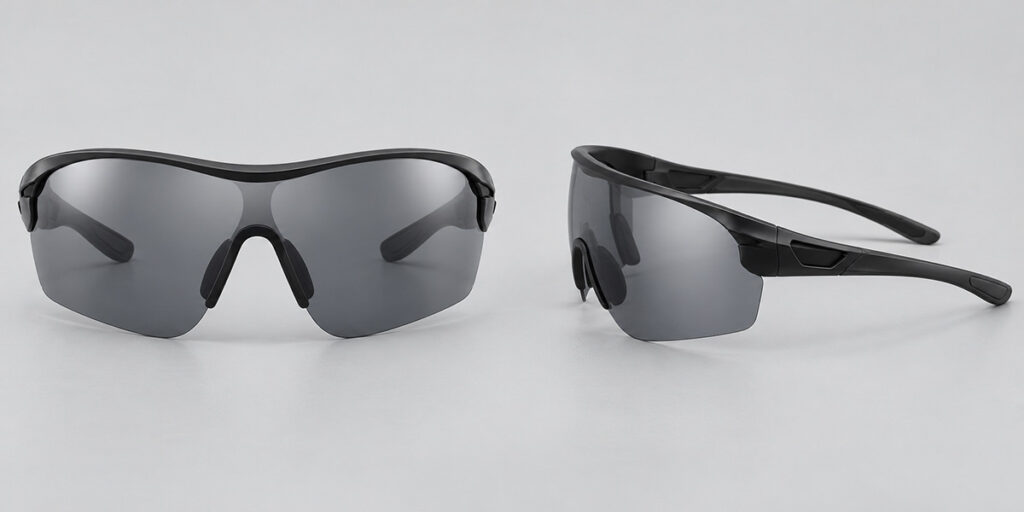
What Are Sport Sunglasses?
Sport sunglasses are a category of sunwear that combines light-filtering lenses with activity-focused fit and coverage features, ideal for outdoor activities where stable positioning, comfortable contact points, and clear vision matter to the wearer during movement.
“Sports sunglasses” is a natural alternative term for the same broad product category. Neither expression establishes a specific impact rating, material grade, or level of optical performance.
A wraparound appearance can suggest coverage, but it cannot confirm UV performance. Likewise, a flexible frame does not establish how well the finished product tolerates repeated use. Buyers need a specification and evidence for the complete configuration.
Our sport sunglasses collection can provide a starting point for discussing shape, construction, and branding requirements. The next step is to connect those preferences to measurable purchasing criteria.
Are sport sunglasses the same as protective sports eyewear?
General-use sunglasses and protectors designed for particular sports have different scopes. ISO 12312-1:2022 covers general-use sunglasses and excludes eye protectors intended for specific sports. The ISO catalogue also lists Amendment 1:2026. Applicable requirements depend on intended use and destination-market rules. ISO sunglasses scope
For general outdoor sunwear, choose sunglasses assessed for that intended use. For activities requiring specific impact protection, sport-specific protective eyewear with appropriate evidence is the better call.
Which 7 Sport Sunglasses Specs Should Buyers Check?
-
What UV protection should sports sunglasses provide?
Request spectral transmission results supporting the exact UV claim planned for the product.
A UV400 statement needs evidence rather than a printed sticker alone. The report should identify the tested model and lens configuration, including material and color. Ask the laboratory or supplier to explain which results substantiate the intended claim.
Lens darkness and UV performance are separate characteristics. A darker appearance does not establish stronger UV protection.
-
Which VLT should buyers specify for sport sunglasses?
Visible light transmission, or VLT, describes how much visible light passes through the lens. Record it as a measured percentage alongside the relevant filter category.
The product brief should identify the expected light environment. A single lens configuration may not suit every activity or lighting condition. Labeling and restrictions should follow the applicable requirements for the finished product.
For photochromic lenses, request results for the relevant transmission states and record the testing conditions. An unexplained “light-to-dark” claim is insufficient for comparing samples.
-
Are polarized sport sunglasses better for every activity?
Polarization should be evaluated against the intended use rather than treated as an automatic upgrade.
Ask for measured polarizing performance and axis consistency. Also check practical tasks, including viewing the screens or displays customers are likely to use.
For activities involving reflected glare, choose polarized lenses after verifying performance. For activities requiring frequent display viewing, a configuration validated with those displays is the better call.
-
How should buyers assess sport sunglasses optical quality?
Request optical results for the finished lens configuration, including relevant refractive power and prism measurements.
This is especially useful when evaluating curved lenses. The visual impression of a sample does not replace optical verification, and the approval process should cover the configuration that will actually enter production.
Record visible defects separately from measured optical properties. Both matter, but they answer different quality questions.
-
Which lens construction should buyers specify?
Define the lens material grade, nominal thickness, coating system, and retention arrangement.
Material names alone do not describe the finished product. Coatings, geometry, assembly, and manufacturing conditions also need to be controlled. Any durability or impact claim should relate to the tested product rather than an assumed property of its raw material.
Include the approved finish and appearance in the reference sample. This gives production and inspection teams a shared target.
-
Which frame construction suits private-label sport sunglasses?
For private-label sport sunglasses, identify the actual frame material, hinge arrangement, finished weight, and surface treatment.
Record dimensions in millimeters and finished weight in grams. For molded parts, specify the approved material grade and identify where substitutions require buyer approval.
Our sport sunglasses frame materials and injection-molding guide should support this discussion with process explanations and verified material information.
A material label should lead to a specification, not replace one.
-
How should sport sunglasses fit the target customer?
Fit evaluation should cover overall width, bridge geometry, temple length, wrap, and contact points.
A frame can match nominal dimensions and still feel different because of its geometry or contact pressure. Structured trials help expose those differences before the order is finalized.
For helmet use, check the actual interaction between the frame, temples, straps, and helmet. Record which combinations were assessed rather than making a universal compatibility claim.
How Are Sport Sunglasses Tested Before Bulk Orders?
Test evidence should identify the product, method, conditions, date, and result. A report for another model or lens configuration may not substantiate the product being purchased.
ISO 12311:2023 provides reference test methods for properties addressed by the ISO 12312 series. The test report should identify the methods actually used and their relationship to the applicable product requirements. ISO sunglasses test methods
How does AQL inspection support a bulk order?
ISO 2859-1:2026 provides acceptance-sampling schemes for inspection by attributes. An agreed plan should identify lot size, inspection level, defect classifications, and acceptance rules. ISO acceptance sampling
AQL inspection supports a shipment decision. It does not replace optical testing, establish certification, or guarantee a fixed defect percentage in every shipment.
How Are Custom Injection-Molded Sport Sunglasses Made?
The main process difference between an existing design and a new custom injection-molded design is mold manufacturing. Existing designs use available tooling; a new shape requiring a new mold adds that development stage.
The project sequence is:
- Confirm the product brief. Agree on the shape, intended use, material, lens configuration, branding, and color requirements.
- Approve the design and tooling scope. Confirm whether available tooling meets the brief or a new mold is required.
- Manufacture the mold where needed. Zhantai’s confirmed mold-making window is 20–30 days.
- Review samples and approve the specification. Document changes and approve the reference sample.
- Produce and inspect the order. Follow the agreed specification, production schedule, and inspection plan.
The 20–30-day window describes mold manufacturing. It is not a confirmed total development or delivery time. The quotation should state the start condition and whether “days” means calendar or working days.

What Is the MOQ for OEM Sport Sunglasses?
MOQ is a minimum order quantity that sets the smallest production commitment for a specified product configuration. Zhantai’s confirmed requirement is 1,200 pairs across three colors for either route, ideal for planning an initial brand or supermarket assortment.
Both existing designs with branding and new custom injection-molded designs have the same confirmed MOQ. The difference is the additional tooling expense and mold-manufacturing stage.
How much do existing and custom-molded sport sunglasses cost?
The following commercial information was confirmed by Zhantai for this article in 2026. These are purchasing terms, not ISO test values.
| Commercial item | Existing design with branding | New custom injection-molded design |
| MOQ | 1,200 pairs across three colors | 1,200 pairs across three colors |
| New tooling fee | None | US$1,500–2,500, depending on shape |
| Mold-manufacturing time | No new mold stage | 20–30 days |
| Product unit price | Project quotation required | Project quotation required |
| Sample fee and sampling time | Project confirmation required | Project confirmation required |
| Bulk-production lead time | Project confirmation required | Project confirmation required |
| Main process difference | Uses existing tooling | Includes new mold manufacturing |
The color allocation within the 1,200-pair order must be confirmed. “Across three colors” does not automatically establish a mandatory allocation of 400 pairs per color.
No verified numerical range is available here for product prices, sampling, or bulk-production timing. A quotation should provide those figures together with specifications, packaging scope, payment terms, and the delivery basis.
At what quantity does custom tooling become more economical?
At the initial 1,200-pair quantity, a US$1,500–2,500 mold fee allocates approximately US$1.25–2.08 per pair.
If that same fee is allocated across a hypothetical cumulative 2,400 pairs using the same mold without another tooling charge, the allocation becomes approximately US$0.63–1.04 per pair. At 6,000 pairs, it becomes US$0.25–0.42 per pair.
These are 2026 planning calculations, not unit-price quotations or forecasts.
There is no verified order-volume break-even point between the two routes. Both have the same MOQ, and no manufacturing unit-price saving has been established for custom tooling.
If quotations later show such a saving, calculate the threshold as additional fixed cost divided by verified per-pair savings. If there is no per-pair saving, larger volume reduces the allocation of tooling cost but does not make that cost disappear.
For a brief met by an existing shape, choose existing tooling to avoid new mold costs. For a brief requiring a new shape, custom tooling is the better call.
How Do Buyers Choose Sport Sunglasses in 3 Steps?
A sound buying decision connects the intended activity to an approved specification and a realistic order plan. For brands and supermarkets, the final product must fit both the consumer and the purchasing program.
- Define the customer and use. Confirm the intended activity, target market, customer profile, retail positioning, and launch window. Establish whether the product is general-use sunwear or requires specific protective performance.
- Confirm specifications and evidence. Review all seven specification areas against samples, drawings, fit checks, and relevant reports. Resolve differences before signing the specification and retaining the approved sample.
- Confirm order scale and delivery conditions. Agree on the three-color allocation, costs, sample milestones, production timing, inspection plan, and shipping basis. Include the mold stage where required.
For a launch prioritizing an available shape, choose an existing design after sample approval. For a launch requiring a new shape, a custom-molded design is the better call.
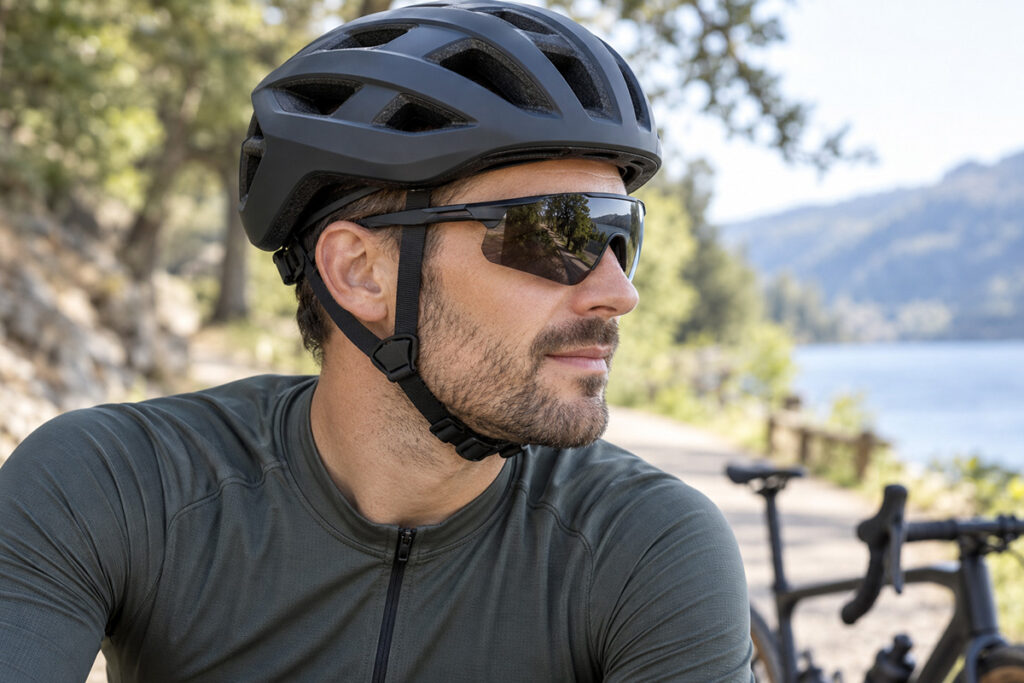
The fit assessment should reflect actual use. A running-focused product brief may emphasize stability during movement, while a cycling brief may include helmet and display interaction. These are evaluation requirements rather than performance claims about an untested model.
What Should Buyers Ask Before Ordering OEM Sport Sunglasses?
What MOQ applies to existing and custom-molded sport sunglasses?
Does the 20–30-day lead time cover the complete order?
What certification or test reports should we request?
Can we approve an OEM sample before bulk production?
What AQL requirements should appear in our purchase order?
How Can Buyers Start a Sport Sunglasses Project With Zhantai?
-
Request samples to evaluate materials and fit. Tell us which construction details, contact points, lens options, or finishes you want to compare before finalizing specifications.
-
Request an OEM/ODM quotation. If your specifications and purchasing quantity are defined, include lens requirements, branding, packaging, and color allocation.
-
Discuss custom development. If your program requires custom shapes, tooling, or coordinated development, share your expected annual purchasing volume and development goals.
For every request, provide expected purchasing volume, target market, and purchasing time window. These details help our team assess suitable options and identify any missing technical or commercial requirements.
Ready to start your project? Leave your requirements in the message form below. Zhantai’s team can help you review product options, sampling needs, and quotation requirements.