To sell reading glasses in retail stores, build a manageable assortment, organize products by strength, display prices clearly, support appropriate customer selection, and replenish according to actual sales. Attractive frames alone do not resolve missing strengths, confusing labels, or unavailable stock. Supermarket buyers and brands should connect the purchasing specification with store execution, from packaging and display compatibility to staff guidance and reorder planning. The aim is to make suitable products easy to find, understand, and purchase.
Key Takeaways
A practical retail program connects assortment, strength allocation, display, pricing, customer assistance, and replenishment.
- Start with a manageable range. Too many combinations can fragment stock across styles, colors, and strengths.
- Make strength and price visible. Product labels, packaging, and display positions should communicate the same information.
- Assess value beyond purchase price. Optical quality, fit, assembly, and packaging remain purchasing requirements.
- Track the actual assortment. Sales by model, color, and strength provide a better replenishment basis than category totals alone.
| Planning dimension | What the buyer defines | What the store executes |
| Customer and store format | Intended shoppers, price positioning, available space | Relevant placement and product explanation |
| Strength assortment | Initial powers and quantity allocation | Organized strength positions and availability checks |
| Style assortment | Shapes, colors, and fit options | Clear grouping and representative samples |
| Product information | Accurate power, intended use, and care details | Legible labels and consistent signage |
| Pricing | Cost basis, margin target, and identifiable feature differences | Visible prices and understandable product tiers |
| Customer interaction | Display, mirror, and sample-handling policy | Accessible try-on and appropriate assistance |
| Replenishment | Confirmed lead time and reorder rules | Sales recording, stock checks, and gap correction |
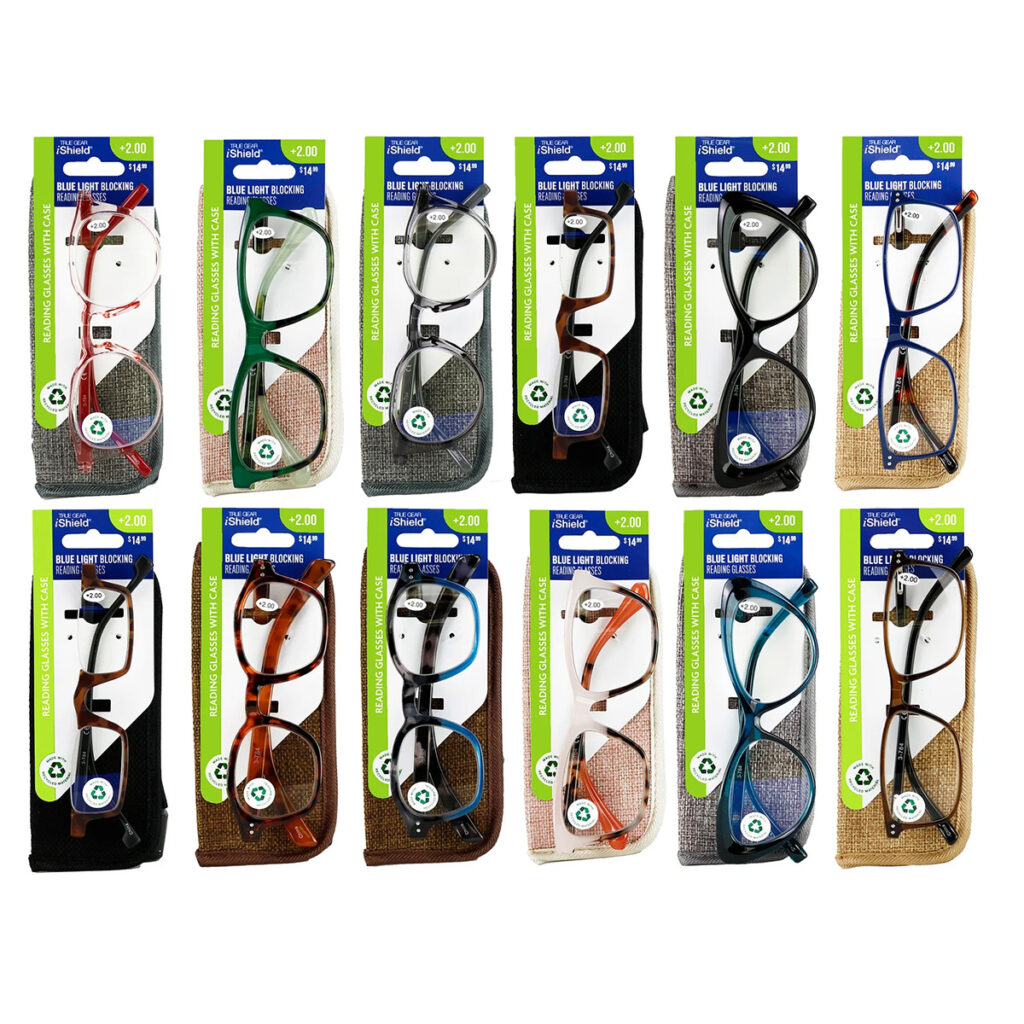
What Are Ready-Made Reading Glasses?
A ready-made reader is a near-vision spectacle supplied in a standard power, usually with equal strength in both lenses. It offers a convenient retail option for suitable wearers, but does not replace an eye examination or individual prescription.
The National Eye Institute explains that readers can help people with presbyopia see up close and that regular eye examinations remain important even when glasses are purchased without a prescription. NEI eyeglasses guidance
Retail assistance should explain the product’s features and limitations, rather than diagnose a customer’s visual needs.
For suitable customers seeking a standard near-vision product, choose ready-made readers. For customers requiring individual correction, an eye-care consultation is the better call, rather than selecting solely from a retail strength display.
What Is a Reading Glasses Retail Program?
A reading-glasses retail program is a coordinated system that connects product selection, strength allocation, display, pricing, customer assistance, and replenishment. It gives stores a repeatable way to organize sales and gives buyers a basis for reviewing stock and performance.
The distinction matters because purchasing more frames does not necessarily solve a retail problem. The actual issue may be unclear labeling, poor placement, or missing stock in a requested strength.
Review the complete program before assuming the assortment needs more products.
Step 1: Which Reading Glasses Should a Retail Store Stock?
Define the Customer and Store Format
A convenience store may have little space and limited staff time for explanation. A supermarket may operate a larger fixture, while a branded store may emphasize coordinated styling and packaging.
Define those conditions before choosing products. Consider how customers will locate the category, compare options, and identify the correct package.
Start with a Manageable Style Assortment
Familiar shapes and neutral colors can provide useful starting options, but they are not universal bestsellers.
Every added style and color creates more combinations when reading strengths are included. If the purchasing quantity stays unchanged, each combination receives less stock.
For a space-limited store, choose a compact assortment with clear product roles. For a larger fixture supported by established demand, a broader range is the better call, provided strength availability remains manageable.
Give Each Product a Reason to Exist
An entry-price option might prioritize straightforward construction and simple packaging. Another product may offer a different fit, hinge, finish, or included case.
Make differences identifiable rather than relying on vague “premium” descriptions. Explore Zhantai’s reading glasses for retail stores as a starting point, then confirm the specifications and availability of selected models.
Step 2: How Do You Choose Reading Glasses Strengths for Retail?
Start with Common Purchasing Strengths
Among Zhantai’s offline retail customers, +1.50 D, +2.00 D, and +2.50 D are common purchasing strengths, according to company information supplied for this 2026 article.
These are useful planning references. They are not global sales rankings and should not be treated as the ideal assortment for every country or retailer.
Confirm how these strengths can be allocated within the 1,200-pair MOQ. Do not assume that every combination of models, colors, and powers can be mixed without agreement.
Allocate Quantities Using Available Evidence
Review sales history, customer requests, stockouts, and the time required to replenish.
Equal allocation is simple to administer, but it is not automatically optimal. Conversely, historical sales can understate demand if a strength was unavailable for much of the period.
For established stores, choose allocations informed by sales and stock availability. For a new channel, a controlled initial mix is the better call, followed by review before the next purchasing commitment.
Keep Strength Identification Consistent
The reading glasses strength shown on the product, package, display position, and sales record should agree.
Color coding may help navigation, but customers should not have to interpret color alone. A misplaced package must still identify its actual power.
Accurate strength labeling is both a product-control requirement and a retail-navigation requirement.
Step 3: How Should Reading Glasses Be Displayed In-Store?
Display products so customers can locate the category, distinguish strengths, see prices, and handle samples without disrupting stock organization.
Test Placement Against the Store Format
Possible locations include accessory areas, checkout zones, or areas connected with reading-related purchases.
No position guarantees better sales. Compare performance with attention to stock availability, display capacity, and differences between stores. Avoid attributing a change to location when the assortment or price changed at the same time.
For a location trial, choose comparable displays with similar assortment and availability. For established placement with consistent performance, the existing position is the better call until evidence supports a change.
Organize the Fixture for Easy Navigation
Keep a consistent hierarchy. For example, a fixture may organize strength first and style within each group, provided the arrangement remains understandable.
A useful display check covers:
- Clearly visible strength and price information.
- Correct products in each labeled position.
- Accessible samples and an appropriately positioned mirror.
- Clean, undamaged frames and packaging.
- Empty positions that are identified and acted on.
A tidy fixture can still fail if the labels and products do not match.
Provide a Mirror and Manage Samples
Let customers assess appearance and fit without forcing them to open every retail package.
Define cleaning, damage checks, and sample replacement procedures. Where appropriate, identify display samples separately from sale stock and maintain consistent rules across stores.

Step 4: How Do You Price Reading Glasses for Retail?
Set prices using a consistent cost basis, the intended margin, and product differences that customers can understand.
Evaluate Cheap Reading Glasses Against Product Requirements
A low purchase price is useful only when the product meets the agreed requirements.
Check optical specifications, frame fit, hinges, lens retention, labels, and packaging. Returns, damaged goods, and stock corrections can reduce the apparent benefit of a cheaper order.
Affordable should describe the price position, not permission to relax essential quality requirements.
For a price-led assortment, choose products meeting the agreed requirements at a workable cost. For a differentiated range, an additional feature package is the better call only when its value and price are clear.
Step 5: How Can Store Staff Help Customers Choose Reading Glasses?
Staff should help customers understand labels, fit options, and intended use while keeping product assistance separate from clinical advice.
Explain the Product Without Prescribing
Staff can locate labeled powers, explain frame differences, and help customers find the intended sample.
They should not assign a fixed strength based solely on age. A reading card or brief trial is not an eye examination.
For customers navigating an existing strength preference, choose clear product information and fit assistance. For unresolved visual difficulty or individual correction needs, professional eye-care advice is the better call, rather than an age-based recommendation.
Separate Reading and Computer-Use Claims
Near-reading power, working distance, and optional filtering are different product properties.
A product described as a computer reader still needs an appropriate optical specification. Staff should explain the supplied configuration rather than suggesting that a marketing label makes one product suitable for every screen distance.
Keep Information Consistent Across Stores
A short, accurate product guide is more useful than unsupported sales language.
The customer should hear the same explanation that appears on the package and the retailer’s product information.
Step 6: How Do You Replenish Reading Glasses by Strength and Style?
Replenish at the level customers select products, using sales, available stock, confirmed lead time, and an agreed safety-stock allowance.
Record the Assortment at the Right Level
Where systems allow, identify model, color, and strength as separate stock combinations.
Category totals can hide a problem. Overall inventory may look healthy while a requested strength is missing from the display.
Also distinguish store stock from warehouse stock. Goods that exist elsewhere but cannot reach the selling fixture promptly do not resolve immediate availability.
Define Reorder Points
A practical planning formula is:
Reorder point = expected demand during replenishment lead time + safety stock.
Use consistent units and time periods. Lead time should reflect the actual replenishment route, including relevant production, transport, receiving, and store-distribution stages.
Do not confuse a supplier’s production estimate with delivery to the selling shelf.
For frequent replenishment with reliable supply, choose stock targets matched to that shorter cycle. For longer or variable supply routes, a larger justified buffer is the better call, balanced against inventory exposure.
Fix Assortment Problems Before Expanding
Review weak-selling combinations, returns, stockouts, misplaced products, and sample condition.
Adding another style can increase complexity without addressing the cause of poor performance.
The first question is whether customers can buy the current range as intended, not whether the store needs more choices.
How Do Buyers Plan a Reading Glasses Order in Three Steps?
Translate the retail plan into an approved product brief, then set quantities and allocation against confirmed supply terms.
- Define store demand. Identify store count, fixture capacity, customer profile, price position, purchasing window, and intended assortment.
- Confirm product and retail parameters. Approve powers, fit, optical requirements, labels, packaging, display compatibility, samples, and inspection criteria.
- Set order scale and allocation. Start from Zhantai’s 1,200-pair MOQ and confirm distribution across models, colors, strengths, warehouses, and stores.
Connect Manufacturing Approval with Store Execution
A frame sample alone cannot demonstrate that the retail program is ready.
Review the finished package, strength identification, hanging or shelf features, and compatibility with the intended fixture. Check that retail requirements reach the production specification before the order is released.
Zhantai’s reading-glasses manufacturing process provides context for frame production, hinge installation, lens cutting, and finishing.

Agree on Product Evidence and Inspection
Discuss applicable ready-to-wear requirements, including ISO 16034:2002, and confirm the relevant edition, amendments, and destination-market requirements at order approval.
For lot sampling, ISO 2859-1:2026 provides an AQL-indexed framework. Agree on inspection level, defect classification, and acceptance criteria.
AQL sampling does not replace optical verification or prove that every unit is defect-free.
For unchanged replenishment, choose the approved configuration with substitution controls. For new packaging, optical specifications, or fixture requirements, revised samples are the better call before production and store rollout.
What Should Retail Buyers Ask a Reading Glasses Supplier?
What Is the MOQ, and Can We Mix Reading Strengths?
The MOQ is 1,200 pairs. Confirm the permitted allocation across models, colors, and strengths before ordering; a shared minimum does not automatically mean every assortment combination is available within that quantity.
Can We Review a Sample with Our Retail Labels?
Yes, buyers can request a labeled sample for feasibility confirmation. Agree the artwork, strength identification, packaging, and approval scope; final retail requirements should be checked before production rather than after delivery.
What Lead Time Should We Use for Store Replenishment?
Replenishment lead time must be confirmed for the actual order. Include production, transport, and receiving requirements in store planning; repeat configurations and changed packaging may follow different approval and delivery schedules.
Which Certification or Test Reports Should We Request?
Required evidence depends on the destination market and product configuration. Request relevant optical and product reports, correct labeling, and traceable sample identification; a general factory certificate does not replace product-specific verification.
Can OEM Customization Include Packaging and Display Requirements?
Yes, packaging and display requirements can be discussed during OEM development. Confirm dimensions, hanging features, labels, artwork, and costs; compatibility with an existing store fixture should be checked using representative samples.
Can We Specify an AQL for Retail Orders?
Yes, buyers can propose an acceptance sampling plan for agreement. Define inspection level, defect categories, and labeling checks; optical verification and critical product requirements need appropriate controls beyond a simple appearance inspection.
How Can Buyers Start a Retail Reading Glasses Program with Zhantai?
Use the message form below to describe the support needed and the retail conditions already defined.
- Assortment samples: Compare styles, fit, strengths, labels, and packaging before finalizing the range.
- OEM quotation: Submit the product specification, quantity, strength allocation, branding, packaging, and delivery requirements.
- Retail-program development: Share store count, fixture needs, expected demand, and any dedicated product or packaging requirements.
For an exploratory assortment, choose sample evaluation. For defined specifications, an OEM quotation is the better call; programs needing coordinated product and display development should begin with a feasibility discussion.
To develop your reading glasses retail program, provide expected purchasing volume, target market, and purchasing time window. Add store count and display requirements where available. Submit your brief through the article-bottom form or the Zhantai reading glasses project contact page.