Blue light reading glasses combine near-vision magnification with lenses designed to filter specified portions of blue light. Buyers should check five specifications: reading power, spectral filtering, optical quality, material and surface treatments, and frame fit. Verify these independently rather than treating a “blue blocking” label as proof of performance. For supermarkets and brands, the purchasing goal is a correctly labeled reading product with documented filtering characteristics, suitable construction, and claims that match the available evidence.
Key Takeaways
A useful purchasing specification separates reading correction, measured filtering, product quality, and commercial requirements.
- Confirm reading power independently. Blue-light filtering does not compensate for an unsuitable reading strength.
- Request meaningful filtering data. A percentage needs a wavelength range, measurement method, and identified sample.
- Evaluate the finished product. Optical quality, surface treatments, fit, and assembly matter alongside filtering.
- Plan the assortment before ordering. Zhantai’s MOQ is 1,200 pairs; confirm allocation across models, colors, and strengths.
| Specification | What buyers should define | Evidence to request |
| Reading power and design | Power in diopters, lens configuration, labeling | Optical measurements and matching product labels |
| Spectral filtering | Wavelength interval, transmission curve, calculation method | Report identifying the tested lens and conditions |
| Optical quality | Applicable tolerances, transmission, tint appearance | Relevant measurements and controlled sample comparison |
| Material and treatments | Substrate, filtering construction, hard coat, optional anti-reflective treatment | Construction statement and relevant durability results |
| Frame fit and assembly | Dimensions, bridge contact, temple pressure, lens retention | Assembled samples and agreed acceptance criteria |
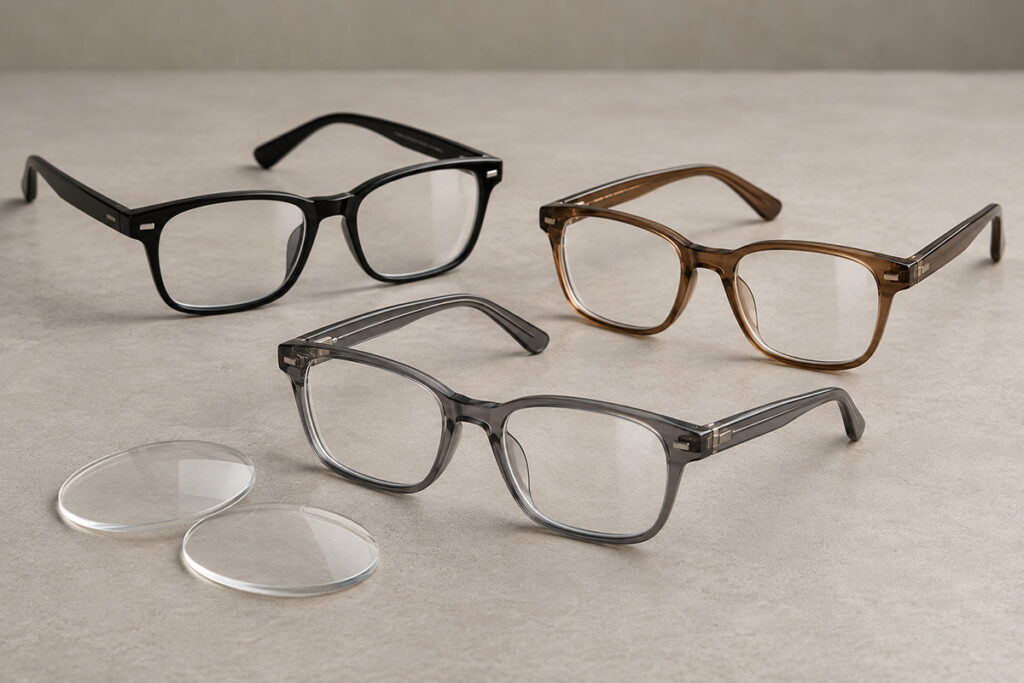
What Are Blue Light Reading Glasses?
A blue light reader is a reading spectacle that combines near magnification with specified blue-light filtering, suited to buyers seeking both features in one product. Correct power, fit, and filtering evidence remain separate requirements for reading use.
How Are Blue Light Blocking Readers Different from Ordinary Readers?
Reading correction changes optical power to support near viewing. Filtering changes how much light passes through the lens at specified wavelengths.
An ordinary reader can provide the required reading power without a blue-light-filtering feature. Conversely, a plano filtering lens has no reading power.
The National Eye Institute’s eyeglasses guidance explains that reading glasses help people with presbyopia see up close. That function should remain clear in product descriptions.
What Benefits Can Buyers Responsibly Describe?
A measured filtering property is an optical result, not a clinical outcome.
A 2023 Cochrane review found that blue-light-filtering lenses may not reduce short-term computer-related eye strain compared with non-filtering lenses. Evidence about sleep effects was uncertain. Cochrane review
Describe verified product functions without promising symptom relief, improved sleep, or retinal protection that the evidence does not establish.
For customers seeking near magnification alone, choose readers with suitable power and fit. For customers requesting an additional filtering feature, documented filtering readers are the better call, without unsupported health promises.
Spec 1: How Do You Specify Reading Power for Blue Light Readers?
Specify reading power in diopters, identify the lens configuration, and confirm that labels match the supplied product.
Confirm the Power and Configuration
State whether the order contains ready-made single-vision readers or individually prescribed lenses. For ready-made products, confirm the nominal power in each lens and the applicable acceptance requirements.
A standard strength assortment does not address every wearer’s needs. Do not present equal-power ready-made readers as equivalent to an individual prescription.
Discuss applicable ready-to-wear requirements with the supplier or testing laboratory. ISO 16034:2002 addresses single-vision ready-to-wear near-vision spectacles; confirm the applicable edition, amendments, and destination-market requirements before ordering.
Which Reading Strengths Should Offline Retailers Stock?
For Zhantai’s offline retail customers, +1.50 D, +2.00 D, and +2.50 D are common purchasing strengths, based on company-supplied purchasing information for this 2026 article.
These provide a starting point for assortment planning, not a global market-share finding. Allocate quantities using the retailer’s sales history, customer profile, and replenishment needs.
Confirm how strengths can be distributed within the 1,200-pair MOQ. Do not assume an equal split or unrestricted mixing across every model and color.
For an established retail program, choose strength allocation supported by sales history. For a new channel without that evidence, a controlled starting assortment is the better call, followed by review before replenishment.
Match Power to the Intended Task
Close reading and a more distant monitor are different tasks. A blue-light feature cannot correct a mismatch between optical power and working distance.
Define the activity in the purchasing brief. The appropriate wearer-level choice still depends on individual visual requirements.
Spec 2: How Is Blue-Light Filtering Measured in Reading Glasses?
Request the Transmission Curve
A claim measured at one wavelength is different from an average calculated across a band.
Ask for wavelengths in nanometers, transmission values in percent, and the calculation used for any headline percentage. The report should identify the lens material, treatment, sample, date, and measurement method.
Do not compare percentages until those conditions are comparable.
What Does a Demonstration Kit Prove?
A pen-and-card demonstration may show a visible difference under its particular light source. It does not establish the full transmission curve.
Without documentation, the source wavelength and output may also be unclear. Such a demonstration cannot establish relief from eye strain or another clinical benefit.
A demonstration can support a sales explanation; it cannot replace a relevant measurement report.
For a quick visual demonstration, choose a clearly explained sample display. For packaging percentages or supplier acceptance, a documented spectral measurement is the better call, using the stated interval and calculation method.
Keep UV Protection Separate
Blue-light filtering and UV protection concern different parts of the spectrum. Verify each claim separately.
For lens-transmission specifications and methods, discuss ISO 8980-3:2022 and applicable amendments with the laboratory. Naming the standard does not substantiate an undefined “blue blocking” percentage.
Spec 3: What Optical Quality Should Buyers Check in Blue Light Reading Glasses?
Check Power Accuracy and Unwanted Optical Effects
Request relevant measurements for the finished configuration. Depending on the product, these may include power accuracy, differences between lenses, optical-center considerations, and unwanted prism.
Agree on the applicable requirements before samples are approved. A frame that looks straight does not prove that its lenses meet the optical specification.
Compare Visible Transmission and Tint
Review samples under consistent lighting against a neutral background. Assess both lenses together and compare production samples with the approved reference.
A stronger yellow appearance does not automatically indicate a better product. It may also be less suitable for the intended appearance or task.
For a collection prioritizing a neutral appearance, choose a documented configuration meeting that requirement. For a customer requesting a more noticeable tint, a reviewed tinted option is the better call, with filtering verified separately.
Evaluate the Complete Pair
Review reflections, viewing experience, and task suitability on assembled samples.
Wearer feedback is useful for product evaluation, but subjective comfort comments should not become clinical performance claims.
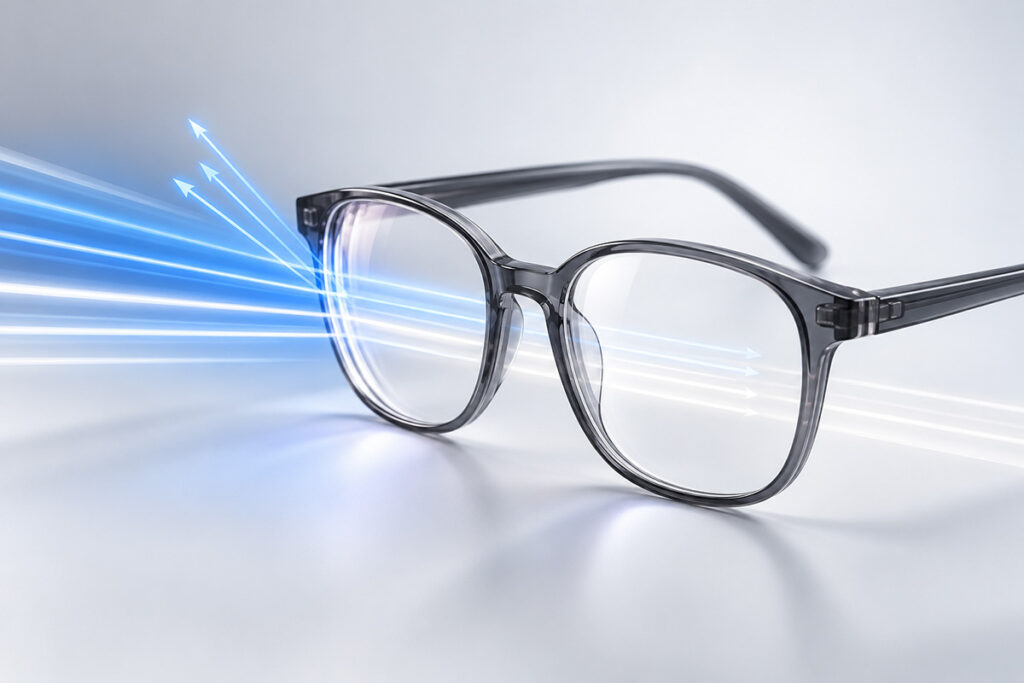
Spec 4: Which Lens Materials and Coatings Suit Blue Light Blocking Readers?
Confirm Where Filtering Is Incorporated
Ask whether the filtering function comes from the substrate, a coating, or a combined construction.
Do not identify the process solely from lens color or reflected appearance. A blue surface reflection is not sufficient evidence of the claimed filtering performance.
Separate Filtering, Hard Coating, and Anti-Reflective Treatment
These functions should have separate specification fields.
Hard coating addresses surface durability according to its construction. Anti-reflective treatment addresses reflections. Filtering concerns transmission at specified wavelengths.
Confirm which treatments are included in the quotation and how they interact in the offered product.
For a brief requiring basic verified filtering, choose the configuration meeting those specifications. For additional reflection or surface-durability requirements, a separately specified treatment package is the better call, after reviewing evidence and cost.
What Factory Test Data Can Zhantai Provide?
No audited machine-output figures or completed product-specific optical and coating-test dataset has been supplied for publication in this article. We therefore do not claim a tested filtering percentage, daily machine capacity, or durability result.
Request project-specific evidence covering:
- Reading power in diopters, applicable tolerances, and measured results.
- Spectral interval in nanometers, transmission in percent, and calculation method.
- Optical-test method, sample identification, equipment information, and report date.
- Coating-test method, exposure or operation conditions, sample quantity, and acceptance criteria.
Numerical acceptance limits must be agreed with the supplier or laboratory. Obtain those parameters and reports before publishing product claims.
Zhantai’s reading-glasses manufacturing process provides production context, while the evidence for an ordered lens configuration needs separate confirmation.
How Should Samples Move Toward Approval?
- Confirm construction. Identify the substrate, filtering route, treatments, and frame.
- Review representative samples. Check optical and cosmetic requirements.
- Review relevant evidence. Match reports to the proposed production configuration.
- Document approval. Record specifications, acceptance requirements, and substitution rules.
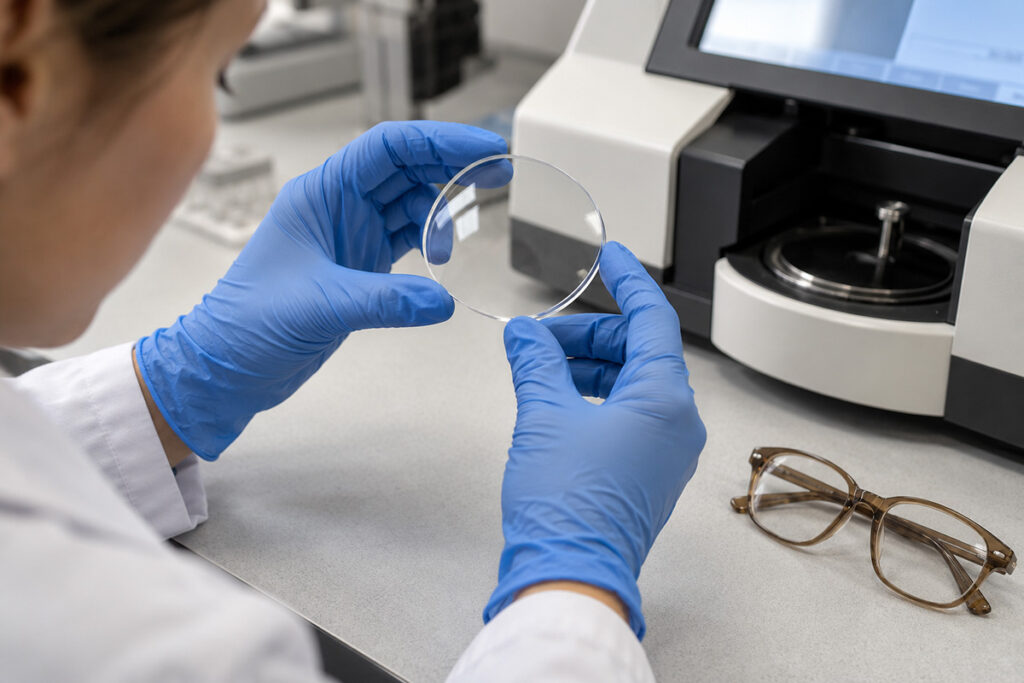
Spec 5: How Do You Check Fit and Assembly in Blue Light Reading Glasses?
Evaluate Fit on Representative Wearers
Use people representative of the intended customer group rather than assuming a single frame fits every market.
Record slipping, concentrated pressure, and repeated adjustments. Specific observations are more useful than a general “comfortable” rating.
Inspect Hinges and Lens Retention
Compare both temples for movement and alignment. Examine lens seating, exposed edges, and contact surfaces.
Keep the approved components identified. A replacement hinge, lens, or frame material should follow the agreed change process.
For routine replenishment, choose the approved assembly with controlled substitutions. For a new fit or component combination, revised samples are the better call, followed by optical and wearing checks before production approval.
Confirm Packaging and Strength Identification
The label should match the power of the supplied lenses. Packaging should protect the product and allow customers to identify the intended strength.
For available product directions, explore Zhantai’s OEM reading glasses collection, then confirm filtering options for the selected model.
What Are Computer Glasses?
A computer glass is a task-oriented spectacle that uses a lens power or design for screen-viewing distances. Reading glasses generally address closer work. Filtering is a separate feature, so the optical design must match the intended screen task.
“Computer glasses” is not, by itself, a complete technical specification. The term can describe plano filtering products, powered readers marketed for screen use, or task-specific occupational designs.
Confirm the optical design before accepting a computer-use claim.
For close reading, choose a suitably specified near-vision product. For a defined monitor distance or multiple desk tasks, a task-specific optical design is the better call, based on individual requirements.

How Much Do OEM Blue Light Reading Glasses Cost?
Zhantai’s confirmed MOQ is 1,200 pairs; the actual price depends on the complete lens, frame, packaging, and development specification.
The following is a hypothetical 2026 budgeting model, not a Zhantai quotation or industry average. Both routes assume equivalent performance, packaging, and acceptance requirements.
| Planning input | Route A: available configuration | Route B: dedicated component development |
| MOQ | 1,200 pairs | 1,200 pairs |
| Illustrative unit-price range | US$2.80–3.40 per pair | US$2.50–3.10 per pair |
| Price used in calculation | US$3.10 per pair | US$2.80 per pair |
| Assumed tooling charge | US$0 | US$900 |
| Assumed sampling period | 10–15 calendar days | 25–35 calendar days |
| Assumed production after approval | 35–50 calendar days | 45–60 calendar days |
Route B’s lower unit price represents an assumed commercial offer. Custom development does not inherently reduce unit cost. The model excludes freight, duties, testing, financing, extra revisions, and unsold stock.
Where Is the Break-Even Quantity?
US$900 ÷ US$0.30 per pair = 3,000 pairs.
At 1,200 pairs, Route A totals US$3,720 and Route B totals US$4,260. At 6,000 pairs, Route A totals US$18,600 and Route B totals US$17,700.
For a 1,200-pair order under these assumptions, choose Route A. For confirmed demand above 3,000 pairs, Route B is the better call on modeled production cost, before inventory and financing effects.
Commercial assumptions have no laboratory test standard. Recalculate using dated supplier quotations and confirm whether tooling remains available for subsequent orders.
How Do Buyers Select Blue Light Readers in Three Steps?
Move from customer needs to approved specifications, then set the purchasing quantity and schedule.
- Define the customer and task. Establish intended use, channel, strength assortment, appearance, and supportable product claims.
- Confirm the five specifications. Approve power, filtering evidence, optical quality, construction, fit, labeling, and representative samples.
- Set the order scale. Allocate the 1,200-pair minimum according to confirmed terms and assess inventory exposure before increasing quantities.
For an untested retail assortment, choose a scale supported by realistic demand. For established replenishment, a larger order is the better call only when complete cost, stock allocation, and delivery timing remain favorable.
Routine AQL sampling and optical verification serve different purposes. Agree the lot size, inspection level, defect classification, and acceptance criteria. ISO 2859-1:2026 provides an AQL-indexed sampling framework; it does not establish filtering efficacy or clinical benefits.
What Should Buyers Ask Before Ordering Blue Light Reading Glasses?
What Is the MOQ for OEM Blue Light Readers?
The MOQ is 1,200 pairs. Confirm allocation across models, colors, and reading strengths before ordering; dedicated components or different lens constructions may require separate planning within the agreed purchasing program.
What Sample and Production Lead Time Should We Expect?
Lead time depends on development scope, approvals, and scheduling. Request dated commitments for samples and production; the budgeting ranges above are hypothetical and should not be used as delivery promises.
Which Certification or Reports Support the Filtering Claim?
A spectral report should identify the lens, wavelength interval, method, and results. Confirm destination-market requirements separately; a demonstration kit or general certificate does not establish a filtering percentage or health benefit.
Can We Approve a Sample Before Full OEM Customization?
Yes, subject to the development route. Confirm which features are final and which remain provisional; a stock sample may illustrate appearance but cannot establish the performance of a different production lens.
Can We Specify Our Own AQL?
Yes, buyers can propose a sampling plan for agreement. Define inspection level, lot size, defect classes, and acceptance criteria; keep optical measurements and filtering-claim substantiation separate from routine appearance sampling.
Does Customization Guarantee Relief from Computer Eye Strain?
No, customization and measured filtering do not establish symptom relief. Keep claims within the available evidence; suitability for a particular working distance also depends on optical design and individual requirements.
How Can Buyers Start a Reading-Glasses Project With Zhantai?
Submit your requirements through the message form below, indicating the support you need.
- Sample evaluation: Compare frame materials, fit, lens appearance, treatments, and strength labeling.
- OEM/ODM quotation: Provide the specification, quantity, strength allocation, colors, branding, and packaging.
- Custom development: Share original references, component requirements, expected annual demand, and development priorities.
For an exploratory brief, choose sample evaluation. For defined specifications, an OEM quotation is the better call; projects requiring new components should begin with a development discussion before price and schedule approval.
To discuss blue light reading glasses, provide your expected purchasing volume, target market, and purchasing time window. Use the article-bottom form or the Zhantai reading-glasses project contact page. Include your intended strength mix and the filtering specification you want verified.