If you wear prescription glasses, you already know the struggle. The sun comes out, and suddenly you have to choose between seeing clearly or protecting your eyes from the glare. For decades, consumers solved this by carrying two expensive pairs of glasses. Today, they demand a smarter solution.
Enter the modern era of two-in-one eyewear. Brands worldwide are seeing massive spikes in demand for seamless, stylish solutions, making magnetic clip on glasses one of the fastest-growing categories in the optical industry.
However, bringing these products to market requires more than just standard eyewear assembly. Producing a base frame that perfectly matches a detachable sun-clip requires extreme precision. If you want to launch your own line, you need to partner with a specialized clip on sunglasses manufacturer.
In this comprehensive guide, we will break down everything you need to know about custom options, Minimum Order Quantities (MOQ), global sourcing strategies (GEO), and the step-by-step manufacturing process.
Why You Need a Specialized Clip On Sunglasses Manufacturer
You might wonder why you cannot just use any standard eyewear factory to make clip-ons. The answer comes down to engineering tolerances.
Standard optical frames allow for tiny margins of error during the polishing and tumbling phases. However, when you design a frame that must hold a separate, detachable piece, those margins disappear. If the factory over-polishes the base frame by just a fraction of a millimeter, the clip will rattle, scratch the lenses, or fall off entirely.
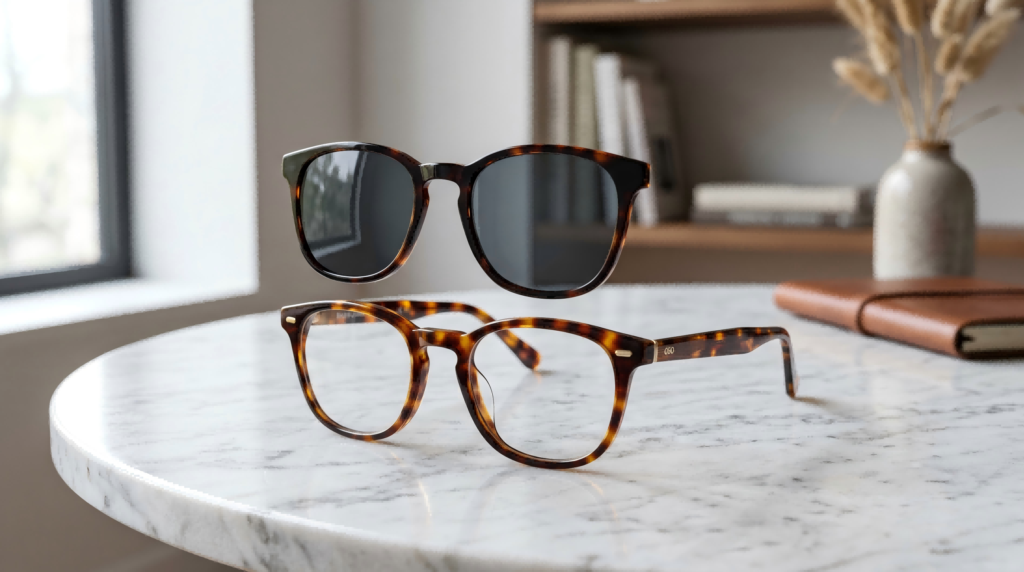
A dedicated clip on sunglasses manufacturer invests in advanced CNC (Computer Numerical Control) machinery and specialized quality control teams. They understand how to hide magnets seamlessly within the frame, ensuring the final product looks like a high-end pair of sunglasses rather than a clunky medical device.
Custom Options to Elevate Your Eyewear Brand
When you source directly from a top-tier factory, you control every aspect of the design. A great manufacturer will offer a vast menu of custom options to help your brand stand out in a crowded market.
-
Advanced Frame Materials
You can choose materials that dictate the weight, durability, and price point of your product:
-
Mazzucchelli Acetate: The gold standard for luxury eyewear. Acetate offers rich, deep colors and beautiful tortoiseshell patterns.
-
TR90 (Memory Plastic): Perfect for sports or lightweight daily wear. TR90 is highly flexible and durable.
-
Titanium: Ideal for premium, ultra-lightweight frames. Titanium resists corrosion and offers a sleek, minimalist aesthetic.
-
Mixed Materials: Many modern brands combine a sturdy acetate base frame with a lightweight stainless-steel wire clip to reduce overall weight.
-
Lens Technologies
The sun-clip exists to protect the eyes, making lens quality paramount. Most manufacturers offer TAC (Tri Acetate Cellulose) polarized lenses as the standard for clips because they are incredibly thin and lightweight. For higher-end markets, you can upgrade to CR39 or Nylon lenses. You can also customize the lens finish with anti-reflective (AR) coatings, vibrant mirror finishes, or sophisticated gradient tints.
-
The Attachment Mechanism
How the clip attaches defines the user experience. You have three main options:
-
Visible Hooks: A retro style that uses small metal prongs to grip the base frame.
-
Hidden Magnets: The most popular modern choice. Factories embed tiny, powerful N52 neodymium magnets into the corners of the base frame and the clip.
-
Hybrid Hook & Magnet: The ultimate secure fit. A small hook secures the bridge, while hidden magnets lock the edges in place.
Decoding MOQ (Minimum Order Quantity) in Eyewear
One of the biggest hurdles for new eyewear brands is navigating MOQ. Factories require a minimum order to cover the costs of setting up production lines, creating molds, and sourcing raw materials.
If you work with a reputable clip on sunglasses manufacturer, you will generally encounter two types of MOQ:
Full Custom OEM (Original Equipment Manufacturer)
If you want a completely unique shape, custom colorways, and proprietary molds, the MOQ will be higher.
-
Acetate Frames: Typically 300 to 500 pieces per model (usually split across 3 or 4 different colors).
-
Metal Frames: Often 600 to 1,200 pieces per model, because metal plating and welding require larger production batches.
ODM (Original Design Manufacturer) or White Label
If you want to test the market without heavy upfront investment, many manufacturers offer “ready-design” frames. They allow you to select existing styles and simply add your brand’s logo. The MOQ for white-label products often drops to 50 or 100 pieces per model, giving you a cost-effective way to launch your brand.
How They Are Made: The Manufacturing Process
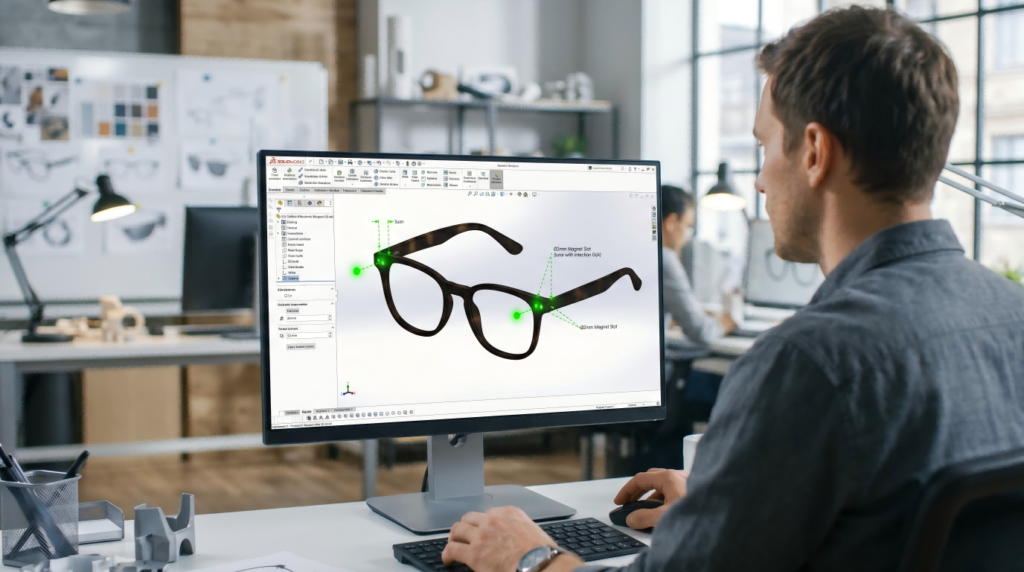
Step 1: 3D CAD Design and Prototyping
Before cutting any materials, engineers create a highly detailed 3D digital model. They calculate the exact curvature of the base frame and design the clip to sit flush against it. Once the digital design passes inspection, the factory 3D prints a prototype to test the fit and functionality in the real world.
Step 2: CNC Milling the Base Frame
For acetate frames, workers load thick rectangular blocks of raw Mazzucchelli acetate into precise CNC machines. The cutting heads carve out the basic shape of the frame front and the temples. Unlike standard frames, the machine also drills precise, millimeter-perfect cavities into the far edges of the frame to house the magnets.
Step 3: Crafting the Sun Clip
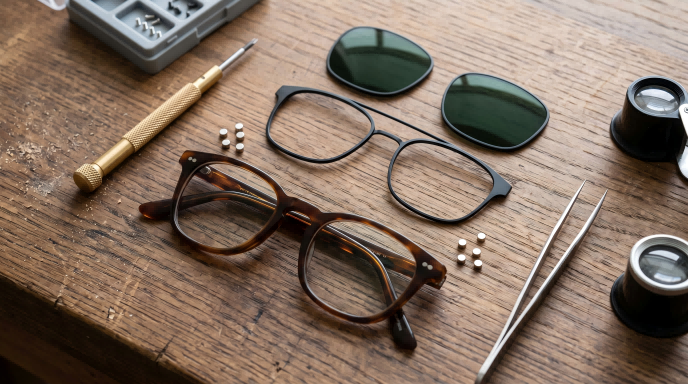
Because standard acetate is often too thick and heavy for a clip, manufacturers usually construct the sun clip from high-tensile stainless steel, titanium, or ultra-thin TR90 memory plastic. Workers bend, solder, and shape the metal wire to perfectly trace the silhouette of the base frame.
Step 4: Magnet Insertion and Sealing
This step separates amateur factories from professionals. Technicians take tiny, high-grade N52 magnets and insert them into the pre-drilled cavities on both the base frame and the clip. To ensure the magnets never fall out or corrode from sweat, the workers seal them inside the frame using specialized resins. They polish the surface until the magnet becomes completely flush and practically invisible to the naked eye.
Step 5: Tumbling and Polishing
The factory places the base frames into large wooden barrels filled with bamboo chips and polishing compounds. The barrels tumble for several days, smoothing out rough edges. Afterward, skilled artisans hand-polish the frames on buffing wheels to achieve a high-gloss, premium finish. They must do this carefully to avoid altering the shape of the frame, which would ruin the connection with the clip.
Step 6: Lens Cutting and Final Assembly
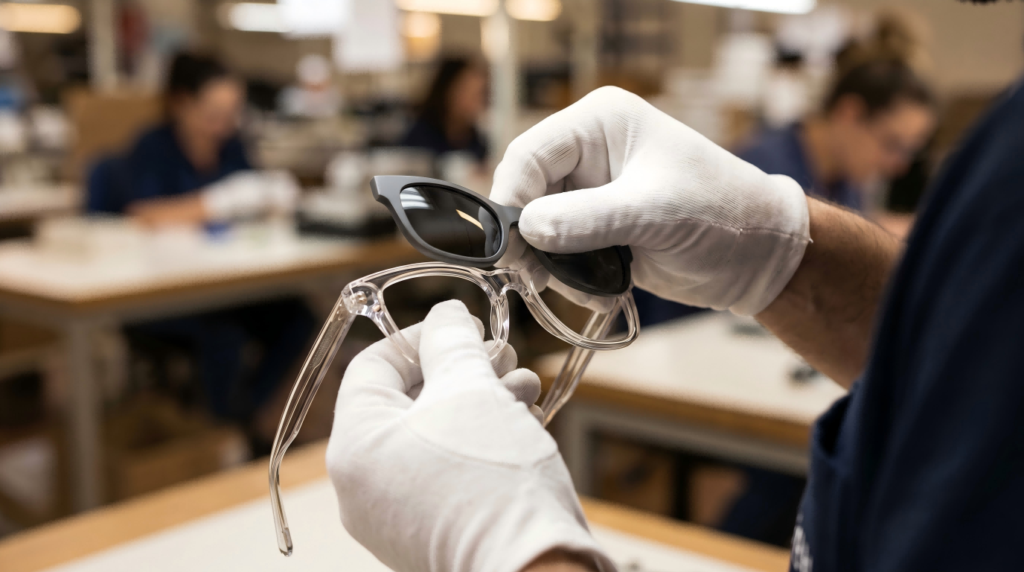
High-speed automated edgers cut the clear prescription lenses (or demo lenses) for the base frame and the polarized sun lenses for the clip. Technicians snap the lenses into place. Finally, quality control inspectors test every single pair. They snap the magnetic clip onto the base frame repeatedly, checking the magnetic pull strength, the alignment, and the visual aesthetics.
Finding the Right Partner for Your Vision
Building a successful eyewear brand requires more than just good marketing; it requires an outstanding product. When you search for a partner, don’t just ask for quotes. Ask about their defect rates, request video tours of their CNC facilities, and order sample prototypes before committing to a bulk order.
Focus on factories located in established optical manufacturing hubs. Regions like Shenzhen and Wenzhou in China house some of the most advanced optical supply chains in the world, producing everything from affordable boutique brands to high-end luxury labels. If you want a “Made in Italy” stamp, you will look toward the Belluno region, though you should expect significantly higher MOQs and production costs.
Conclusion
The market for functional, stylish eyewear is expanding rapidly. Consumers no longer want to compromise between vision correction and sun protection, which is exactly why magnetic clip on glasses continue to dominate optical trends.
By understanding the available custom materials, planning for MOQs, respecting regional GEO differences, and learning the precise manufacturing steps, you put your brand in a position to succeed. Take the time to vet and select a premium clip on sunglasses manufacturer who shares your commitment to quality. When you deliver a product that snaps together flawlessly and looks incredible, your customers will reward you with lifelong loyalty.