Introduction
Round sunglasses for men have been around for over a century. They were practical gear for pilots and soldiers before they became a style choice. Today, guys round sunglasses sit at the center of a quiet trend that most buyers don’t fully notice until they check their sales numbers.
We’ve been making round frame sunglasses mens styles since the early 2000s. In the past three years, orders for this shape have grown fast in our lineup. Round frames had a “niche” reputation for a long time. Apparently that’s changing.
This article covers what’s driving that shift, which styles actually sell, and what brands and buyers should know before placing an order. We’ll also get into face shapes, materials, and how the manufacturing process for sunglasses round mens designs differs from other frame categories. If you’re building or expanding a men’s eyewear line, the information here should save you some back-and-forth.
Why mens round sunglasses frames keep selling
Most frame shapes follow a clear logic. Square frames add structure. Aviator frames create a sporty, masculine look. Cat-eye frames pull the eye upward. Round frames do something different. They soften everything.
That’s not a minor point. A lot of men don’t want sharp angles on their face. A round frame sunglasses mens style balances out a strong jawline or a long face without calling attention to itself. That’s one reason the shape has stayed relevant across different fashion cycles.
Three things are keeping demand alive right now.
First, vintage and retro styling isn’t fading. Round frames were standard in the 1960s and 1970s. When designers bring back those eras, this shape comes with them. We’ve seen it in our own orders. Clients who want a “classic” look almost always pick round or semi-round silhouettes over sharper alternatives.
Second, guys round sunglasses have moved past the “intellectual” or “artist” stereotype. Ten years ago, if you wore round frames, people assumed you worked in design, music, or academia. That association has weakened. Round frames now show up in streetwear looks, outdoor lifestyle branding, and even formal accessories. The frame itself stopped being a statement about who you are.
Third, smaller frames are trending. Oversized round styles still sell, but the real growth in sunglasses round mens orders has come from small and medium diameters. These sizes suit Asian facial structures better and fit current minimalist tastes. A 45mm lens width, which used to feel niche, is now a standard request.
None of this means round frames will outsell aviators or wayfarers. They won’t. But they don’t need to. The category is stable, profitable, and easier to overlook than it should be. If you’re building a men’s eyewear line and skipping round frames, you might be leaving a reliable segment on the table.

Main styles in round frame sunglasses mens collections
Round frames aren’t one thing. The category splits into several distinct looks, and each one sells to a different kind of buyer. If you’re sourcing sunglasses round mens styles, it helps to know which sub-styles are moving and what they signal.
Classic round
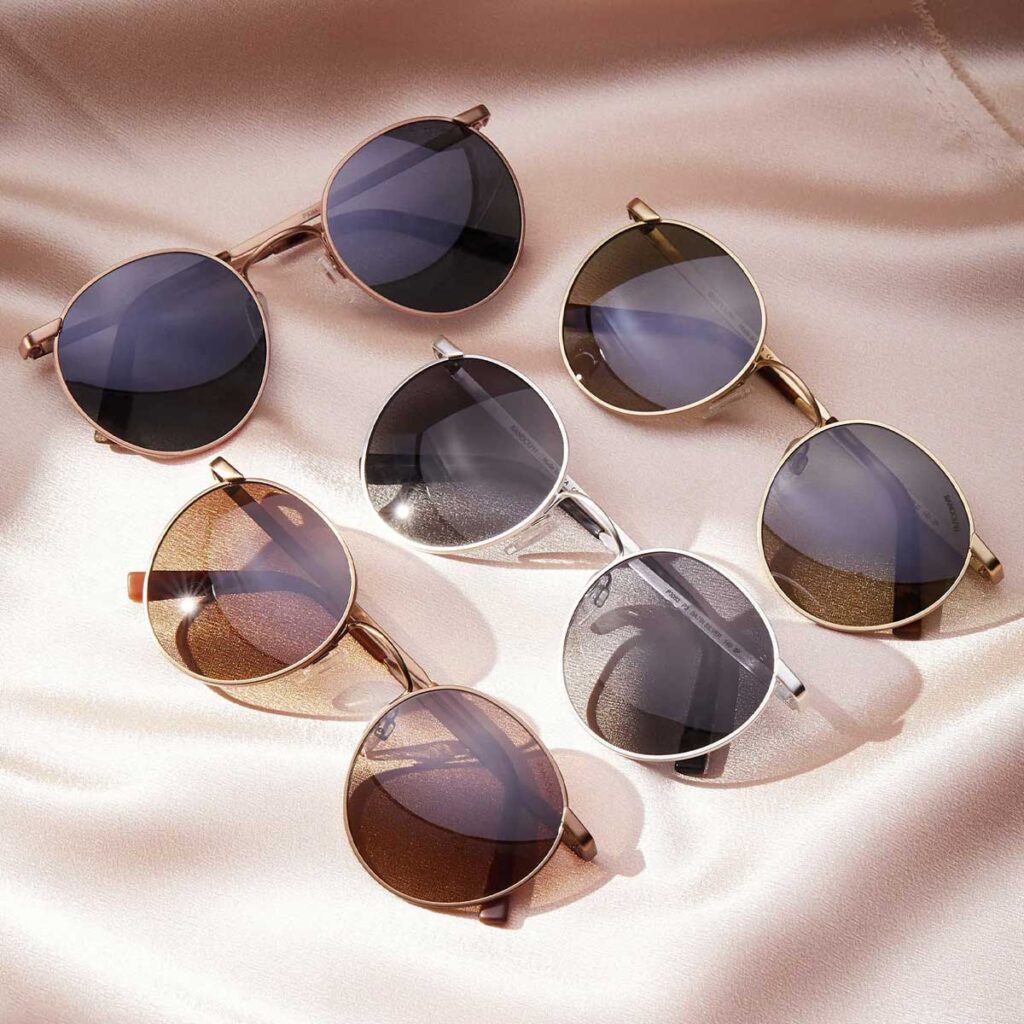
Thin metal frame. Small to medium lens diameter. Minimal hardware. This is the version most people picture when they hear “round sunglasses.”
The look is clean and slightly retro. It works well with casual and smart-casual outfits, especially in silver or gold finishes. We see steady demand from brands that want a timeless men’s frame without chasing trends. It also photographs well, which makes it a common choice for lookbook and catalog shoots.
Best fit: Men who want something understated but distinctive. Ages 25 to 50 tend to be the strongest segment.
Flat lens round
Same general shape, but the lens is flat instead of curved. That one change shifts the whole feel. The frame looks more modern, more urban, less vintage.
Flat lens round frame sunglasses mens styles have grown in the past five years, especially in streetwear and fashion-forward lines. The flat front catches light differently, which makes the product stand out in retail displays. Brands like the visual impact.
Best fit: Younger buyers, urban markets, fashion-led collections.
Oversized round
Bigger lens, bolder presence. Some versions approach “John Lennon” territory. Others land closer to a thick acetate frame with a rounded silhouette.
Oversized round sunglasses for men sell better in certain regions than others. Northern Europe and parts of North America tend to favor the bolder look. Asian markets often prefer smaller diameters. We usually recommend oversized styles for brands targeting a fashion-forward or retro-revival customer.
Best fit: Confident dressers, seasonal capsule collections, buyers who already wear bold frames.
Half-rim round
The top half of the frame is metal or acetate. The bottom is nylon cord or invisible wire. The lens sits inside the rim instead of being fully enclosed.
This style is lighter and more technical. It reads as sporty or outdoor-oriented, though some fashion brands use it for a minimalist aesthetic. Round frame sunglasses mens designs in half-rim are less common than full-rim versions, which is part of the appeal. They stand out in a crowded product wall.
Best fit: Outdoor lifestyle brands, sport-influenced lines, minimalist collections.

Double bridge round
Two horizontal bars cross the nose bridge instead of one. The extra line adds structure without breaking the round silhouette.
This style sits between classic and fashion. It has enough detail to feel designed, but not so much that it looks noisy. We’ve seen guys round sunglasses with double bridges perform well in Asia and the Middle East, where customers often favor intricate metalwork.
Best fit: Brands that want something slightly more designed than a basic round frame, especially in metal-heavy collections.
How to choose what to stock
If you’re building a small lineup, start with classic round and flat lens round. Those two cover the largest share of demand. Add oversized or half-rim styles if your target market leans fashion-forward or outdoor-oriented. Double bridge works best as a secondary option, not the core SKU.
One more thing. Round frames are sensitive to lens size. A 2mm difference in diameter can change how the frame sits on the face and how it photographs. When you request samples, ask for two lens sizes in the same design. Test both before locking in your production specs.
2026 Trend Report: What’s Actually Moving in Round Sunglasses for Men
Trends in eyewear move slower than fashion people like to admit. But a few things have genuinely shifted in the round sunglasses category this year. Here’s what we’re seeing across orders and buyer conversations at Zhantai.
Lens and frame colors
The brown tones are back in a serious way. Not the washed-out amber that floated around in 2019. We’re talking richer tobacco, cognac, even burnt orange tints on round lenses. Buyers from the European market started requesting these in late 2024. By mid-2025, we were cutting more brown lens blanks than grey ones for some product lines.
On frame color, matte black held its ground. No surprise there. But we also saw a jump in two-tone requests: black front with gold temples, or tortoise acetate with brushed silver nose bridge. These combinations work well for online product photography and tend to perform better in A/B listing tests.
What’s fading: bright mirrored lenses on round frames. They peaked around 2022. Some buyers still order them for resort collections, but the volume is lower.
Frame materials
Two opposite trends are running in parallel right now, and both are doing well.
Titanium wire frames, under 20g total weight, have consistent demand from Japanese and Korean buyers. They want thin temples, minimalist profiles, spring hinges, nothing flashy. These are harder to source because the tolerances are tighter. A bent titanium bridge that’s off by 2mm looks wrong immediately. But the buyers who want this style pay for quality and come back with repeat orders.
On the other end, thick acetate in a retro silhouette gained ground too. We’re talking 6-8mm temple width, strong front frames, the kind of weight you can feel on your face. Buyers from fashion-forward European boutiques and some North American independent labels are driving this. They describe it as “craft” or “heritage” positioning. The frame does the marketing work for them.
I’d say the middle ground, generic lightweight plastic in semi-rimless, lost market share this year. Buyers picking that style are mostly on pure price. Margins are thin.
Frame size: small round is back
This is the most notable shift in 2026. Small round frames, 44-48mm lens diameter, are moving again. We saw strong demand from the Korean market first, then US buyers started asking about it around Q3 2025.
The oversized round (55mm+) didn’t disappear. It still sells well for women’s collections and beach-season orders. But for men’s specifically, buyers are requesting smaller, more refined frames. The logic is simple: big round frames on men skew costume. A 46mm round with thin titanium temples reads more like serious eyewear.
We now run two standard tooling sizes for round men’s frames: 46mm and 52mm. The 52mm is the workhorse. The 46mm is smaller volume but growing.
Temple design
Thin needle temples, 3-4mm wide, pair naturally with titanium wire frames and small round lenses. They look right. Buyers who want a clean 1960s aesthetic always spec these.
Flat wide temples, 7-8mm wide with a slight taper, are the acetate frame standard. Some buyers add printed patterns on the inner temple: wood grain, marble texture, subtle geometric prints. These get photographed and shared on social, which is part of the point.
One thing we tell buyers: temple width affects comfort at scale. A 4mm temple works fine for most face widths. Push it to 3mm on a heavy acetate front and you get pressure points behind the ear. We always test the balance before approving a new mold.
There’s no single “winning” trend in 2026. Small titanium rounds and heavy acetate retro frames are both doing well, which sounds contradictory but makes sense when you think about who’s buying. Different customers, different channels, different price points.
The color shift toward warm brown tones is probably the most universal signal. If you’re planning a new collection and haven’t added a tobacco or cognac lens option, it’s worth a conversation with your sourcing team.
Which face shapes actually work with round frames?
The short answer: most of them. But some combinations work better than others, and it’s worth knowing why before you finalize a collection.
Square and oblong faces: the obvious match
Square faces have strong jaw angles and flat foreheads. A round frame softens that. The curved lens outline pulls the eye away from sharp corners and creates some visual balance. It works because the shapes contrast.
Oblong faces, which are long and narrow, get a similar benefit. A round lens adds horizontal width to the middle of the face. It breaks the vertical dominance. Buyers targeting men with more angular or longer face structures tend to do well with round frames across multiple SKUs.
These two face shapes are why round sunglasses for men have stayed in the market for over a century. The contrast geometry just works.
Diamond and heart-shaped faces: solid options too
Diamond faces are wide at the cheekbones and narrow at the forehead and jaw. Round frames sit across the cheekbone zone and draw attention there, which is usually fine. The curved bottom of the frame also softens a pointed chin.
Heart-shaped faces are wide at the forehead and narrow toward the chin. A round frame with a lower lens position visually balances the upper face width. It’s not a perfect fit but it works better than you’d expect.
Round and oval faces: more complicated
Round faces are where this gets tricky. A round lens on a round face can look like too much of the same thing. The frame gets absorbed into the face shape rather than contrasting with it. Some men pull it off, but it takes the right frame size and bridge fit.
Oval faces are similar. Oval is often called the “ideal” face shape because most styles technically work. But round on oval can feel generic. The oval face needs something with a bit more edge to look interesting.
That said, these are patterns, not rules. I’ve seen guys with round faces wear small round frames and look genuinely good. Bridge width, lens size, and how the frame sits on the nose all matter more than the broad face shape category.
Telling your retail buyers “this style suits square faces” gives them a selling point. Just don’t turn it into a hard restriction that scares off customers who don’t fit the profile.
6.What buyers and brand owners need to know before sourcing
If you’re building a round sunglasses line for men, the decisions you make at the sourcing stage determine your margins, your return rate, and whether buyers come back for a second order. Here’s what matters.
Frame materials: a working comparison
Metal
Metal frames, typically stainless steel or titanium alloy, run between 18-25g finished weight. They hold their shape well across temperature changes and don’t warp in shipping containers. Spring hinges on metal frames last longer than barrel hinges on plastic because the stress point is reinforced.
For pricing, metal frames sit in the mid to upper range. They photograph cleanly and work for brands that want a refined, minimal positioning. Most of our Japanese and Korean buyers default to metal for their core round SKUs.
TR-90
TR-90 is a nylon-based material with a memory effect. Bend it and it returns to shape. This makes it good for active and casual use, and it’s lighter than acetate. Drop-test performance is better than most metals.
The tradeoff is that TR-90 frames have less perceived weight and substance. Some buyers describe them as feeling “cheap” at retail even when the construction is fine. It depends on your customer and price point. For sport-leisure collections at accessible price points, TR-90 makes sense. Some high-quality plastic can also meet the requirements.
Acetate
Thick acetate is the premium play in round frames right now. A well-made acetate round frame has a visible weight to it, 30-35g, that feels intentional rather than heavy. The material takes color in a way that plastic doesn’t. Tortoise, layered transparents, marble effects: you can’t replicate these in TR-90.
The premium positioning works in practice. We consistently see higher retail prices and lower return rates on acetate frames versus comparable TR-90 styles. The customer who pays more for the frame tends to treat it better.
Lens options
Polarized cuts glare from water and road surfaces. It’s the right choice for any round frame going into coastal or outdoor markets. Most buyers ask for it as a default now.
Gradient lenses are darker at the top and lighter at the bottom. They work well on larger round frames where there’s more lens area to show the fade. Buyers for resort and fashion channels like these.
Mirror coating sits on the outer surface. It adds visual drama and makes the lens appear opaque from the outside. Durability matters here: a low-quality mirror coat scratches in the first month of use. We apply hard coat as a base layer before the mirror to extend lifespan.
UV400 is not an option, it’s the baseline. Every frame we produce meets UV400 and CE standards. For buyers selling into the EU, CE marking is required. For the US market, FDA compliance applies. If a supplier doesn’t mention this upfront, ask why.

Customization options
Logo placement on round frames is tighter than on other silhouettes because there’s less flat surface area. The most reliable options:
- Temple laser engraving: clean, permanent, works on metal and acetate
- Temple pad printing: color logos, usually on the inner or outer temple face
- Lens silk screen: small brand mark near the lower corner of the lens
- Inner temple lining: colored acetate layer visible when the temples open, good for brand differentiation without affecting the exterior look
We can match inner lining color to a Pantone reference. Some buyers use this to create a brand-consistent detail that shows up in unboxing content.
MOQ and planning
Our standard MOQ is 600-1200 pairs per style with 2-3 colors.
Lead time from confirmed order to shipment runs 45-60 days for stock frame styles. Custom mold development adds 30-45 days before production starts.
One thing worth planning for: round frames in small sizes (under 48mm) require tighter lens cutting tolerances. If you’re ordering a 46mm classic round for the first time, build in a sample review round before committing to full production. A lens that’s off by 1mm reads visibly wrong in a circular cut.
Zhantai Glasses have been producing round frames since the early 2000s. The category looks simple from the outside. The geometry is unforgiving compared to rectangular or aviator shapes. Details that buyers often overlook at the sampling stage, like nose bridge width and lens curve depth, become the main complaint after retail launch.
Get the fit right on the sample. Everything else is easier after that.
Closing thoughts
Round sunglasses for men have been around for over a century. They’ll be around for another one. The silhouette doesn’t go out of style because it’s not really a trend. It’s geometry.
For buyers and brand owners, the practical question is always the same: which version of round fits your customer, your price point, and your channel? A 46mm titanium wire frame for a Japanese boutique is a completely different product from a 58mm thick acetate for a European fashion label, even if both are technically “round sunglasses.”
We’ve made both. We’ve made most versions in between.
If you’re building a men’s collection and want to explore round frame options, including existing styles from our ODM catalog or custom development for something new, reach out. We’ll send samples before you commit to anything.
Contact Zhantai Glasses Email: [email protected] Website: zhantaiworld.com
We ship to 50+ countries. CE, UV400, and FDA documentation available on request.