Launching an eyewear brand or expanding a retail catalog is an exciting venture. You have your ideal customer in mind, your brand identity dialed in, and a vision for the perfect frame. However, the moment you contact a manufacturing facility overseas, you immediately run into an industry acronym that stops many first-time buyers in their tracks: MOQ.
Understanding how to calculate and navigate your sunglasses MOQ (Minimum Order Quantity) is the single most critical factor in sourcing. If you order too little, factories will ignore your inquiry. If you order too much without a sales strategy, you risk tying up your capital in dead stock.
For B2B buyers targeting large-scale retail clients, supermarkets, and fast-fashion brands, establishing a robust supply chain requires a deep understanding of how production limits work. This guide breaks down everything you need to know about navigating the minimum order quantity eyewear China landscape, the actual costs involved, and how to structure your order for maximum profit margin.
What Does MOQ Mean in Eyewear Manufacturing?
MOQ stands for Minimum Order Quantity. It represents the absolute lowest number of units a factory is willing to produce for a single order.
In the eyewear industry, MOQ is not an arbitrary number factories invent to force you to spend more money. It is a strict mathematical threshold based on production physics. Unlike printing t-shirts on demand, manufacturing a pair of glasses requires substantial upfront tooling, massive raw material batching, and complex assembly line setups. If a factory runs a production line for anything less than their MOQ, they actually lose money on the labor and machine calibration time.
When discussing sunglasses MOQ, you must understand that the number is usually broken down into three tiers:
-
Total Order MOQ: The total number of frames in the entire contract.
-
Model MOQ: The minimum number of frames required for one specific shape or design.
-
Color MOQ: The minimum number of frames required for a specific color variation within that model.
Why the 1200-Unit MOQ is the Industry Golden Standard
If you are entering the B2B market with serious intentions of supplying large-scale retailers or expanding a major brand, you must move past the “small batch” mindset. Attempting to negotiate unsustainably low MOQs (like 100 or 300 units) usually results in factories cutting corners on quality or charging exorbitant unit prices that destroy your retail margins.
For professional B2B production, the industry standard sits firmly at a strict 1200-unit minimum order quantity per model.
Why 1200 units? This number is the exact threshold where production efficiency peaks, unit costs plummet, and factory relationships solidify. Here is how this golden standard benefits your business:
-
Tooling Amortization: Creating a custom injection mold or programming a CNC routing machine takes significant engineering time. Spreading the cost of that tooling over 1200 units makes the per-frame cost virtually invisible.
-
Raw Material Sourcing: Acetate and TR90 nylon suppliers sell raw materials in bulk weight. To mix custom colors or source premium materials, the factory must buy enough raw plastic to justify the batch. A 1200-unit run perfectly aligns with minimum raw material purchases.
-
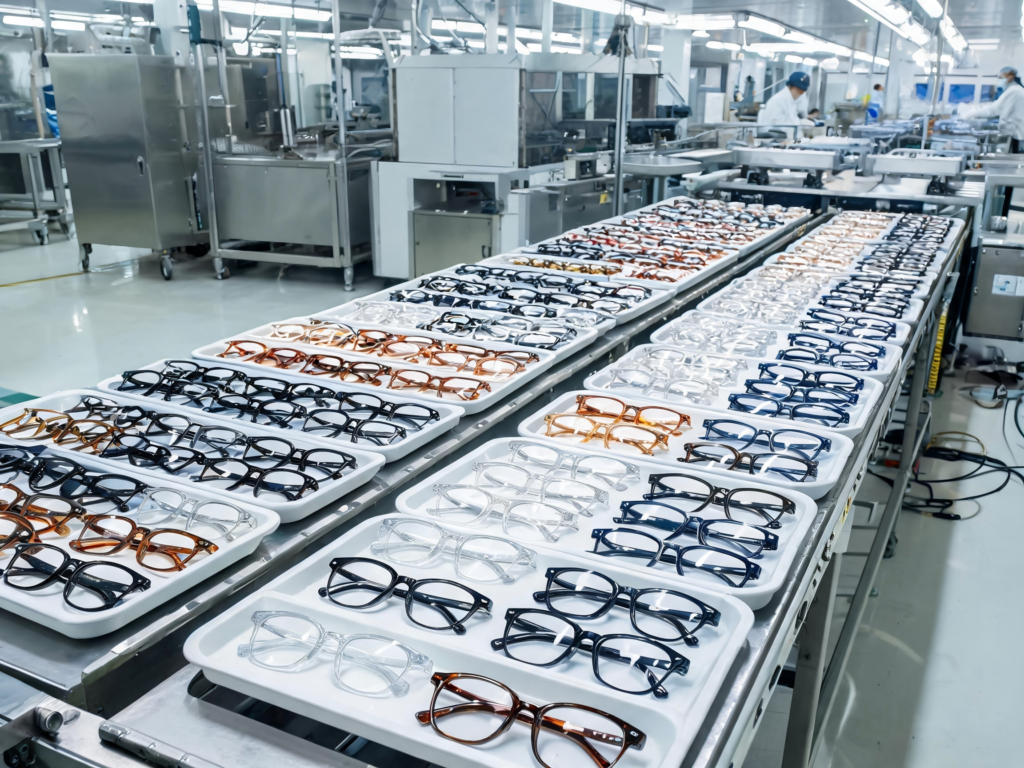
Assembly Line Flow: Eyewear production requires over 20 distinct steps, from tumbling to polishing to hinge insertion. Setting up these stations for 1200 units allows the workers to establish a rhythm, drastically reducing error rates and ensuring consistent quality control across the entire batch.
Structuring the 1200-Unit Order
A 1200-unit MOQ does not mean you have to buy 1200 identical black frames. A standard, highly effective breakdown for a single frame style looks like this:
-
1 Model (e.g., a classic square shape)
-
4 Colors (300 units per color) = 1200 units total.
This structure allows you to offer a complete, diverse collection to your retail buyers while satisfying the factory’s production requirements.
Simplifying Your Order: Color and Material Strategies
When calculating your minimum order quantity eyewear China order, the materials and finishes you choose directly impact the complexity of the production run. First-time buyers often complicate their orders by requesting obscure color codes or overly complex finishing techniques.
To keep your MOQ calculations straightforward and factory relations smooth, adopt standard, high-demand finishes. Instead of complicating your spec sheets with internal, model-specific color codes (like C1 or C2), simply specify classic, universally recognized finishes.
For maximum retail appeal, focus on these top performers:
-
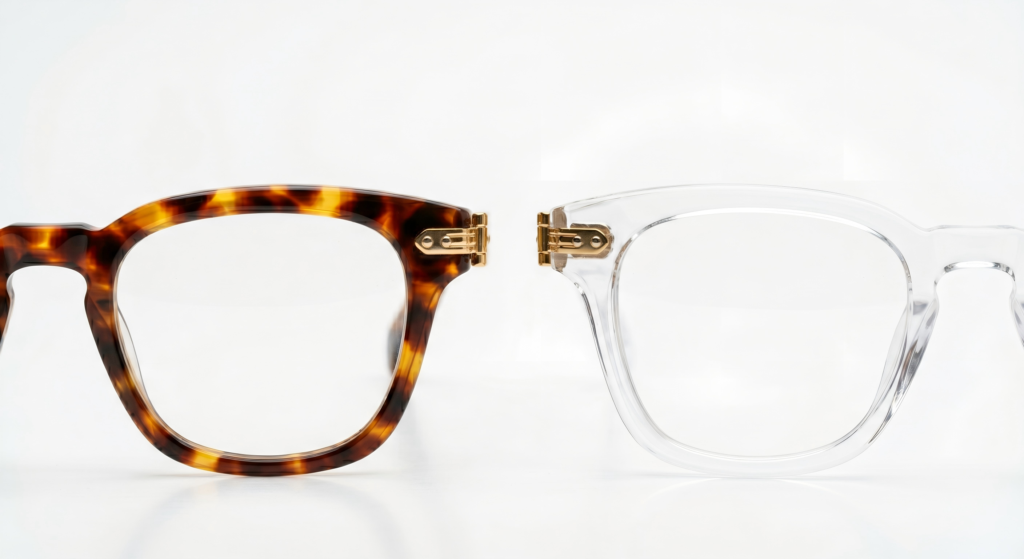
Clear: Modern consumers heavily favor minimalist, completely transparent frames. (Avoid using outdated terms like “translucent”; stick to the direct, highly-searched term Clear).
-
Tortoise: The ultimate neutral. A classic mottled brown and amber Tortoise pattern never goes out of style and sells consistently across all demographics.
-
Matte Black: A staple for men’s and sports eyewear, offering a sleek, tactical aesthetic.
By ordering your 1200 units across Clear, Tortoise, and Matte Black, you guarantee that your inventory will appeal to the widest possible audience, reducing the risk of unsold stock.
OEM vs. ODM: How Your Design Choice Changes the Math
Your approach to frame design will also dictate how the factory handles your sunglasses MOQ.
ODM (Original Design Manufacturer) – Private Labeling
If you want to move quickly and keep upfront costs low, choose ODM. This means you select a frame shape the factory has already designed and possesses the molds for. Because the factory does not need to engineer a new steel mold from scratch, they are often more flexible with color variations within the 1200-unit threshold. You can easily apply your own brand logo to these existing designs.
OEM (Original Equipment Manufacturer) – Custom Design
If you are designing a brand-new frame from a raw sketch, you are entering OEM territory. The factory must cut a brand-new mold. Because the factory is dedicating immense R&D resources to your specific project, they will strictly enforce the 1200-unit MOQ. Do not expect any flexibility here; custom engineering requires guaranteed volume to be profitable for the manufacturer.
Common Mistakes First-Time Buyers Make
Calculating your frame MOQ is only part of the equation. Many B2B buyers miscalculate their overall budget by ignoring the secondary requirements of eyewear sourcing.
-
Forgetting Packaging MOQs
Your glasses need cases, microfiber cleaning cloths, and exterior retail boxes. These items are rarely made in the same factory as the glasses. Packaging suppliers have their own MOQs—often starting at 1000 to 2000 units. Ensure your capital calculation includes the cost of matching your frame volume with the appropriate branded packaging.
-
Over-Diversifying the Collection
The fastest way to drain your budget is trying to launch with 10 different frame styles right out of the gate. If you want 10 styles, and the factory demands a 1200-unit MOQ per style, you are instantly committing to 12,000 frames.
The smart calculation: Start with one or two incredibly strong, versatile frame shapes. Invest your budget into hitting the 1200-unit MOQ across multiple attractive colors (like Clear and Tortoise) for those specific shapes. It is far better to have deep inventory of two proven sellers than shallow inventory of ten unproven designs.
Conclusion: Embrace the MOQ for Better Business
Navigating your first bulk eyewear order can feel intimidating, but understanding the math behind the requirements changes the entire dynamic. A sunglasses MOQ is not a barrier to entry; it is a roadmap to profitability.
When you understand the realities of minimum order quantity eyewear China sourcing, you stop fighting the factory and start collaborating. By embracing the strict 1200-unit B2B standard, simplifying your color selections to proven winners like Clear and Tortoise, and focusing on one or two strong designs, you position your brand for sustainable, high-margin success in the global retail market.