Choose rimless sunglasses by evaluating the complete lens-and-hardware assembly before comparing decoration or price. Define the customer, confirm lens suitability for drilling, inspect mounting points, assess edge finishing and fit, approve customization, and calculate the complete order cost. Pay particular attention to cracks that develop around mounting holes after storage. For supermarket and brand buyers, an attractive sample is the starting point; a documented specification and suitable durability evaluation provide the basis for ordering.
Key Takeaways
Reliable purchasing depends on lens toughness after processing, controlled assembly, consistent finishing, and realistic commercial planning.
- Confirm the complete construction. A material described as “high strength” still needs to be suitable for drilling and the selected attachment system.
- Evaluate delayed cracking. Inspect mounting holes after agreed storage or conditioning, as well as immediately after assembly.
- Treat diamond-cut edging as a separate specification. Its facets add visual interest, processing work, and cost.
- Plan from a 1,200-pair MOQ. Compare complete costs and validated demand before increasing the order to spread development charges.
| Buying factor | Rimless construction | Semi-rimless construction | Full-rim construction |
| Lens support | Localized bridge and temple attachments | Partial rim with design-specific retention | Surrounding eyewire |
| Exposed edges | Most of the lens perimeter | Part of the lens perimeter | Most edges enclosed |
| Material evaluation | Compatibility with the proposed mounting method | Compatibility with grooves and retention | Compatibility with frame groove and curvature |
| Assembly priorities | Mounting position, fastening, and alignment | Partial-rim alignment and retention | Lens seating and frame alignment |
| Decorative options | Lens outline, facets, hardware, and temples | Exposed-edge and frame details | Frame shape, surface treatment, and decoration |
| Handling checks | Exposed edges and mounting points | Exposed edges and retention system | Frame condition and lens seating |
| Cost comparison | Quote the actual configuration | Quote the actual configuration | Quote the actual configuration |
What Are Rimless Sunglasses?
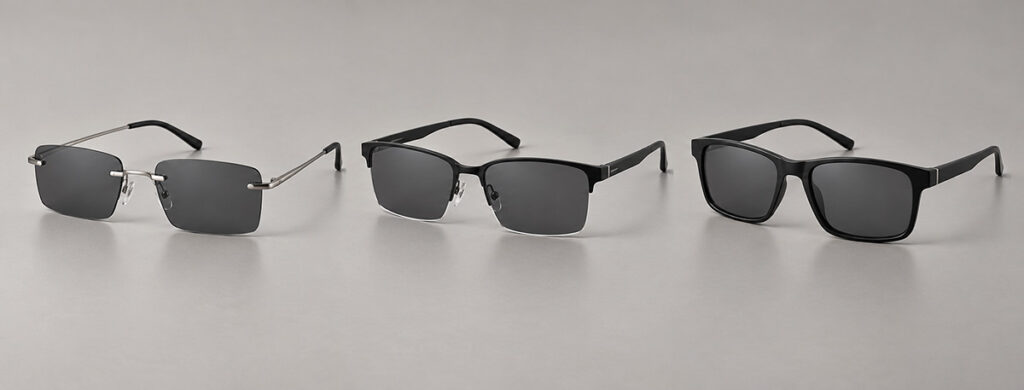
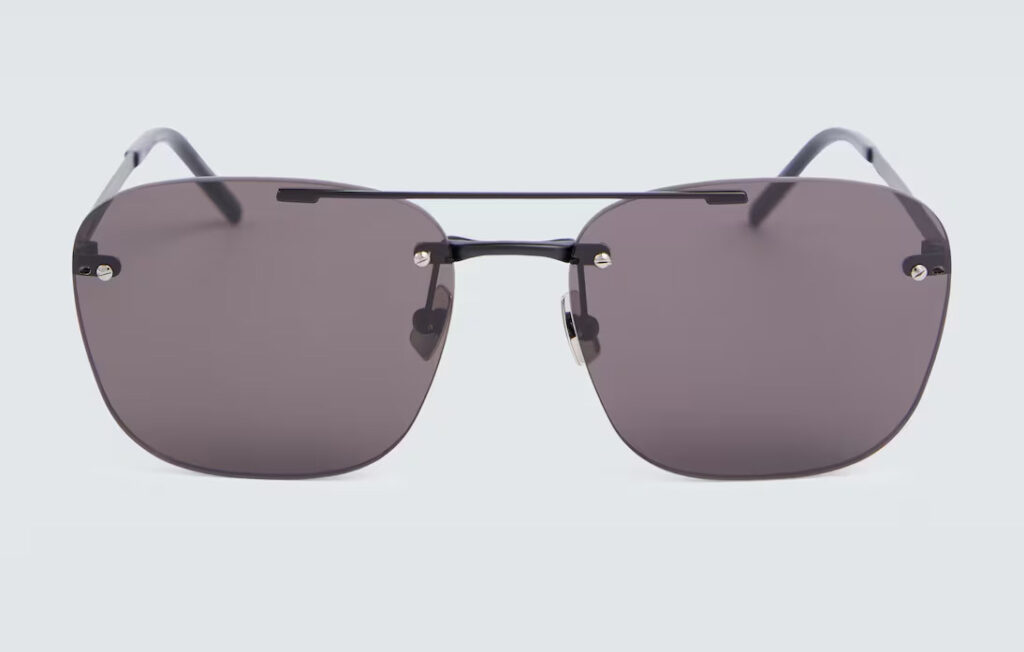
A rimless sunglass is an eyewear design that supports its lenses through bridge and temple attachments without a surrounding eyewire. Often called frameless sunglasses, this construction exposes the lens perimeter and suits collections seeking a visually minimal front with distinctive lens shapes.
The construction matters because the lens participates in the mounting system. It is not simply a tinted component enclosed by a frame.
Semi-rimless products retain part of a surrounding structure. Fully rimless products connect the bridge and temples through localized attachments. Product names are not always precise, so review photographs and construction details before comparing quotations.
For a visually minimal front with exposed decorative edges, choose rimless construction. For a design that surrounds most lens edges, full-rim construction is the better call, subject to the intended fit and product requirements.
Step 1: Which Rimless Sunglasses Suit Your Target Customers?
What Should Supermarket Buyers Prioritize?
A supermarket program needs a product that remains consistent across the assortment and can be presented clearly at retail.
Discuss packaging protection, shelf handling, color allocation, and replenishment. Check whether the product can be removed from and returned to its packaging without unnecessary pressure on exposed edges or joints.
A visually simple model can still require careful assembly. Avoid equating a minimal appearance with a simple manufacturing process.
What Should Brand Buyers Prioritize?
A brand may place greater emphasis on an original lens outline, coordinated hardware, or a recognizable temple detail.
Identify which features define the concept. Changing a lens outline may also affect mounting locations and edge clearances, so the development discussion should address construction alongside styling.
For a collection built around available styles, choose an existing design that meets the brief. For a collection requiring original outlines or hardware, custom development is the better call, provided its cost and schedule are acceptable.
Zhantai’s OEM metal rimless sunglasses provide a starting point for discussing available designs and project-specific modifications.
Step 2: Which Lens Material Is Suitable for Drilled Rimless Sunglasses?
A suitable lens must retain adequate toughness after drilling, edging, finishing, and assembly in the proposed mounting system.
Why Must Lenses Retain Toughness After Drilling?
The finished mounting points matter more than the apparent strength of an unprocessed lens.
Drilling introduces openings where the lens connects to hardware. The resulting performance depends on the material, geometry, processing quality, and assembly. A general “high-strength” description does not resolve those questions.
Ask the supplier to identify the exact lens specification and confirm compatibility with the proposed mounting method. Changes to material or processing should trigger a review rather than pass unnoticed.
How Should Buyers Specify Lens Thickness and Geometry?
Specify nominal thickness in millimeters, the measurement location, and the agreed tolerance. Include base curve, outline, mounting locations, and edge treatment.
There is no single minimum thickness that can be responsibly applied to every rimless design without considering its construction.
For a new outline or mounting arrangement, choose a documented material-and-geometry review followed by assembled samples. For a repeat order with unchanged specifications, the previously approved configuration is the better call, with substitution controls maintained.
Are Polarization and UV Protection Separate Requirements?
Yes. Lens material, polarization, tint, and UV performance are separate specification fields.
Confirm whether the proposed construction supports each requested feature. Review evidence for the ordered configuration rather than assuming that a polarized or dark lens satisfies every sunwear requirement.
Zhantai’s rimless eyewear fabrication guide provides additional construction context for the supplier discussion.
Step 3: How Do You Check Rimless Sunglasses for Cracking Around Mounting Holes?
Inspect mounting points immediately after assembly and again after agreed storage or conditioning, because some cracks become visible later.
Why Can Cracking Appear After Storage?
A product can look acceptable when first assembled yet develop visible cracks around a hole during storage. This makes initial appearance inspection insufficient on its own.
The cause requires investigation. Lens suitability, hole quality, local geometry, fastening pressure, component fit, and environmental exposure may all deserve examination. A visible crack does not identify its cause by itself.
Delayed cracking should be treated as a product-development and acceptance issue, not merely a cosmetic complaint after delivery.
What Should Buyers Inspect?
- Mounting holes or notches for chips, roughness, and visible cracks.
- Attachment locations and their relationship to lens edges.
- Sleeves, washers, or other interface components where specified.
- Bridge alignment, temple symmetry, and signs of excessive local pressure.
- Changes in the mounting area after agreed storage or conditioning.
Define viewing conditions and acceptance criteria with the supplier. A consistent inspection method makes comparisons more useful.
How Should the Manufacturing Sequence Be Controlled?
- Confirm the lens and mounting design. Approve the material, geometry, holes or notches, and interface components.
- Process the lenses. Control cutting, drilling, and edge finishing against the agreed specification.
- Inspect before assembly. Examine processed edges and mounting areas before hardware conceals them.
- Assemble under defined controls. Use the agreed components and fastening method.
- Reinspect and condition samples. Check alignment and mounting areas before and after the agreed evaluation.
What Is Diamond-Cut Edging on Sunglasses?
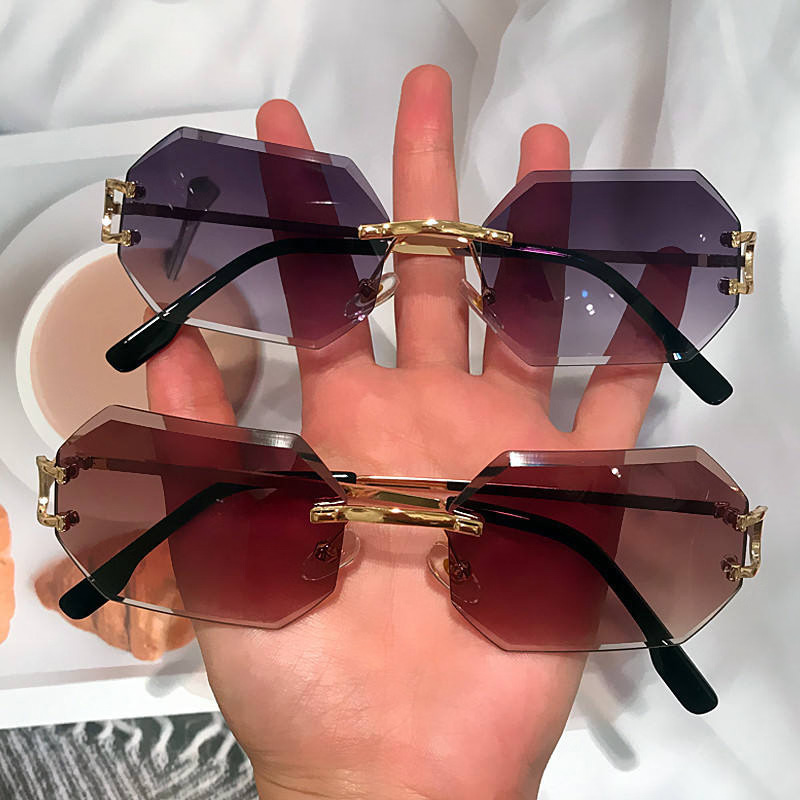
Diamond-cut edging is a lens-edge finishing style that uses shaped, polished facets to create changing highlights as light meets the exposed perimeter, ideal for fashion collections seeking decorative detail without adding a prominent surrounding frame or oversized ornament.
The name describes the edge treatment. It does not mean that the product contains diamonds, and it does not establish improved optical vision.
On an exposed lens, facets can catch and redirect light as the wearer moves. Their appearance depends on geometry, polish, tint, and lighting.
The design value lies in the finished visual effect, which should be approved on a physical sample.
Step 4: How Do Diamond-Cut Edges Affect Rimless Sunglasses Quality and Cost?
Diamond-cut edges add shaping, polishing, handling, and inspection work, while making finishing consistency more visible.
What Should Buyers Check on Faceted Lenses?
Review facet width, angle, continuity, polish, and symmetry between the lenses. Check that corners and transitions feel appropriate and that the edge design remains compatible with mounting locations.
A broad facet can look different from a narrow one even when the lens outline is unchanged. Approve the actual effect under consistent lighting.
Does Decoration Affect Everyday Fit?
The product still needs appropriate bridge support, temple contact, and weight distribution.
Check that hardware or exposed edges do not create uncomfortable contact points. Evaluate normal movement, storage, and handling alongside appearance.
For restrained everyday styling and fewer finishing operations, choose standard polished edges. For a collection where changing edge highlights support the intended retail positioning, diamond-cut edging is the better call after sample and cost approval.

Step 5: What OEM Customization Is Available for Rimless Sunglasses?
Customization can involve lens outlines, edge treatments, hardware, finishes, temples, branding, and packaging, subject to construction feasibility.
Can an Existing Design Meet the Brief?
An existing model may already provide the required proportions and mounting arrangement. Discuss permitted changes before assuming that every feature is interchangeable.
A different color or surface finish may be straightforward in one configuration and require additional work in another.
Which Changes Require Development or Tooling?
A lens cutting-pattern change differs from developing a new bridge or temple component. However, neither should be assumed free of setup or validation costs.
Ask the supplier to separate design work, fixtures, tooling, samples, and production charges. Confirm what remains usable for repeat orders.
For a brief satisfied by existing geometry, choose controlled detail customization. For a concept requiring different attachment locations or dedicated components, full development is the better call, with additional feasibility and sample stages.
How Are Samples and Changes Approved?
Identify the final approved sample and its corresponding specification. Record material, components, lens processing, finishing, and packaging.
Approval should cover the product that will be manufactured, with a written process for substitutions and revisions.
Step 6: What Do Rimless Sunglasses Cost at Different Order Quantities?
Zhantai’s confirmed MOQ for this program is 1,200 pairs; price and development costs depend on the complete configuration.
The model below is a hypothetical 2026 budgeting example, not a Zhantai quotation or market-price survey. Both routes assume equivalent specifications and acceptance requirements. Commercial figures are not laboratory measurements, so an ISO test designation does not apply to them.
| Budget input | Route A: lower upfront cost | Route B: upfront tooling with a lower assumed unit price |
| MOQ | 1,200 pairs | 1,200 pairs |
| Illustrative unit-price range | US$4.50–5.10 per pair | US$4.00–4.60 per pair |
| Unit price used in the example | US$4.80 per pair | US$4.30 per pair |
| Illustrative tooling charge | US$0 | US$1,500 |
| Assumed sample-development period | 10–15 calendar days | 25–35 calendar days |
| Assumed production after approval | 40–50 calendar days | 45–60 calendar days |
These assumptions exclude freight, duties, financing, extra development rounds, and unsold inventory. Sample and production periods must not be treated as a confirmed delivery schedule.
Where Is the Break-Even Quantity?
Using the assumed prices, the break-even calculation is:
US$1,500 ÷ (US$4.80 − US$4.30 per pair) = 3,000 pairs.
At 1,200 pairs, Route A totals US$5,760 and Route B totals US$6,660. At 6,000 pairs, Route A totals US$28,800 and Route B totals US$27,300.
For a 1,200-pair order under these assumptions, choose Route A. For confirmed demand above 3,000 pairs, Route B is the better call on modeled manufacturing cost, before inventory and financing effects.
Custom development does not inherently produce a lower unit price. Route B represents an assumed commercial offer that must be obtained and verified.
How Much Does Diamond-Cut Edging Add?
Use the actual processing surcharge multiplied by quantity. As a separate hypothetical 2026 example, US$0.40 per pair × 1,200 pairs = US$480.
Keep this charge separate from the tooling break-even calculation unless it applies equally to both configurations.
For a price-led program without a validated premium for decorative edges, choose standard finishing. For a differentiated collection with an approved visual effect and workable margin, diamond-cut edging is the better call.
How Do Buyers Choose Frameless Sunglasses in Three Purchasing Stages?
Complete the decision by moving from demand, to approved specifications, to a commercially justified order quantity.
- Define demand. State the customer, market, sales channel, target price, purchasing window, and expected quantity.
- Confirm specifications. Approve material, mounting design, edge finishing, fit, packaging, relevant evidence, and sample acceptance.
- Set the order scale. Start from the 1,200-pair MOQ and evaluate tooling amortization, inventory exposure, and confirmed delivery timing.
For an untested assortment, choose an order scale supported by realistic demand. For established replenishment with unchanged specifications, a larger commitment is the better call only when its complete cost and inventory position remain favorable.
What Should Buyers Ask Before Ordering Rimless Sunglasses?
Resolve MOQ, samples, lead time, testing, inspection, and customization terms before approving an order.
What Is the MOQ for OEM Orders?
The MOQ is 1,200 pairs. Confirm how that quantity is allocated across models, colors, and configurations in the quotation, especially where different hardware or edge treatments are requested.
What Sample and Production Lead Time Should We Plan?
Lead time depends on the actual development scope and approval sequence. Request dated sample and production commitments; the budgeting ranges above are hypothetical and should not determine a retail launch date.
Which Certification or Test Reports Should We Request?
Evidence depends on the destination market, intended use, and claims. Review applicable standards, report scope, and tested configuration; general sunwear evidence does not automatically support occupational or specialized protective applications.
Can We Request Storage Checks for Cracking Around Holes?
Yes, buyers can request an agreed evaluation protocol. Define sample selection, storage conditions, inspection timing, and acceptance criteria before testing; retained production samples are useful for investigating later observations.
Can We Specify Our Own AQL?
Yes, buyers can propose a sampling plan for agreement. Define inspection level, lot size, defect categories, and acceptance criteria; AQL sampling does not replace separate performance testing or delayed-failure evaluation.
Does OEM Customization Include Exclusive Rights?
No, customization alone does not establish exclusivity. Record agreed design use, tooling arrangements, territories, and duration; standard components and dedicated buyer-funded parts may require different commercial treatment.
How Can Buyers Start a Rimless Sunglasses Project With Zhantai?
Use the message form below to explain the support you need and the purchasing conditions already defined.
- Sample evaluation: Request suitable models to compare mounting construction, standard versus faceted edges, fit, and packaging.
- OEM/ODM quotation: Provide an approved or proposed specification, quantity, color allocation, lens requirements, and branding.
- Custom development: Share original references, required geometry, tooling needs, and expected annual demand for feasibility review.
For an exploratory brief, choose sample evaluation. For a defined purchasing specification, an OEM/ODM quotation is the better call; projects requiring new components should begin with a development discussion.
To begin your rimless sunglasses project, provide three details: expected purchasing volume, target market, and purchasing time window. Submit them through the article’s message form, or use the Zhantai rimless sunglasses project contact page to discuss suitable options.