You spent weeks finalizing tech packs, debating CAD drawings, and waiting for international shipping. Finally, the courier hands you the box containing your new sunglasses prototypes. What you do in the next 24 hours dictates the success or failure of your entire retail collection.
Many B2B buyers simply put the sample on their face, look in the mirror, and send the factory an email saying, “Looks good, let’s proceed.” As an experienced manufacturing partner at Wenzhou Zhantai Glasses Co., Ltd., we dread this email.
We do not want a quick glance. We want you to tear the sample apart visually and mechanically. A rigorous eyewear sample testing protocol protects your brand reputation and prevents disastrous misunderstandings during mass production.
hope our B2B buyers execute when they receive our prototypes.
The First Impression and Balance Check
Before you grab your measuring tools, trust your hands and eyes. The initial unboxing reveals the fundamental engineering of the frame.
When you pick up the sunglasses, evaluate the weight distribution. A poorly engineered frame feels “front-heavy” because the manufacturer used cheap, lightweight plastic for the temples and heavy glass lenses. This causes the sunglasses to slide down the wearer’s nose constantly.
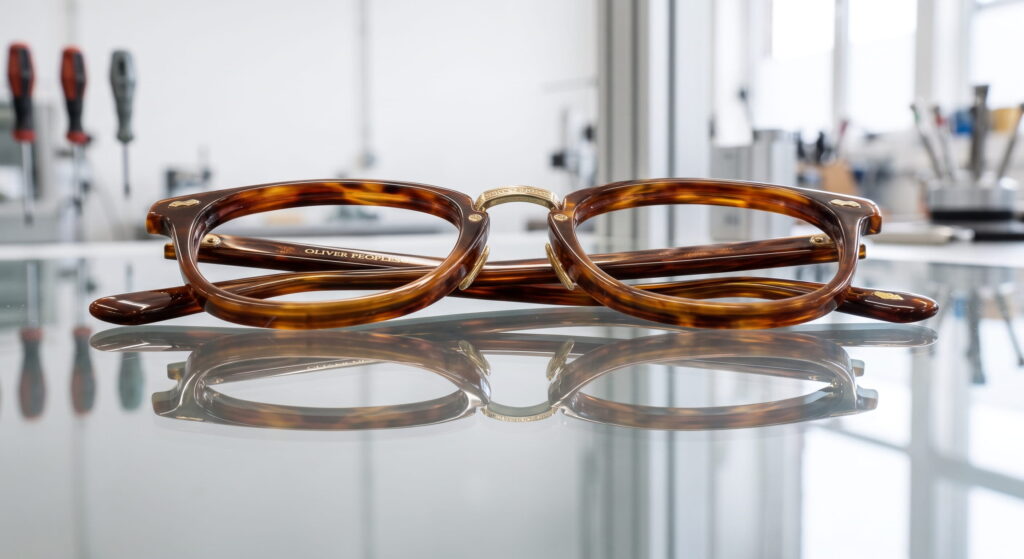
We engineer our frames to achieve perfect equilibrium. The weight of the front frame should perfectly counterbalance the weight of the temple tips resting behind the ears. Put the glasses on a flat glass table. Do all four points (the two bottom rims and the two temple tips) touch the glass simultaneously? If the frame wobbles, the factory failed to align the chassis properly.
Dimensional Measurements: Grab Your Calipers
Never trust a tech pack blindly. Physical materials behave differently than digital lines on a screen. During your eyewear sample testing, you must verify the critical dimensions using a digital caliper.
Measure these three core areas and compare them strictly to your original CAD drawings:
-
Frame Width (Total and Lens): Measure the widest point of the front frame. Then, measure the exact width of the lens. Even a 2mm deviation changes how the glasses fit a human face.
-
Bridge Width: This dictates how the frame sits on the nose. Measure the distance between the narrowest points of the lenses.
-
Temple Length: Measure from the hinge screw directly to the end of the temple tip. If the temples are too short, they will pinch the wearer’s head; if they are too long, the glasses will fall off.
Material Verification: Did You Get What You Paid For?
Unfortunately, the optical industry contains bad actors who substitute premium materials for cheap plastics. You must verify the structural integrity of your sample.
-
Verifying Cellulose Acetate: If you ordered premium acetate, tap the frame against your teeth or a glass table. It should produce a dense, dull “thud.” Cheap injection-molded PC (Polycarbonate) sounds hollow and high-pitched. Furthermore, look at the metal wire core inside the temple. Acetate frames require this wire for adjustability. If you ordered transparent acetate, the wire core should look pristine, without any trapped air bubbles or burn marks from the insertion process.
-
Verifying TR90: If you ordered TR90 sports frames, bend the temples outward aggressively. TR90 possesses extreme “memory.” It should flex wide and immediately snap back to its original shape without cracking or leaving white stress marks at the bending point.
Lens Testing: Safety and Optical Clarity
The lenses carry the highest legal and functional liability in your product. You cannot evaluate a lens merely by looking through it outdoors. You must conduct objective optical testing.
-
UV400 Verification: Take the sample to a local optometrist and ask them to place it in a UV spectrometer. It must block 100% of UVA and UVB rays.
-
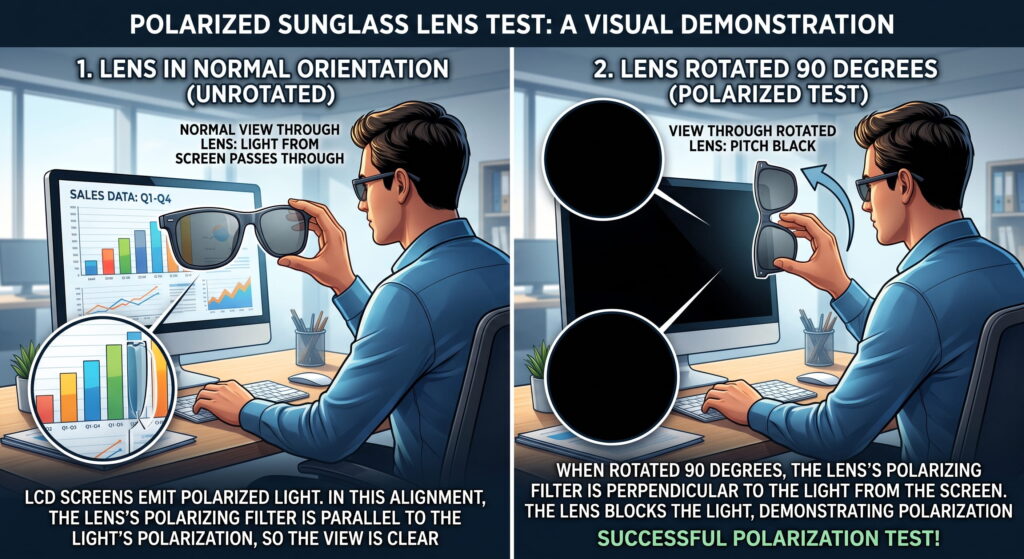
Polarization Check: Do not just trust the “polarized” sticker. Hold the sunglasses up to an LCD computer monitor. Rotate the sunglasses 90 degrees. The lens should turn completely pitch black as the polarization filter blocks the directional light from the screen.
-
Anti-Reflective (AR) Coating Check: Hold the glasses under a bright overhead light. Look at the inside (back surface) of the lens. A high-quality AR coating will display a faint, uniform green, blue, or purple residual reflection. If you see a harsh, blinding white reflection, the factory skipped the AR coating process.
Hinge and Assembly Mechanics
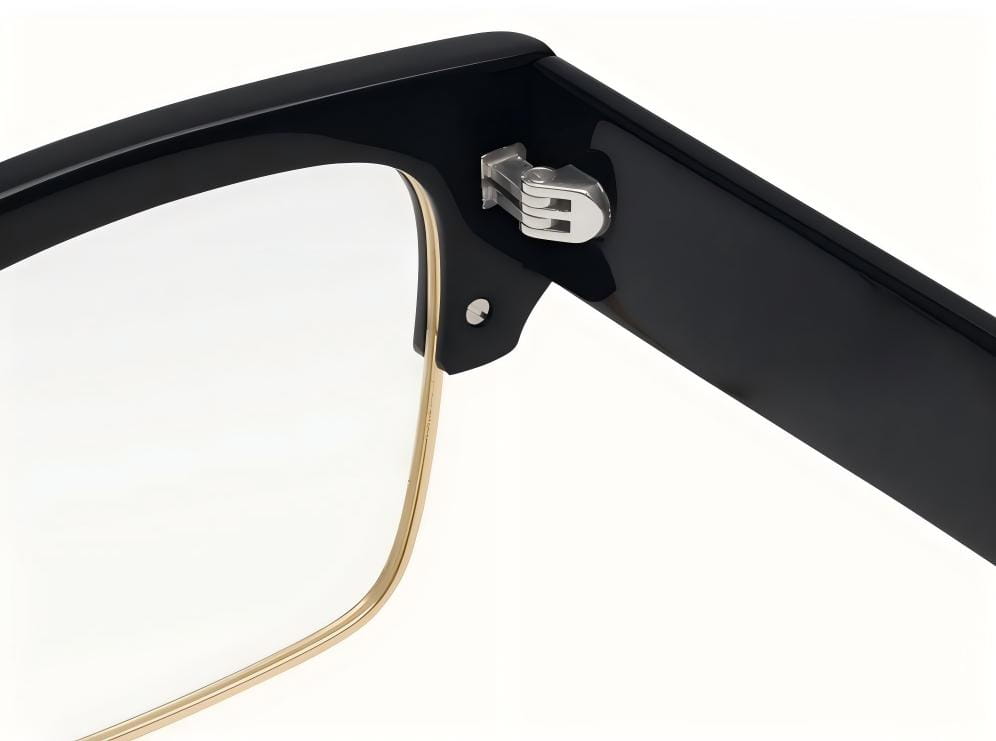
The hinge is the only moving part on a pair of sunglasses, making it the most common point of failure. Your eyewear sample testing must ruthlessly evaluate hinge mechanics.
Open and close the temples twenty times. The motion should feel smooth and offer a consistent, buttery resistance.
-
The Drop Test: Hold the frame by the front rims with the temples fully extended. Gently shake the frame. If the temples immediately flop down, the hinge screws are too loose or the factory used low-grade barrel hinges.
-
Spring Hinge Tension: If you specified spring hinges, pull the temple outward past its resting point. The spring should feel firm, not spongy, and snap back sharply.
-
Flush Assembly: Run your thumb over the junction where the temple meets the front frame. The two pieces of material should align perfectly flush. If you feel a sharp lip or an uneven gap, the factory’s CNC milling calibration is flawed.
Surface Finish and Treatment Inspection
Consumers buy with their eyes. The surface finish dictates whether your sunglasses look like a $20 gas station pair or a $200 luxury accessory.
Take the sample into a dark room and shine a harsh LED flashlight directly onto the frame.
-
For Polished Acetate: The light should reveal a flawless, liquid-glass shine. If you see tiny, circular swirl marks or dull patches, the factory rushed the tumbling and hand-polishing phases.
-
For Matte/Rubberized TR90: Scratch the inside of the temple lightly with your fingernail. A premium rubberized PU paint coating will resist the scratch. If the paint flakes off easily, the factory failed to apply the proper adhesion primer before painting.
Predicting Bulk Consistency: Managing Expectations
Here is a crucial factory secret: your first prototype is often handmade.
When a factory cuts a single sample, an artisan might spend three hours hand-polishing that specific frame. During mass production, machines handle the bulk of that work. Therefore, you must use your eyewear sample testing to set realistic expectations for bulk consistency.
If you design a frame with incredibly sharp, aggressive geometric angles, a handmade sample might capture those edges perfectly. However, during bulk production, industrial tumbling barrels naturally round off sharp edges slightly. Ask your manufacturer explicitly: “Which details on this sample will change during automated bulk production?” A transparent factory, like Zhantai, will tell you exactly how the mass-manufacturing process alters the final aesthetic, allowing you to tweak the CAD design before cutting expensive steel molds.
Your Downloadable Sample Evaluation Checklist
To streamline your procurement workflow, use this actionable checklist every time a new sample arrives at your office. Distribute this to your QA team:
I. Unboxing & Dimensions
-
Frame sits perfectly flat on a glass table without wobbling.
-
Frame width matches CAD spec (± 1mm).
-
Bridge width matches CAD spec (± 1mm).
-
Temple length matches CAD spec (± 1mm).
II. Materials & Hardware
-
Acetate frames feature a clean, visible wire core with no trapped air bubbles.
-
TR90 frames flex past 90 degrees and return instantly without stress marks.
-
Hinge movement is smooth with consistent resistance.
-
No gaps or sharp lips exist at the temple-to-frame junction.
III. Lens & Optical Performance
-
Spectrometer confirms 100% UV400 blocking.
-
LCD screen test confirms true polarization.
-
Back-surface AR coating exhibits a faint, uniform hue (green/blue/purple) under harsh light.
-
Drop-ball safety test passed (no shattering).
IV. Finish & Cosmetics
-
LED flashlight inspection reveals zero polishing swirl marks or dull patches.
-
Paint/matte coatings pass the fingernail adhesion scratch test.
-
Brand logo is crisp, centered, and fully filled with ink/foil.
Conclusion: Testing Builds Partnerships
Do not view eyewear sample testing as a chore; view it as the ultimate communication tool between you and your manufacturer.
When you provide a factory with a detailed, highly technical feedback report—pointing out a 1mm gap in the hinge or a slightly weak AR coating reflection—you command instant respect. You prove that you are a serious B2B buyer who understands the mechanics of optical engineering.
At Wenzhou Zhantai Glasses Co., Ltd., we thrive on this level of scrutiny. We invite our clients to test our hinges, verify our polarization, and measure our CNC tolerances. When we align our manufacturing precision with your rigorous testing protocols, we eliminate production risks and guarantee that every pair of sunglasses in your bulk order matches the exact vision you designed.
Read More
Eyewear Seasonal Sourcing Calendar: When to Order Sunglasses for Every Retail Season
Wholesale Guide: Why Square Sunglasses Mens are a Top Seller in 2026