Photochromic lenses have transformed the eyewear industry by offering dynamic light adaptation. Instead of switching between standard optical glasses and heavy sunglasses, these lenses automatically adjust their Visible Light Transmission (VLT) based on environmental ultraviolet (UV) exposure.
This guide breaks down the core technology, performance variables, and structural applications of photochromic lenses for modern eyewear collections.
How Photochromic Technology Actually Works
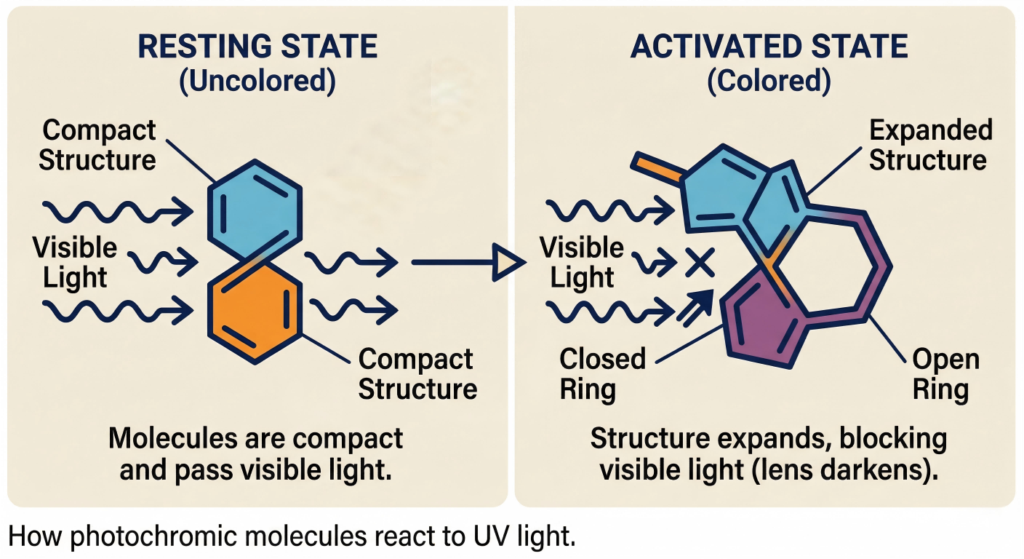
The ability of a lens to shift from transparent indoors to a dark tint outdoors relies on a precise, reversible chemical reaction.
Embedded within the lens material or applied as a front-surface coating are millions of photochromic molecules, typically oxazines or naphthopyrans. When these molecules are exposed to UV radiation from the sun, their chemical bonds absorb the energy and physically change structure. This new structural formation absorbs visible light, causing the lens to darken.
Once the UV source is removed—such as when you step inside a building—the molecules gradually snap back to their original resting state, and the lens returns to being perfectly clear.
Key Functional Benefits
-
Continuous UV Protection: Regardless of whether the lens is in its clear or darkened state, the material actively blocks 100% of harmful UVA and UVB radiation.
-
Blue Light Filtration: The molecular structure naturally absorbs a significant portion of high-energy visible (HEV) blue light emitted by digital screens and artificial lighting, reducing digital eye strain.
-
Dynamic Glare Reduction: By constantly adapting to exact ambient lighting conditions, these lenses optimize visual acuity and drastically reduce eye fatigue compared to static tinted lenses.
Factors Influencing Transition Performance
The speed, depth of color, and fade-back time of a photochromic lens are not static. They are heavily influenced by environmental conditions and manufacturing methods.
| Factor | Impact on Lens Performance |
| UV Intensity | Direct sunlight triggers maximum darkness. Inside a vehicle, standard photochromic lenses will not fully darken because modern car windshields are built to block UV rays. |
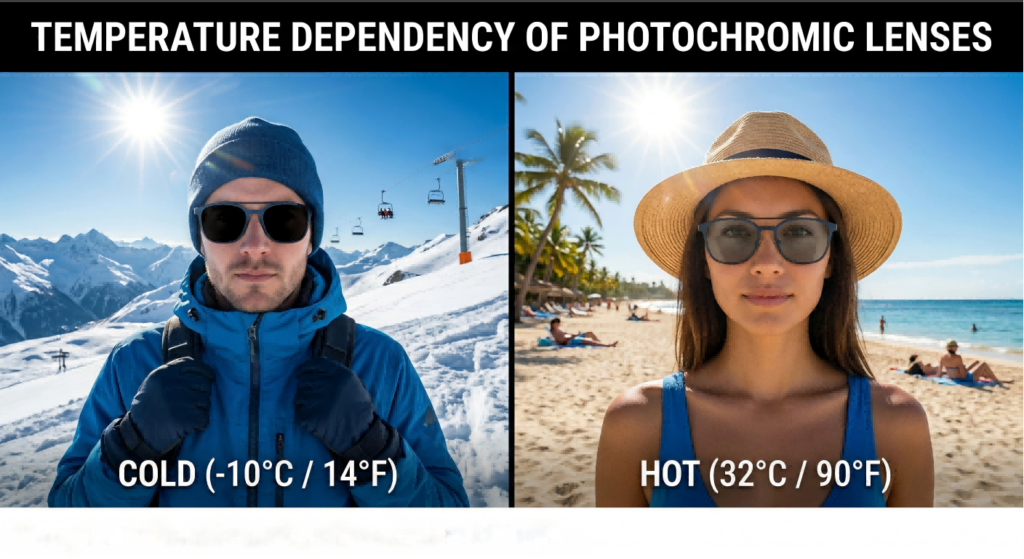
| Temperature | The chemical reaction is highly temperature-dependent. Lenses achieve their darkest tint—and transition fastest—in cold weather. In extreme heat, the molecules struggle to maintain their altered state, resulting in a lighter maximum tint. |
| Manufacturing Process | Spin Coating: Molecules are applied directly to the surface, ensuring rapid and uniform darkening regardless of lens thickness. In-Mass: Molecules are mixed into the raw polymer before molding. This is highly durable but can cause uneven tinting on high-index prescription lenses with varying thicknesses. |

Frame Pairings and Aesthetic Integration
Photochromic technology integrates seamlessly into modern optical designs, allowing for extreme versatility without compromising style.
For a lightweight, minimalist everyday solution, photochromic lenses pair exceptionally well with clear or transparent frames, drawing focus purely to the adaptive nature of the lens. Alternatively, housing these intelligent lenses in a classic Tortoise frame provides a timeless, professional aesthetic that functions brilliantly in an office environment and provides essential sun protection during a lunchtime commute.
FAQ: How Lens Substrates Impact Photochromic Performance
While frame pairings dictate the aesthetic, the lens substrate completely dictates how well the photochromic film adheres, reacts, and survives over time. Here is how different base materials interact with photochromic technologies on the manufacturing floor.
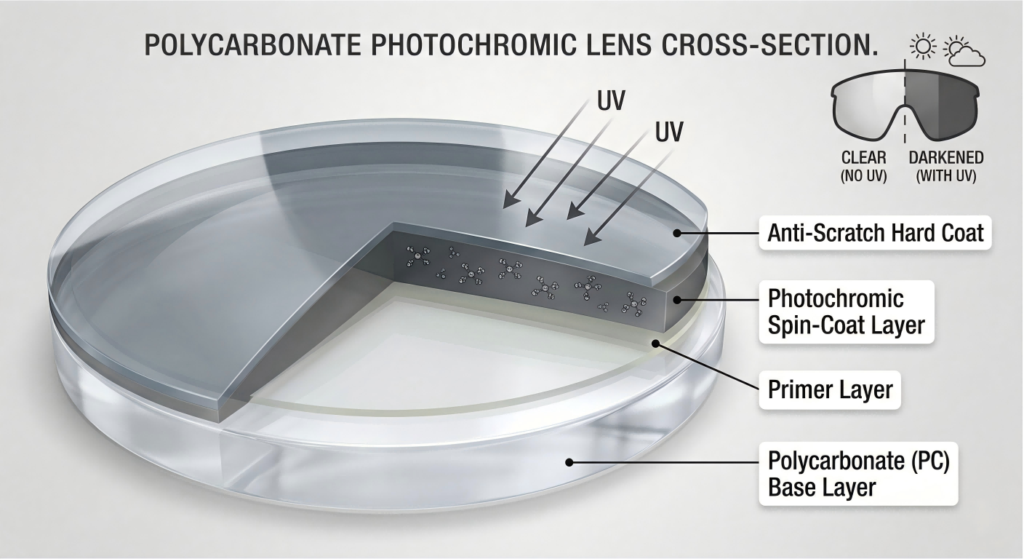
How does Polycarbonate (PC) interact with photochromic coatings?
Polycarbonate is the industry standard for impact-resistant sports eyewear. However, applying photochromic technology to PC presents a unique engineering challenge.
Polycarbonate naturally blocks 100% of UV rays. Since photochromic molecules require UV light to activate, manufacturers cannot mix the molecules directly into the PC raw material (the “in-mass” method). Instead, engineers must apply a highly specialized photochromic layer to the front surface of the lens via spin-coating or lamination. To ensure the coating does not peel or scratch off the slick PC surface, manufacturers apply a dedicated primer and a protective hard-coat over the top.
Can you put photochromic coatings on TR90?
We often hear buyers ask about “TR90 lenses.” It is important to clarify that TR90 is an advanced thermoplastic designed exclusively for eyewear frames, not lenses. TR90 offers incredible flexibility and shape-memory, making it the perfect housing for high-performance lenses. For the lenses themselves, manufacturers typically pair TR90 frames with Polycarbonate, TAC (Tri Acetate Cellulose), or Nylon lenses, applying the photochromic treatments to those specific optical substrates.
What is the difference between coating CR-39 and Nylon lenses?
-
CR-39 (Standard Optical Plastic): This material absorbs photochromic treatments exceptionally well. Manufacturers often use the “imbibition” process, where heat and chemicals draw the photochromic molecules deep into the surface of the plastic. This creates a highly durable, fade-resistant tint that will not peel.
-
Nylon Lenses: High-end sports and luxury fashion sunglasses often use Nylon because of its superior optical clarity and lightweight profile. Engineers typically use advanced spin-coating techniques for Nylon. The photochromic layer adheres beautifully to Nylon, providing rapid transition speeds while maintaining the lens’s premium, glass-like clarity.
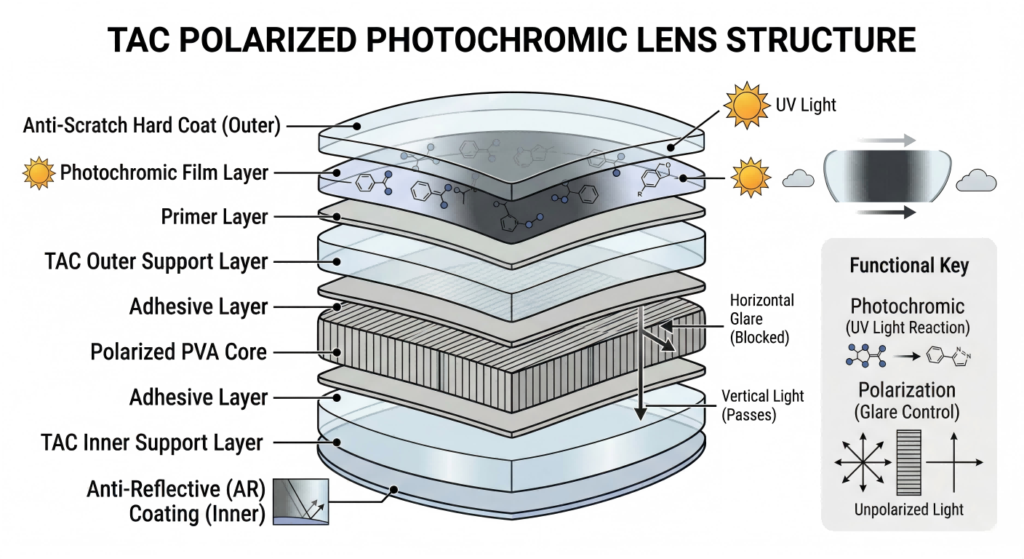
Do polarized TAC lenses support photochromic features?
Yes, but manufacturers use a totally different process. TAC (Tri Acetate Cellulose) lenses consist of multiple thin layers of film pressed together. Instead of spraying a coating, engineers embed a specific photochromic film layer directly into the TAC sandwich, right next to the polarized filter. This delivers a lightweight, glare-killing lens that darkens in the sun, making it the ultimate setup for driving and water sports.
Conclusion
Photochromic lenses represent a vital intersection of optical health, material science, and daily convenience. By understanding the mechanics behind UV reactivity, temperature dependence, and substrate compatibility, buyers and consumers can make highly informed decisions regarding adaptive eyewear.
At Zhantai Glasses, we integrate advanced photochromic lens technologies into our rigorous OEM and ODM manufacturing processes. Whether you are developing a new line of TR90 activewear frames or premium optical collections requiring complex spin-coated Nylon lenses, we provide the technical expertise to ensure your eyewear performs flawlessly in any light. With our robust manufacturing hub and dedicated Thailand factory, we deliver precision, scale, and uncompromising quality for global brands.