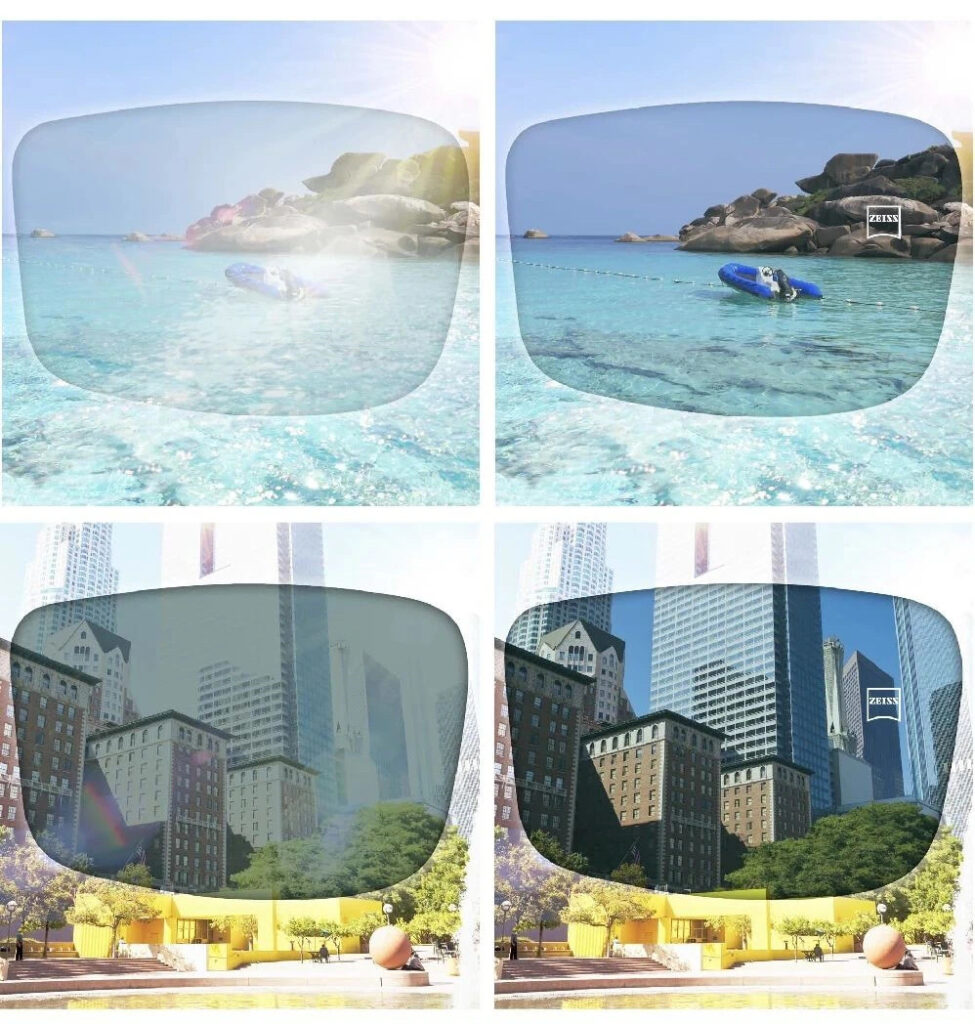
Polarized sunglasses use a directional filter to reduce reflected glare from surfaces such as roads, water, glass, and vehicle hoods. However, for B2B buyers, confirming that a lens is polarized is only the first step. The polarization axis, lens material, mounting pressure, color consistency, surface treatments, and bulk inspection method can all affect the final product.
A lens may reveal the hidden image on a polarization test card and still create problems after assembly. Its left and right axes may not match. The frame may apply excessive pressure. A mirror coating may show pinholes, or one lens may appear darker than the other.
This article explains the practical factory tests buyers should request before approving a polarized sunglasses order.
Key Takeaways
-
A polarization test card confirms the presence of a polarizing filter, but it does not prove complete product quality.
-
The LCD rotation test helps identify polarization function and obvious left-right axis differences.
-
TAC and PC polarized lenses serve different cost, weight, impact-resistance, and product-positioning requirements.
-
Lens installation can introduce pressure that causes rainbow patterns, distortion, or visual discomfort.
-
Bulk QC should cover polarization, axis direction, lens color, surface quality, fitting pressure, frame symmetry, and packaging.
What Are Polarized Sunglasses and How Do They Reduce Glare?
-
Less reflected brightness
-
Better visual comfort outdoors
-
Improved visibility on roads or water
-
Stronger perceived contrast in some environments
-
Reduced need to squint in glare-heavy conditions
-
A very dark lens can be non-polarized.
-
A relatively light lens can still be polarized.
-
Lens darkness does not measure polarization strength.
-
UV protection and polarization are separate specifications.
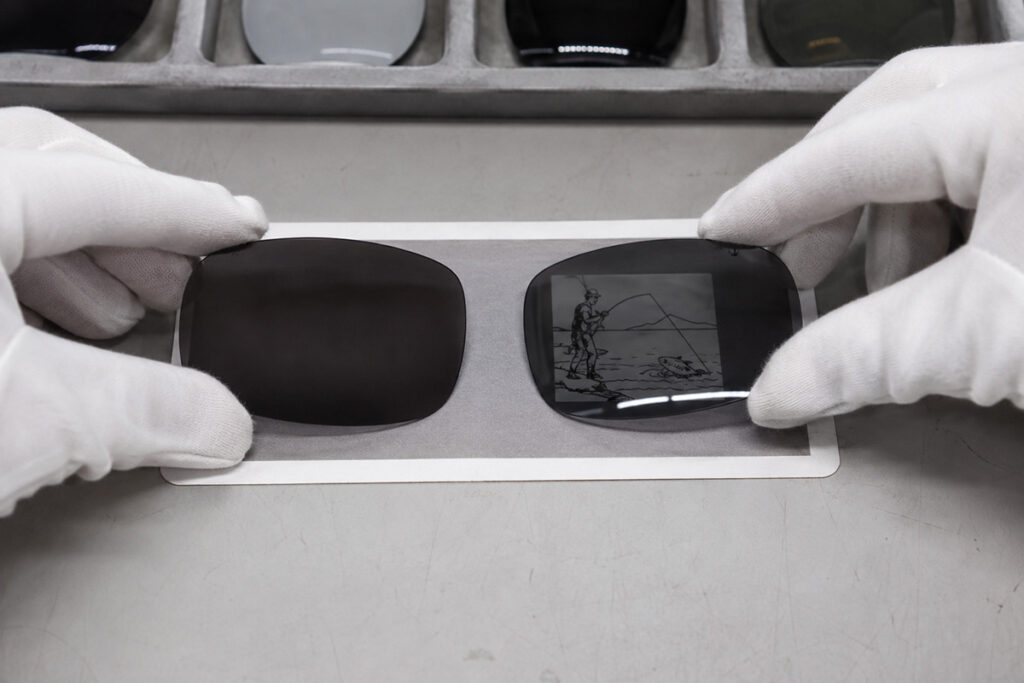
Polarization Test Card: The Fastest Factory Check
What an Ordinary Tinted Lens Shows
-
The hidden image remains invisible.
-
The image remains extremely faint.
-
The card only looks darker overall.
-
Rotating the lens produces little meaningful change.
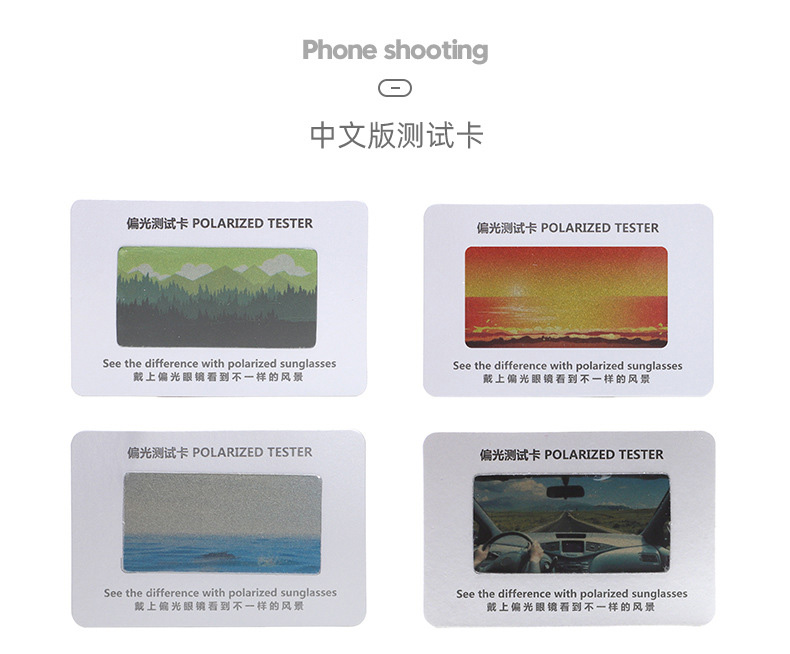
What a True Polarized Lens Shows
-
Clearly visible
-
Repeatable
-
Similar through both lenses
-
Easy to distinguish from the ordinary tinted-lens result
Practical Test-Card Procedure
-
Place the test card under stable, neutral lighting.
-
View the card without any lens.
-
Hold an ordinary tinted lens over the card.
-
Record whether the hidden pattern appears.
-
Repeat the test with the polarized lens.
-
Test the left and right lenses separately.
-
Compare several finished sunglasses from different cartons.
-
Separate pieces showing weak or inconsistent results.
What the Test Card Cannot Confirm
-
Polarization-axis accuracy
-
Left-right axis matching
-
Lens optical distortion
-
Mounting pressure
-
Coating adhesion
-
Surface quality
-
Lens color consistency
-
Long-term durability
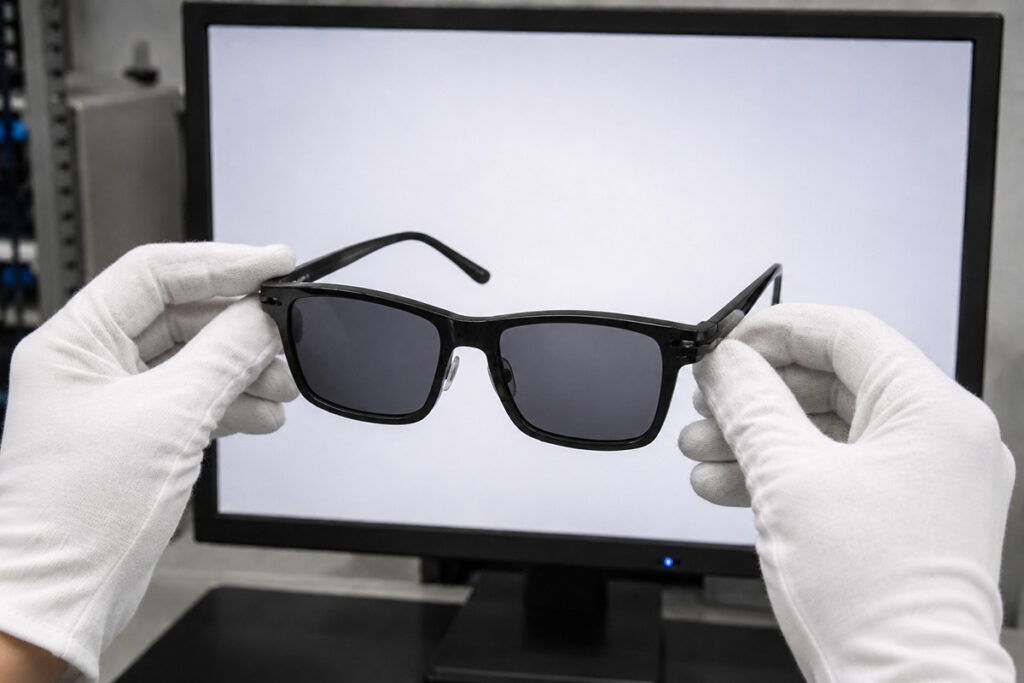
Why Does an LCD Screen Become Dark During Rotation?
-
More light passes at some angles.
-
Less light passes at other angles.
-
The screen becomes darkest when the two relevant polarization directions approach a blocking relationship.
-
At or near the strongest blocking angle, the display may appear almost black.
Factory LCD Rotation Test
-
Display a bright white screen on a phone, tablet, or monitor.
-
Hold the finished sunglasses in front of the screen.
-
Keep the frame parallel to the display.
-
Rotate the frame slowly.
-
Observe the gradual change from bright to dark.
-
Identify the darkest angle.
-
Repeat the test through each lens.
-
Compare the results between the left and right sides.
A Normal Result
-
Clear darkening during rotation
-
A repeatable darkest position
-
Similar behavior in the left and right lenses
-
No large irregular bright or colored patches
Abnormal Results
-
No darkening: The lens may not be polarized.
-
Weak darkening: The polarizing effect may be weak or the test position may be unsuitable.
-
Different dark angles: The left and right polarization axes may not match.
-
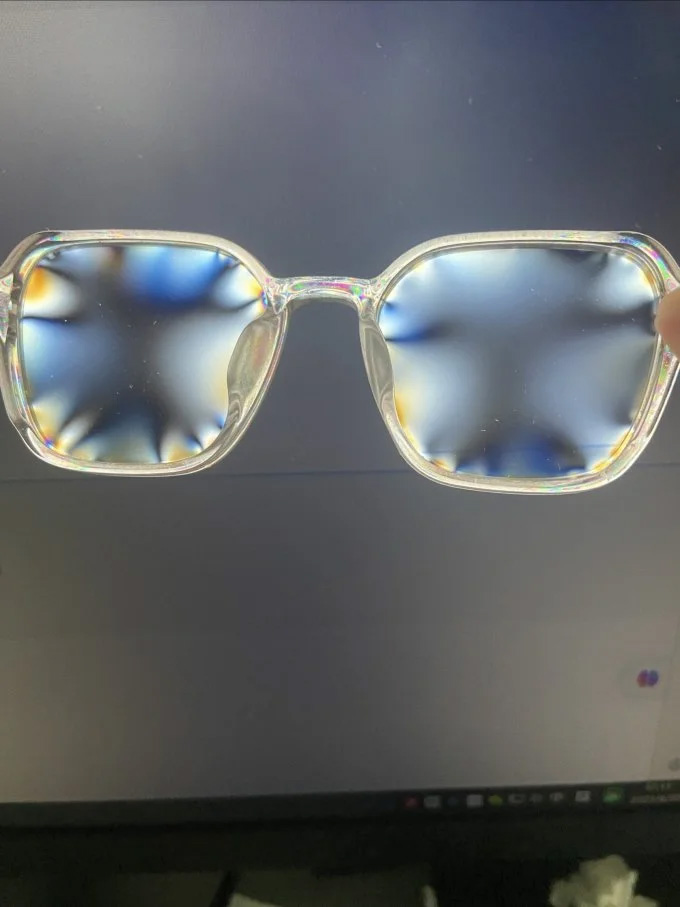
Uneven dark patches: The lens may have internal stress or assembly pressure.
-
Strong rainbow patterns: The lens or frame installation may be creating stress.
Why Does Polarization-Axis Direction Matter?
What Happens When Left and Right Axes Do Not Match?
-
Uneven glare reduction between the two eyes
-
Different LCD-screen darkness through each lens
-
An imbalanced visual sensation
-
Eye fatigue during extended wear
-
Reduced comfort while driving or looking at water
-
A feeling that one side is clearer or darker than the other
Common Causes of Axis Misalignment
-
Incorrect orientation of the lens blank
-
Cutting-position errors
-
Left and right lenses mixed during production
-
Rotation during lens fitting
-
Inaccurate or missing axis marks
-
Weak workstation controls
-
Incomplete final inspection
Factory Axis-Checking Method
-
Confirm the lens blank’s axis marking before cutting.
-
Keep the reference direction visible during lens layout.
-
Cut the left and right lenses according to the approved orientation.
-
Install both lenses in the final frame.
-
Rotate the finished sunglasses in front of an LCD screen.
-
Compare the darkest angle of both lenses.
-
Use a dedicated axis-checking instrument when the order specification requires tighter control.
-
Reject or rework products with visible left-right differences.
TAC vs PC Polarized Lenses: Which Should Buyers Choose?
| Comparison Item | TAC Polarized Lens | PC Polarized Lens |
| Relative factory cost | Generally lower to medium | Generally medium to higher |
| Weight | Lightweight | Lightweight to medium |
| Impact resistance | Moderate | Higher |
| Typical structure | Laminated multilayer lens | PC-based molded or integrated structure |
| Commercial position | Fashion, driving, wholesale, general outdoor | Sports, active use, durability-focused programs |
| Common advantage | Cost-performance and broad commercial use | Stronger impact performance |
| Main production risk | Edge separation, layer bonding, moisture exposure | Molding stress, optical distortion, coating compatibility |
| Best-fit order | Cost-sensitive and mid-market programs | Performance and higher-impact programs |
TAC Polarized Lenses
-
Competitive factory cost
-
Low weight
-
Commercially effective glare reduction
-
Broad color possibilities
-
Compatibility with many fashion frames
-
Suitability for medium- and high-volume orders
-
Layer bonding
-
Lens-edge quality
-
Cutting cleanliness
-
Moisture exposure
-
Surface scratches
-
Edge separation
-
Coating compatibility
PC Polarized Lenses
-
Higher impact resistance
-
Better suitability for sports programs
-
Stronger durability positioning
-
Compatibility with some molded or curved structures
-
Better fit for active, outdoor, or safety-conscious customers
-
Internal molding stress
-
Optical distortion
-
Uneven thickness
-
Coating incompatibility
-
Higher material or processing cost
-
Rainbow stress patterns after assembly
How Buyers Should Choose
-
Competitive cost
-
Fashion positioning
-
Driving or general outdoor use
-
Lightweight construction
-
Large commercial orders
-
Higher impact resistance
-
Sports or active use
-
Durable product positioning
-
More demanding use conditions
-
A retail price that supports the higher specification
Why Must Polarized Lenses Be Checked After Assembly?
Signs of Mounting Stress
-
Rainbow-colored patches
-
Bright and dark stress zones
-
Wavy visual distortion
-
Local color changes
-
Warped lens surfaces
-
Uncomfortable vision
-
Uneven left-right appearance
-
Stress concentrated near corners or edges
Why the Problem Occurs
-
Lens diameter cut too large
-
Incorrect bevel angle
-
Uneven frame groove
-
Excessive force during fitting
-
Too much heating
-
Mismatch between frame and lens curvature
-
Frame deformation
-
Uneven screw pressure in metal frames
-
Inaccurate lens shape
Assembly-Stress Inspection
-
Inspect the loose lens before assembly.
-
Record its appearance in front of an LCD screen.
-
Fit the lens into the frame.
-
Rotate the finished sunglasses in front of the same screen.
-
Look for new rainbow or uneven dark patterns.
-
Inspect the lens edges and frame corners.
-
Compare both lenses.
-
Remove and refit the lens if a strong stress pattern appears.
-
Correct the lens size, bevel, groove, or frame alignment.
-
Approve the final structure before starting mass production.
Does Lens Color Affect Polarization Strength?
Gray Polarized Lenses
-
Driving
-
Travel
-
Daily outdoor wear
-
General retail collections
-
Black, gray, silver, or transparent frames
Brown or Tea Polarized Lenses
-
Driving
-
Lifestyle collections
-
Outdoor use
-
Tortoise frames
-
Transparent champagne frames
-
Gold or brown metal frames
Green Polarized Lenses
-
Outdoor programs
-
Classic sunglasses
-
Premium-inspired collections
-
Black and tortoise frames
-
Gold and gunmetal frames
Does a Darker Lens Polarize More Strongly?
-
Dark and non-polarized
-
Light and polarized
-
Dark with weak axis control
-
Light with effective glare reduction
-
Lens color
-
Visible-light transmission
-
Polarization function
-
UV performance
-
Axis direction
-
Optical quality
Can Polarized Lenses Use Mirror, Gradient, and Functional Coatings?
Mirror Coating
-
Sports sunglasses
-
Fashion collections
-
Fishing products
-
Outdoor programs
-
Strong visual merchandising
-
Mirror color consistency
-
Pinholes
-
Edge coverage
-
Adhesion
-
Scratches
-
Left-right reflection matching
-
Color shift after lens forming or fitting
Gradient Polarized Lenses
-
Polarization function
-
Gradient color and transition
-
Axis direction
-
Upper darkness
-
Lower transparency
-
Gradient position
-
Overall color
Hydrophobic Treatment
-
Outdoor collections
-
Fishing
-
Travel
-
Sports products
-
Premium programs
Oleophobic Treatment
-
Easier cleaning
-
Improved retail presentation
-
Better consumer experience
-
Premium product positioning
Risks of Complex Coating Combinations
-
Poor adhesion
-
Edge peeling
-
Color changes
-
Surface haze
-
Uneven reflection
-
Reduced durability
-
Higher rejection rates
-
Longer production lead time
What Are Polarized Sunglasses Quality Risks in Bulk?
Polarization Risks
-
Non-polarized lenses mixed into the order
-
Weak or unclear test-card effect
-
Inconsistent LCD darkening
-
Material variation between supplier batches
-
Incorrect lens orientation
Pair-Matching Risks
-
One lens darker than the other
-
Different polarization axes
-
Different visible-light transmission
-
Unequal mirror reflection
-
Different gradient positions
-
Warm and cool color mismatch
Surface Risks
-
Scratches
-
Dust
-
Haze
-
Mirror pinholes
-
Coating marks
-
Edge peeling
-
Fingerprints or oil
-
Inconsistent hydrophobic appearance
Assembly Risks
-
Lens gaps
-
Oversized lenses
-
Excessive pressure
-
Incorrect bevel
-
Uneven frame groove
-
Frame distortion
-
Loose screws
-
Incorrect lens orientation
Zhantai Bulk QC Process for Polarized Sunglasses
-
Incoming Lens Inspection
-
Confirm the lens material.
-
Check the supplier and material batch.
-
Verify the specified color.
-
Test polarization with a test card.
-
Conduct an LCD rotation check.
-
Inspect the lens surface.
-
Review coating appearance.
-
Separate abnormal lenses.
-
Axis and Cutting Control
-
Confirm polarization-axis markings.
-
Maintain the intended lens orientation.
-
Separate left and right lenses.
-
Control lens shape and dimensions.
-
Inspect the bevel.
-
Prevent color or batch mixing.
-
Keep the approved reference at the workstation.
-
Assembly Inspection
-
Confirm that the lens sits evenly in the groove.
-
Check for lens gaps.
-
Compare left and right colors.
-
Rotate the finished frame against an LCD screen.
-
Look for rainbow stress patterns.
-
Check lens distortion.
-
Verify frame symmetry.
-
Test screw and hinge condition.
-
Surface and Coating Inspection
-
Scratches
-
Dust
-
Haze
-
Coating spots
-
Mirror pinholes
-
Edge peeling
-
Uneven color
-
Fingerprints
-
Left-right reflection consistency
-
Final Sampling
-
Polarization test-card verification
-
LCD rotation verification
-
Left-right axis comparison
-
Lens-color comparison
-
Surface-quality inspection
-
Mounting-stress inspection
-
Frame-symmetry inspection
-
Hinge and screw inspection
-
Logo and packaging inspection
-
Carton-to-carton comparison
-
Batch and Carton Comparison
-
Early production
-
Middle production
-
Late production
-
Different packing cartons
-
Different lens-material lots where applicable
Polarized Lens QC Comparison Table
| QC Item | Test Method | Acceptable Result | Common Failure |
| Polarization function | Polarization test card | Hidden image appears clearly | No image or weak image |
| LCD rotation | Rotate lens against an LCD screen | Screen darkens clearly at a repeatable angle | No or weak darkening |
| Axis consistency | Compare left and right lenses | Both reach darkness at similar angles | Different axis positions |
| Lens color | Compare under standard lighting | Left and right lenses match | One lens is darker, warmer, or cooler |
| Mounting stress | LCD or polarized-light inspection | No strong irregular rainbow pattern | Large colored stress patches |
| Surface quality | Bright-lamp inspection | Clean and uniform | Scratches, haze, dust, or peeling |
| Lens fitting | Frame and groove inspection | Even fit without excessive pressure | Gaps, distortion, or oversizing |
| Coating quality | Visual and adhesion checks | Uniform appearance and stable adhesion | Pinholes, color shift, or edge peeling |
| Frame assembly | Symmetry and function checks | Balanced front and stable hinges | Twisted frame or loose screws |
| Packaging | Packed-product inspection | Lens and frame remain protected | Scratching or pressure damage |
Common B2B Sourcing Mistakes
Treating the Test Card as a Complete Test
-
Axis alignment
-
Optical quality
-
Mounting pressure
-
Coating performance
-
Lens color
-
Frame assembly
How Should B2B Buyers Approve Samples?
-
Confirm TAC, PC, or another specified lens material.
-
Confirm lens color and visible-light requirements.
-
Test the lens using a polarization test card.
-
Conduct the LCD rotation test.
-
Compare left and right polarization axes.
-
Fit the lenses into the final production frame.
-
Inspect for mounting stress and distortion.
-
Approve mirror, gradient, hydrophobic, or oleophobic treatments.
-
Check frame symmetry and hinge function.
-
Approve several pre-production pieces.
-
Define acceptable bulk tolerances.
-
Retain signed physical samples for production and reorders.
Conclusion: Polarization Must Be Tested as a Finished Product
-
Correct axis direction
-
Matched left and right lenses
-
Suitable TAC or PC material
-
Stable lens color
-
Compatible surface coatings
-
Controlled frame-fitting pressure
-
Clean surface quality
-
Repeatable bulk inspection