Newsroom

News Release |

The Expert’s Blueprint: 5 Critical Signs of a World-Class Sunglasses Factory

In today’s highly saturated eyewear market, aesthetics can be deceiving. A frame may look stunning on a shelf or in a digital catalog, but as any seasoned sunglasses manufacturer will tell you, the true value lies in the workmanship.
Workmanship is the “soul” of glasses. It directly determines the service life, wearing comfort, and the stability of the wearer’s visual health. A truly excellent pair of glasses is a masterpiece of materials science and precision manufacturing, built to withstand tens of thousands of hinge cycles and years of exposure to skin oils and sweat.
As a leading sunglasses factory, we’ve compiled this expert guide to the five details that separate premium eyewear from low-quality imitations.

Surface Engineering: Depth and Luster

The surface finish is the first indicator of a factory’s technical grade.
Acetate Depth: High-quality cellulose acetate should feel “grown,” not “sprayed.” Premium frames undergo 72+ hours of drum tumbling followed by manual buffing. The surface should be as flat as a mirror, with no ripples or pits. When viewed under strong light from the side, the color should appear layered and deep within the material, rather than a flat tint on the surface.
Metal Plating (IP vs. Water): High-end metal frames (especially titanium) utilize Vacuum Ion Plating (IP). This process implants color molecules into the substrate, making it incredibly durable. In contrast, budget manufacturers often use “water plating,” which looks bright initially but scratches easily. Over time, water plating can lead to skin allergies or leave behind green oxidation marks on the temples.
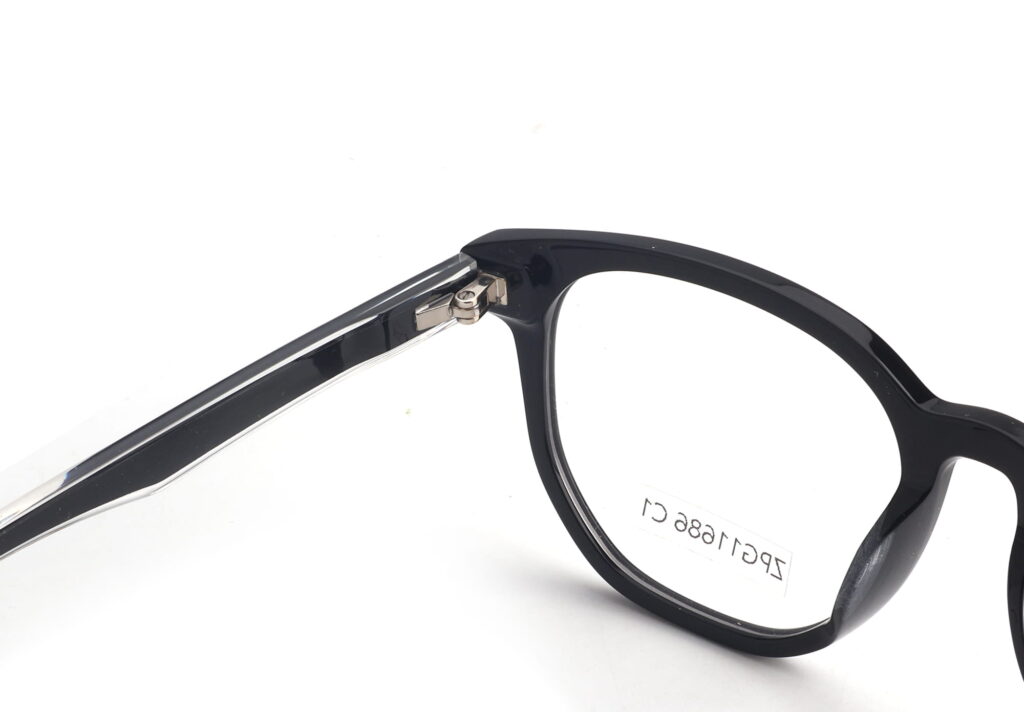
ZPG11686 readers eyeglasses

Connection Systems: The Mechanics of the Hinge

The hinge is the “heart” of the glasses, bearing almost all mechanical stress.
Functional Rivets vs. Decorative Stickers: In premium acetate frames, true rivets are functional—they penetrate the material to secure the hinge. You should see the metal pins on both the inside and outside. Cheap imitations use “heat-embedded hinges” where the external rivet is just a plastic or metal sticker. These lack the structural integrity required for long-term use.
Damping and Locking: A quality hinge should open with a “silky” resistance—neither loose nor crunchy. Look for Teflon-coated screws or locking washers. These are critical details that prevent the temples from becoming wobbly after a few months of wear.

Geometric Balance: The Four-Point Contact Principle

Structural balance is the reason why a pair of glasses stays on your face without sliding or pinching.

The Static Balance Test

Place the glasses unfolded and upside down on a flat glass surface:
Four-Point Contact: Both temple ends and both top edges of the frame should touch the surface simultaneously and steadily.
Folding Symmetry: When closed, the temples should stack neatly. One should not sit significantly higher or tilt outward more than the other.
Precision Tolerances: At a world-class sunglasses factory, manufacturing tolerances are strictly controlled within ±0.5mm. If you can see a visible twist in the frame with the naked eye, its structural stability is compromised.

Nose Pad Engineering: Pressure and Biocompatibility

The nose pads are the most concentrated pressure points on the face.
Welding Precision: Check the “pad arms” (the stalks holding the pads). High-quality welds are rounded, clean, and free of burrs or scorch marks. There should be no excess solder pile-up.
Material Choice: By 2026, premium manufacturers have transitioned almost exclusively to titanium nose pads or medical-grade silicone. Titanium pads do not turn yellow or develop odors from sweat, making them the gold standard for sensitive skin.

Micro-Processing: Edges, Engravings, and Integration

The gap between “good” and “great” is found in the corners most people ignore.
Edge Rounding: Run your finger along the inner side of the frame, especially where it touches the ears and nose. High-quality frames undergo a “de-burring” process to ensure every edge is smooth and radiused.
Engraving Sharpness: Look at the branding and specs on the inner temples. Premium manufacturers use deep laser engraving or high-definition stamping. The edges of the text should be razor-sharp and resistant to being rubbed off by sweat.
The V-Groove: Observe where the lens meets the frame. The groove should be consistent in depth. If there are gaps or “flashing” (excess material) squeezed out around the lens, the manufacturing precision is low.

Quality Identification Checklist

Use the table below as your quick-reference guide when auditing a sunglasses manufacturer:
Detail Premium Quality Low-Quality
Surface Mirror-like, deep color, no ripples Tool marks, dull luster, surface ripples
Hinge Functional rivets, countersunk screws Decorative stickers, screws sit above surface
Balance 4-point glass contact, symmetrical folding Uneven temples, twisted frame front
Welding Clean, rounded, no burn marks Rough scars, excess filler/solder
Touch Fully rounded edges, smooth inner feel Sharp edges, “sticky” or bubbling coating

Conclusion

Mastering these five details allows you to see past the marketing and evaluate a frame like an industry professional. Whether you are a brand looking for a reliable sunglasses factory or a consumer seeking a worthy investment, remember: quality is not an accident; it is the result of precision engineering.
Recent Posts

Round Sunglasses Women Want: A Sourcing Guide for Brands and Retailers


Why round sunglasses women sell all year Most eyewear buyers treat round sunglasses as a summer category. That assumption costs them money. Round frames for women have a different demand pattern than seasonal styles. Aviators and sport shields spike in Q2 and drop hard after August. Round frames stay flat through the year with mild […]

Round Sunglasses Women Want: A Sourcing Guide for Brands and Retailers
Full Article

From Retro to Modern: The Timeless Appeal of Sunglasses Round Mens Collections


Introduction Round sunglasses for men have been around for over a century. They were practical gear for pilots and soldiers before they became a style choice. Today, guys round sunglasses sit at the center of a quiet trend that most buyers don’t fully notice until they check their sales numbers. We’ve been making round frame […]

From Retro to Modern: The Timeless Appeal of Sunglasses Round Mens Collections
Full Article

2026 Sunglasses Trends: Which Styles to Watch?


Looking at the latest runway street snaps and fresh eyewear collections this year. One thing becomes abundantly clear: sunglasses are no longer just accessories. In 2026, they are the main character. In the past, we wore dark lenses simply to block the sun, make our faces look smaller, or hide tired eyes. But this year, […]

2026 Sunglasses Trends: Which Styles to Watch?
Full Article

Professional Service Process

OEM/ODM service

Learn about the cooperation process
FAQs

Q1: What is your production capacity for OEM/ODM sunglasses orders?

Our total annual output exceeds 20 million pieces. For our primary injection styles, our capacity is between 800,000 and 1,000,000 pieces per month, while our metal production lines output 400,000 to 600,000 pieces per month. This large-scale capability allows us to support high-volume orders for global supermarkets and chain stores reliably.

Q2: What kind of customization services do you provide for fast-fashion brands?

We offer a complete product and packaging one-stop service. Our R&D team develops over 50 new sample designs per month based on market research and trend analytics. We fully support custom frames, lenses, and LOGO customization to match your exact brand identity.

Q3: How long is the typical lead time for samples and bulk production?

We pride ourselves on speed and efficiency. We offer fast sample-making within 7 to 15 days. If your project requires a new mold, it typically takes 20 to 30 days. For bulk order production, our standard lead time is 30 to 60 days.

Q4: Do your sunglasses meet international quality and safety standards?

Absolutely. We strictly follow quality control steps from raw materials (IQC) to finished products (OQC). Our factory and products hold comprehensive professional qualification certificates, including CE, FDA, ISO 9001, ISO 13485, BSCI, SMETA, and the Global Recycled Standard.

Q5: Do you have experience working with major global retailers?

Yes, Wenzhou Zhantai Glasses has over 30 years of company history and extensive experience manufacturing for top supermarkets, ecommerce platforms, and global brands. Our recognized quality control has earned us partnerships with industry leaders like Walmart, Disney, Muji, Safilo, and QUAY. By working with us, you receive factory prices with no middlemen.

Q6: What types of eyewear materials do you manufacture?

We work with a wide variety of materials across our 3 production lines. Our capabilities include injection PC and TR, metal, acetate, and eco-friendly materials. This diverse material expertise allows us to meet the specific price points and design requirements of different fast-fashion brands and supermarkets.

Q7: What are your main product categories?

Our main products are sunglasses, optical glasses, and reading glasses. While we specialize in injection sunglasses for retail chains, we also have dedicated production lines for optical frames and reading glasses to provide a comprehensive eyewear catalog.

Q8: What is your Minimum Order Quantity (MOQ)?

As an OEM/ODM factory focusing on large-scale production, our standard MOQ is 1200 pieces per model for 3-4 colors. However, we offer flexible solutions for trial orders or specific customization needs. Please contact our sales team to discuss your project.

Q9: Do you have manufacturing facilities outside of China?

Yes, we do. In addition to our main 10,000-square-meter headquarters in Wenzhou, China, we also operate a specialized manufacturing facility in Thailand. Having a dual-country production strategy allows us to provide our global clients with highly flexible supply chain solutions, optimize import logistics, and mitigate international trade risks (such as tariffs). This ensures uninterrupted, high-capacity delivery for major supermarkets and brands.

Q10: What is your company’s background and manufacturing scale?

Wenzhou Zhantai Glasses was founded in 1990, giving us over 30 years of deep expertise in eyewear manufacturing. Our headquarters covers a construction area of over 20,000 square meters and employs more than 500 skilled workers. Thanks to the trust of our global clients, we maintain a highly stable operational status; our annual turnover continues to grow steadily, reaching $40 million in 2025, with a projected figure of $45 million in 2026. We are a financially strong and scalable partner ready for long-term collaboration.

Get in touch

Let’s build your vision together. Backed by 30 years of manufacturing excellence, Zhantai Glasses offers the quality and customization your brand needs to stand out. From concept to global distribution, we handle the details so you can focus on growth.

Let's collaborate for exceptional eyewear. We look forward to a meaningful collaboration.

Wenzhou Zhantai Glasses

Beiwei No.2 Street, Ouhai District, Wenzhou City, Zhejiang Province, China.

[email protected]