In today’s highly saturated eyewear market, aesthetics can be deceiving. A frame may look stunning on a shelf or in a digital catalog, but as any seasoned sunglasses manufacturer will tell you, the true value lies in the workmanship.
Workmanship is the “soul” of glasses. It directly determines the service life, wearing comfort, and the stability of the wearer’s visual health. A truly excellent pair of glasses is a masterpiece of materials science and precision manufacturing, built to withstand tens of thousands of hinge cycles and years of exposure to skin oils and sweat.
As a leading sunglasses factory, we’ve compiled this expert guide to the five details that separate premium eyewear from low-quality imitations.
Surface Engineering: Depth and Luster
The surface finish is the first indicator of a factory’s technical grade.
Acetate Depth: High-quality cellulose acetate should feel “grown,” not “sprayed.” Premium frames undergo 72+ hours of drum tumbling followed by manual buffing. The surface should be as flat as a mirror, with no ripples or pits. When viewed under strong light from the side, the color should appear layered and deep within the material, rather than a flat tint on the surface.
Metal Plating (IP vs. Water): High-end metal frames (especially titanium) utilize Vacuum Ion Plating (IP). This process implants color molecules into the substrate, making it incredibly durable. In contrast, budget manufacturers often use “water plating,” which looks bright initially but scratches easily. Over time, water plating can lead to skin allergies or leave behind green oxidation marks on the temples.
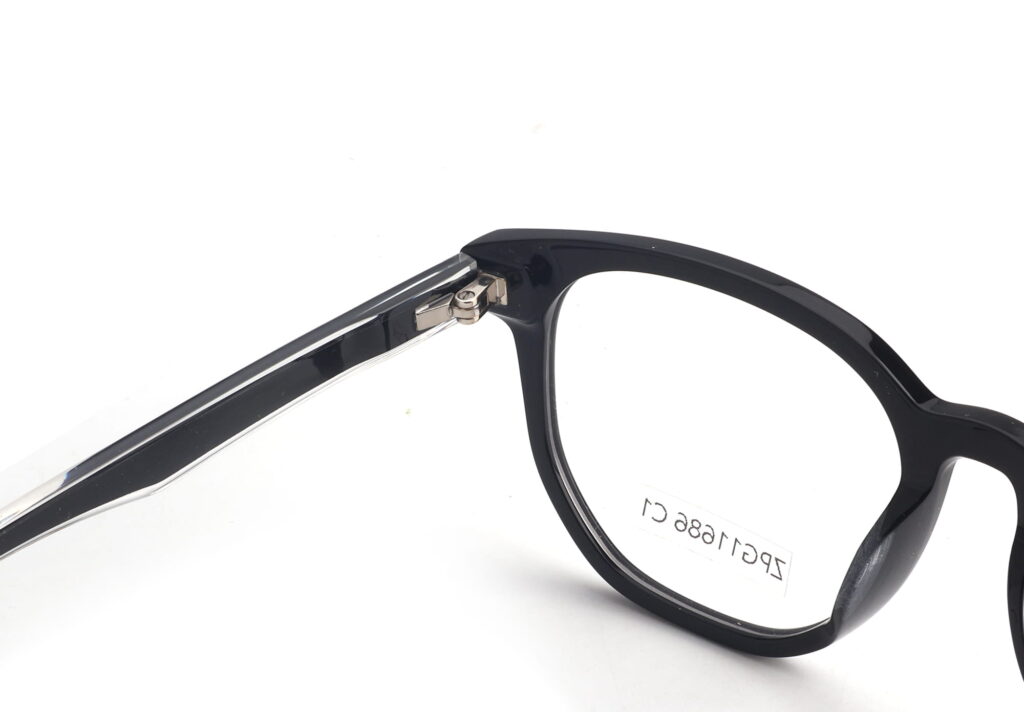
Connection Systems: The Mechanics of the Hinge
The hinge is the “heart” of the glasses, bearing almost all mechanical stress.
Functional Rivets vs. Decorative Stickers: In premium acetate frames, true rivets are functional—they penetrate the material to secure the hinge. You should see the metal pins on both the inside and outside. Cheap imitations use “heat-embedded hinges” where the external rivet is just a plastic or metal sticker. These lack the structural integrity required for long-term use.
Damping and Locking: A quality hinge should open with a “silky” resistance—neither loose nor crunchy. Look for Teflon-coated screws or locking washers. These are critical details that prevent the temples from becoming wobbly after a few months of wear.
Geometric Balance: The Four-Point Contact Principle
Structural balance is the reason why a pair of glasses stays on your face without sliding or pinching.
The Static Balance Test
Place the glasses unfolded and upside down on a flat glass surface:
Four-Point Contact: Both temple ends and both top edges of the frame should touch the surface simultaneously and steadily.
Folding Symmetry: When closed, the temples should stack neatly. One should not sit significantly higher or tilt outward more than the other.
Precision Tolerances: At a world-class sunglasses factory, manufacturing tolerances are strictly controlled within ±0.5mm. If you can see a visible twist in the frame with the naked eye, its structural stability is compromised.
Nose Pad Engineering: Pressure and Biocompatibility
The nose pads are the most concentrated pressure points on the face.
Welding Precision: Check the “pad arms” (the stalks holding the pads). High-quality welds are rounded, clean, and free of burrs or scorch marks. There should be no excess solder pile-up.
Material Choice: By 2026, premium manufacturers have transitioned almost exclusively to titanium nose pads or medical-grade silicone. Titanium pads do not turn yellow or develop odors from sweat, making them the gold standard for sensitive skin.
Micro-Processing: Edges, Engravings, and Integration
The gap between “good” and “great” is found in the corners most people ignore.
Edge Rounding: Run your finger along the inner side of the frame, especially where it touches the ears and nose. High-quality frames undergo a “de-burring” process to ensure every edge is smooth and radiused.
Engraving Sharpness: Look at the branding and specs on the inner temples. Premium manufacturers use deep laser engraving or high-definition stamping. The edges of the text should be razor-sharp and resistant to being rubbed off by sweat.
The V-Groove: Observe where the lens meets the frame. The groove should be consistent in depth. If there are gaps or “flashing” (excess material) squeezed out around the lens, the manufacturing precision is low.
Quality Identification Checklist
Use the table below as your quick-reference guide when auditing a sunglasses manufacturer:
| Detail | Premium Quality | Low-Quality |
| Surface | Mirror-like, deep color, no ripples | Tool marks, dull luster, surface ripples |
| Hinge | Functional rivets, countersunk screws | Decorative stickers, screws sit above surface |
| Balance | 4-point glass contact, symmetrical folding | Uneven temples, twisted frame front |
| Welding | Clean, rounded, no burn marks | Rough scars, excess filler/solder |
| Touch | Fully rounded edges, smooth inner feel | Sharp edges, “sticky” or bubbling coating |
Conclusion
Mastering these five details allows you to see past the marketing and evaluate a frame like an industry professional. Whether you are a brand looking for a reliable sunglasses factory or a consumer seeking a worthy investment, remember: quality is not an accident; it is the result of precision engineering.