Driving at night in 2026 presents a unique modern hazard. As automotive manufacturers universally upgrade their fleets with ultra-bright, high-intensity LED and HID headlights, nighttime glare has become a severe issue for drivers worldwide. This intense blue-white light causes visual fatigue, blinding halos, and momentary vision loss on dark roads.
To combat this, consumers rapidly turn to specialized eyewear. Night driving glasses, immediately recognizable by their distinct yellow lenses, have transitioned from niche catalog items into high-turnover retail essentials. For international supermarkets, auto-accessory retailers, and department stores, this product category represents a massive, high-margin revenue stream.
However, selling a highly functional product requires sourcing a product that actually works. If you sell a cheap, ineffective yellow plastic lens, the consumer will return it immediately. Choosing the right night driving glasses manufacturer dictates your optical quality, product safety, and ultimate retail profitability.
This comprehensive guide breaks down the science behind the yellow lens, identifies the exact buyer demographic, and explains how corporate buyers can successfully execute a yellow lens glasses wholesale order.
The Science: What Do Night Driving Glasses Actually Do?
To market these glasses effectively and source them accurately, retail buyers must understand the optical science behind the product. You cannot just put a yellow tint on a piece of plastic and call it a night driving lens. A premium night driving glasses manufacturer engineers these lenses to manipulate specific light wavelengths.
Filtering High-Energy Blue Light
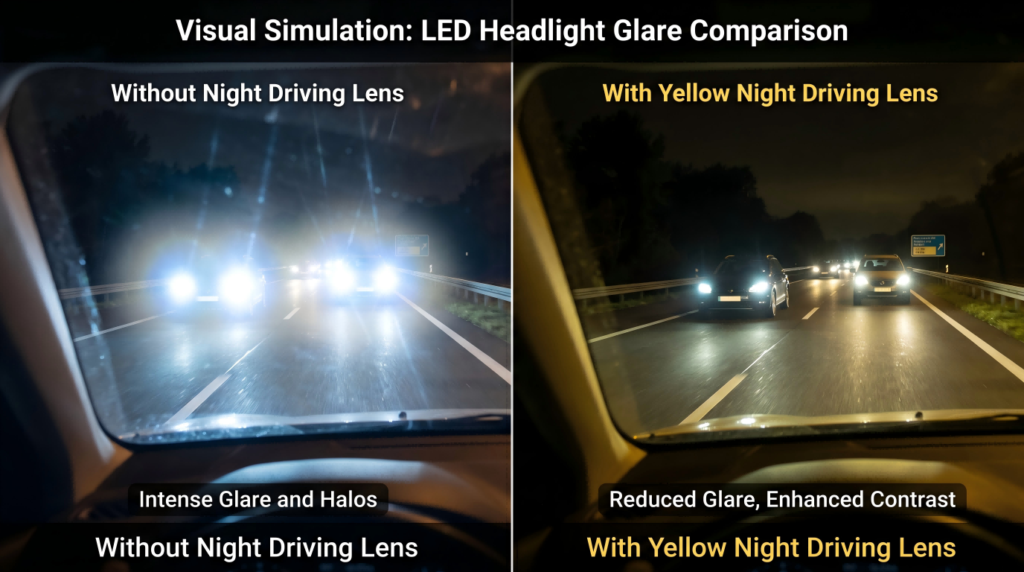
Modern LED car headlights emit a massive amount of high-energy visible (HEV) blue light. Because blue light features short wavelengths, it scatters easily when it enters the human eye. This scattering creates the blinding “halo” effect around oncoming headlights.
Yellow lenses sit on the opposite end of the color spectrum. The yellow dye actively absorbs and filters out these harsh blue light frequencies. By cutting the blue light, the lens instantly reduces the glare and eliminates the fuzzy halos around streetlamps and oncoming traffic.
Enhancing Contrast in Low Light
Yellow tints uniquely enhance visual contrast in low-light conditions. When you remove the hazy blue light from the driver’s field of vision, the remaining colors (reds, greens, and yellows) appear sharper and more defined. This makes it significantly easier for the driver to read street signs, spot lane markers, and identify pedestrians in the rain, fog, or fading dusk light.
The Critical Role of Anti-Reflective (AR) Coatings
The tint alone does not solve the entire problem. When you drive at night, light bounces off the internal and external surfaces of your eyewear lenses, creating internal reflections that distract the eyes.
A professional night driving glasses manufacturer always applies a multi-layer Anti-Reflective (AR) coating to both the front and back of the lens. The AR coating allows maximum light transmission through the lens to the eye (which is crucial for dark environments) while entirely eliminating the internal “ghosting” reflections caused by dashboard lights or streetlamps behind the driver.
The Target Demographic: Who Buys Them?
Understanding the end consumer dictates how you package, merchandise, and price your bulk inventory. Night driving glasses boast a surprisingly broad and highly motivated buyer demographic, making them an incredible impulse purchase for large retail chains.
The Daily Commuter and Professional Driver
Long-haul truck drivers, delivery couriers, and daily commuters who drive home after sunset form the primary customer base. These individuals experience severe eye fatigue from staring at headlights for hours. They actively seek out tools that make their drive safer and less physically exhausting.
The Aging Driver
As the human eye ages, the pupil shrinks, and the internal lens becomes slightly cloudy. This natural process makes older drivers highly sensitive to bright glare and significantly reduces their contrast sensitivity in the dark. For the senior demographic, night driving glasses restore driving confidence and comfort.
Post-Surgical Eye Care Patients
Individuals who recently underwent LASIK surgery or cataract removal frequently experience heightened glare and “starbursts” around lights at night. Optometrists often recommend yellow-tinted glasses with heavy AR coatings to help these patients navigate night driving during their recovery periods.
The Supermarket Impulse Buyer
Because the problem of headlight glare is universal, this product thrives in high-traffic retail environments. When an everyday shopper walks through a supermarket and spots a well-merchandised display of night driving glasses near the automotive or seasonal aisle, the immediate recognition of their own driving frustration triggers an impulse purchase.

2026 Design Trends: Merging Function with Style
Historically, night driving glasses looked terrible. They often featured bulky, wrap-around designs that consumers felt embarrassed to wear. In 2026, fast-fashion brands and optical retailers have completely revamped the aesthetic. Consumers want glasses that look stylish enough to wear into a gas station or a late-night diner.
When you source yellow lens glasses wholesale, you must pair the functional lenses with trending frame materials to ensure rapid retail turnover.
The Modern Appeal of Clear and Transparent Frames
Heavy, opaque black frames can obstruct peripheral vision—a dangerous flaw for driving. Modern consumers demand high-gloss clear and transparent injection-molded plastics.
Pairing a vivid yellow lens with a sleek transparent frame creates a highly modern, almost cyberpunk aesthetic. The transparent frame catches the interior dashboard lights beautifully and feels visually weightless on the face. For retail buyers, stocking transparent options dramatically reduces inventory risk, as these futuristic styles appeal heavily to younger demographics and tech-forward consumers.
The Professional Sophistication of Tortoise
When shoppers want a frame that looks expensive and sophisticated, they immediately reach for the classic Tortoise pattern. Advanced injection molding technology allows factories to create rich, multi-dimensional Tortoise designs that look incredibly premium. A Tortoise frame paired with a yellow lens bridges the gap between a functional driving tool and a high-end fashion accessory.
Ultra-Lightweight TR90 Construction
Comfort dictates whether the consumer actually uses the product. Top-selling driving models strictly utilize advanced thermoplastic polymers like TR90. This Swiss-engineered material provides extreme flexibility. A TR90 frame rests weightlessly on the face, eliminating the pressure points on the nose and temples during a long, stressful drive.
Evaluating a Night Driving Glasses Manufacturer
Finding a factory capable of producing yellow plastic is easy. Finding a B2B partner capable of delivering thousands of flawless, optically precise, retail-ready units requires rigorous vetting. When your procurement team evaluates a night driving glasses manufacturer, you must demand excellence across the following operational pillars:
Optical Precision and Spectrophotometer Testing
You cannot accept cheap acrylic lenses that distort vision. A bad lens will cause headaches and increase driving danger. Your manufacturing partner must utilize premium Polycarbonate (PC) or CR-39 lenses with flawless optical centering. Furthermore, they must provide legitimate spectrophotometer testing reports proving that the yellow dye effectively absorbs the specific blue-light wavelengths emitted by LED headlights.
Expertise in Precision Injection Molding
To achieve the high profit margins required in fast-fashion and supermarket retail, you need a partner who masters high-speed precision injection molding. A premium manufacturer precisely controls the heating and cooling cycles, ensuring that every TR90 or Polycarbonate frame emerges with a flawless, high-gloss finish, entirely free of rough seams or structural weak points.
Uncompromising Quality Control (QC)
Driving glasses function as safety equipment. Your manufacturing partner must enforce strict, multi-stage quality control. This includes performing drop-ball impact tests on the lenses to ensure shatter resistance in the event of an airbag deployment, stress-testing the metal hinges, and verifying the exact application of the Anti-Reflective (AR) coatings before the cargo leaves the loading dock.
Global Logistics: The Thailand Factory Advantage
In 2026, international retail brands face significant logistical hurdles. Fluctuating shipping costs, strict customs inspections, and complex international trade tariffs require brands to build highly resilient supply chains.
If a buyer relies on a manufacturer confined to a single geographic location, they expose their entire retail operation to massive geopolitical risks. To provide international B2B clients with unparalleled stability and highly competitive pricing, premium manufacturers operate diversified production hubs.
Utilizing a state-of-the-art Thailand factory alongside a Wenzhou headquarters offers immense strategic advantages when you order yellow lens glasses wholesale:
-
Tariff Mitigation: Utilizing a Thailand facility helps global brands bypass specific regional export tariffs, directly lowering the landed cost and protecting your retail profit margins.
-
Streamlined Americas Expansion: The demand for driving accessories is massive across North and South America. A Thailand facility provides a highly efficient shipping route to supply large-scale retail buyers rapidly expanding into Mexico, the United States, and Canada.
-
Guaranteed High-Volume Capacity: Operating multiple massive facilities ensures that the factory can dedicate specific injection machines entirely to your bulk orders, guaranteeing that your seasonal launches arrive exactly on time.
The Bulk OEM/ODM Ordering Process: A Step-by-Step Guide
Executing a high-volume custom order requires a highly organized workflow. Here is the exact step-by-step roadmap you experience when initiating a bulk order to stock your retail displays.
Step 1: Design Consultation and Technical Specifications
The process begins with your brand’s specific vision. Your buying team provides reference concepts and ideal retail price points to the engineering department. Together, you lock in the technical specifications. You decide whether to utilize a sleek transparent TR90 polymer or a classic Tortoise finish. You specify the exact yellow tint formulation and mandate the crucial Anti-Reflective (AR) lens coatings.
Step 2: 3D CAD Modeling and Physical Prototyping
Engineers generate precise 3D CAD (Computer-Aided Design) models of your driving frame. After you approve the digital files, the factory utilizes advanced CNC machining to produce a physical prototype. This allows your buyers to test the ergonomic fit, evaluate the hinge tension, and verify the optical clarity of the yellow lens before committing to mass production.
Step 3: Mold Creation and The MOQ Standard
Upon approval of the prototype, engineers cut the heavy steel injection molds. Because tooling these precision molds requires massive engineering labor, mass production relies heavily on economies of scale. To optimize the injection machines and deliver the lowest possible unit cost for corporate clients, premium factories operate with a strict Minimum Order Quantity (MOQ) of 1200 units per style. This volume guarantees production efficiency and protects your bottom line.
Step 4: High-Speed Mass Production and Assembly
With the molds locked into the machines, technicians inject the molten TR90 or Polycarbonate. Once the frames cool, the finishing team polishes the plastic to achieve a premium luster. The assembly department then installs the durable metal hinges, secures the AR-coated yellow lenses into the rims, and applies your custom brand logo to the temple arms via precision pad printing.
Step 5: Final Inspection and Freight Logistics
Before boxing the order, every single pair passes through rigorous Quality Assurance. Inspectors verify hinge tension, check lenses for microscopic scratches, and run random batch tests through the spectrophotometer. Finally, the logistics team packages the glasses according to your exact retail specifications and arranges direct freight shipping from the Thailand or Wenzhou facilities directly to your international distribution centers.
Conclusion
Night driving glasses are no longer a niche catalog gimmick; they are a highly profitable, foundational pillar of the modern automotive accessory and eyewear market. Their unique ability to filter blinding LED glare and enhance visual contrast makes them a mandatory inclusion for any fast-fashion brand, department store, or international supermarket chain looking to maximize revenue.
By pairing highly functional AR-coated yellow lenses with major consumer design trends—such as the massive demand for lightweight transparent frames and classic Tortoise patterns—you can curate an inventory that immediately captures consumer attention and drives high-volume impulse purchases.
More importantly, by sourcing your collections through a dedicated, high-capacity night driving glasses manufacturer who understands the exact science of optical tinting and precision injection molding, you secure the production scale required to dominate the competitive retail landscape. At Zhantai Glasses, we leverage our deep Wenzhou manufacturing heritage, our strategic Thailand production capabilities, and our commitment to flawless execution at an MOQ of 1200 units to deliver the exact manufacturing power your brand needs to succeed.