The winter sports market experiences massive, predictable growth every year as consumers seek high-performance gear. Among all snow sports accessories, goggles represent a highly technical and lucrative product line. A pair of ski goggles is not just a fashion accessory; it is a vital piece of protective equipment that shields the wearer from blinding alpine glare, extreme cold, high winds, and dangerous UV rays.
For brand owners, wholesale distributors, and sports retailers, expanding into winter eyewear requires a deep understanding of material science, lens mechanics, and production logistics. Launching a premium, reliable collection means finding a partner that offers technical expertise, stringent quality control, and scalable production.
Working with a reliable ski goggles manufacturer allows you to navigate the complexities of winter eyewear production smoothly. This comprehensive B2B sourcing guide breaks down everything you need to know about navigating snow goggles OEM China production lines to build a high-margin, market-dominating winter collection.
Frame Materials: Balancing Flexibility and Protection
Unlike standard sunglasses, ski goggles must perform in sub-zero temperatures. At $$-20^\circ\text{C$$, standard plastics become incredibly brittle. If a skier crashes, a brittle plastic frame can shatter into sharp fragments, causing severe facial or eye injuries.
Top-tier manufacturers build snow goggles almost exclusively using TPU (Thermoplastic Polyurethane).
-
Extreme Thermal Stability: TPU retains its rubbery elasticity and structural integrity in deep-freeze environments.
-
Impact Shock Absorption: The material flexes upon impact, absorbing kinetic energy and protecting the wearer’s face during a wipeout.
-
Ergonomic Fit: A TPU frame molds smoothly to the unique contours of different face shapes, ensuring a tight seal against freezing winds.
When negotiating with your ski goggles manufacturer, ensure they use virgin TPU rather than cheaper recycled blends. Virgin TPU guarantees that the frame will not yellow under heavy UV exposure or stiffen when the temperature drops.
Advanced Lens Engineering: Anti-Fog and Dual-Layer Systems
The biggest technical challenge in snow goggle engineering is managing condensation. When warm, humid air from the skier’s face meets the freezing outer lens surface, it instantly creates fog.
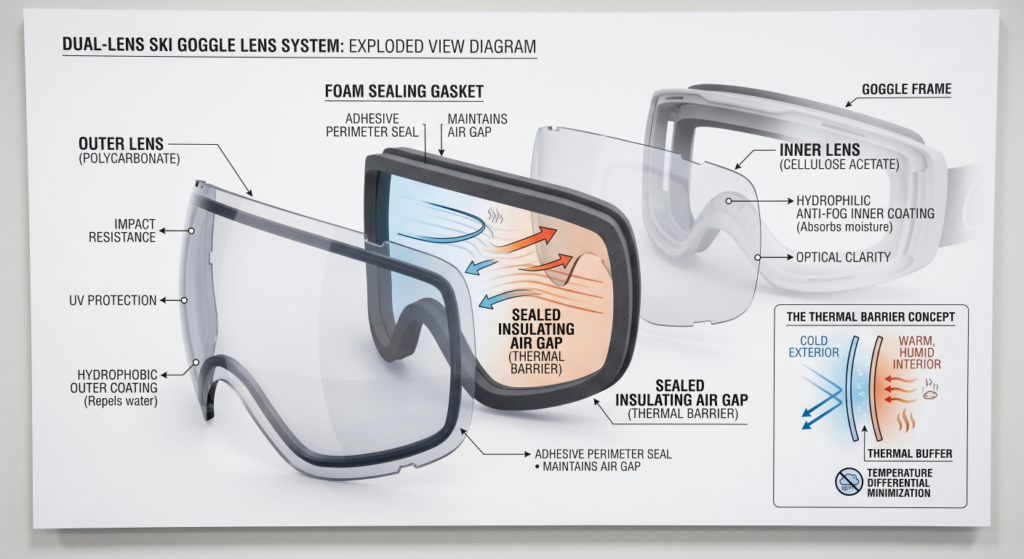
To combat this, professional snow goggles OEM China factories build a sophisticated Dual-Lens System.
-
The Thermal Barrier: This design seals a layer of dry air between an outer PC (Polycarbonate) lens and an inner CA (Cellulose Acetate) lens. This acts exactly like a double-paned window in a house, minimizing the temperature differential and stopping fog before it starts.
-
Material Differentiation: The outer lens uses PC because it offers incredible scratch resistance and impact protection against stray ski poles or tree branches. The inner lens uses CA because it naturally absorbs moisture and accepts high-grade chemical anti-fog coatings exceptionally well.
Additionally, ensure your manufacturing partner uses premium, long-lasting anti-fog coatings rather than temporary sprays that wash away after two or three uses. High-end factories permanently bond the anti-fog layer to the inner lens during the curing process.
Optical Treatments: VLT and Magnetic Quick-Change Systems
Alpine weather changes rapidly. A skier can start their morning in brilliant, blinding sunshine and end their afternoon in a low-visibility “whiteout” blizzard. Therefore, your product line must account for Visible Light Transmission (VLT).
| VLT Percentage | Lens Tint / Coating | Ideal Weather Conditions |
| S1 (43% – 80% VLT) | Clear, Yellow, or Light Rose | Low light, heavy fog, night skiing, or blizzards. |
| S2 (18% – 43% VLT) | Medium Amber, Pink, or Light Blue | Overcast, partly cloudy, or changing alpine conditions. |
| S3 (8% – 18% VLT) | Dark Grey, Dark Brown, or Full REVO Mirror | Bright, bluebird days with intense snow reflection. |
The Rise of Magnetic Quick-Change Systems
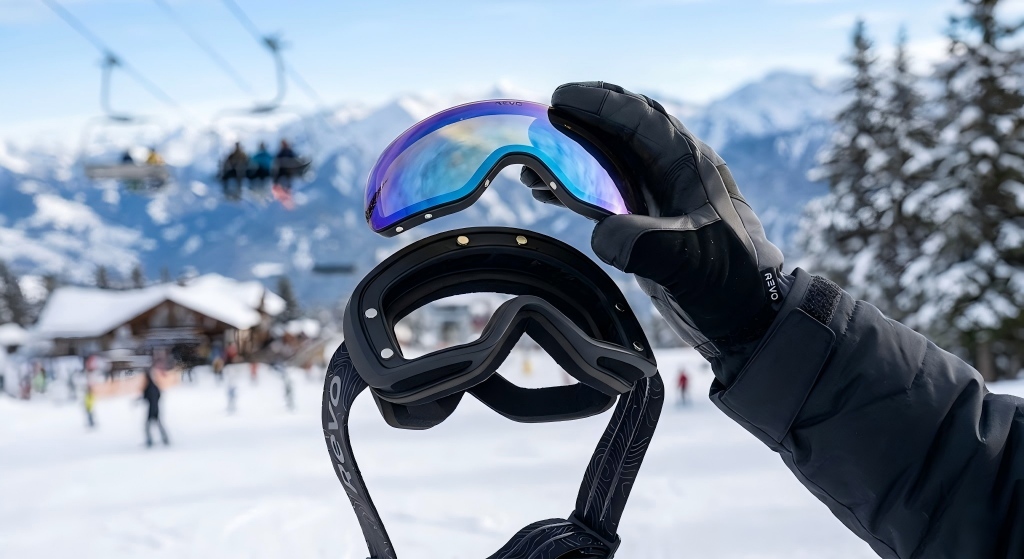
To help skiers adapt to changing light instantly, the market now heavily demands magnetic interchangeable lens systems.
A forward-thinking ski goggles manufacturer embeds high-energy N52 neodymium magnets directly into the TPU frame and the lens perimeter. This allows the user to snap a low-light lens off and replace it with a bright-sun lens in less than three seconds, without even taking their gloves off. Integrating this feature into your OEM line instantly shifts your brand into the lucrative, premium tier of winter gear.
Ventilation and Triple-Layer Face Foam
Even the best anti-fog coatings fail if the goggle does not breathe. Factories cut strategic ventilation channels along the top and bottom of the TPU frame. Technicians cover these vents with a porous, breathable foam layer that allows hot air to escape while blocking powdery snow and moisture from entering.
For face-contact comfort, high-end snow goggles OEM China facilities specialize in triple-layer face foam assembly.
-
First Layer (High-Density): Fuses directly to the TPU frame to give the goggle structural cushioning.
-
Second Layer (Medium-Density): Flexes easily to conform to the wearer’s nose bridge and cheekbones, sealing out drafts.
-
Third Layer (Hypoallergenic Fleece): Rests gently against the skin, actively wicking away sweat and preventing skin irritation.
Navigating Sourcing: Why Choose Snow Goggles OEM China?
The manufacturing ecosystem in China offers unparalleled supply chain advantages for winter sports gear. Specialized optical hubs combine advanced plastics processing, lens coating laboratories, and automated textile printing (for the goggle straps) all within the same industrial zone.
When you partner with an established factory for snow goggles OEM China production, you gain access to several critical advantages:
-
Massive Tooling Catalogs (Private Labeling): Developing custom injection molds for a unique TPU frame front can cost thousands of dollars. Top factories offer extensive catalogs of existing, unbranded molds. You can utilize these open-market molds for free, customizing the look with your own logo, frame colors, strap graphics, and lens tints to keep upfront development costs incredibly low.
-
OTG (Over The Glasses) Engineering: Modern buyers expect goggles that accommodate prescription glasses. Reputable factories offer specialized molds with deep cut-outs in the frame foam and temple areas, allowing users to wear their everyday optical frames underneath comfortably.
-
Helmet Compatibility Layouts: Goggles must fit seamlessly with standard winter helmets without creating a “goggle gap” on the forehead. Experienced manufacturers design their frame top-curves and strap outriggers to match global helmet brands perfectly.
Conclusion
Sourcing ski and snow goggles requires a balance between technical safety standards and aesthetic fashion trends. By choosing a flexible, impact-resistant TPU frame, utilizing a dual-layer lens system with permanent anti-fog bonding, and offering modern features like magnetic quick-change lenses, you can easily launch a highly competitive winter collection.
Ultimately, your success hinges on the capabilities of your production partner. Working with a dedicated, quality-focused ski goggles manufacturer allows you to navigate the complexities of winter eyewear seamlessly. By choosing a partner well-versed in snow goggles OEM China logistics, you ensure that your winter sports line arrives on time, meets international safety standards, and provides the high-margin performance your brand needs to scale.