Newsroom

News Release |

What to Do When Your Lenses Fog Up: A Practical Comparison of 5 Anti-Fog Technologies

You are pushing your limits on a steep climb. Your heart is pounding, you are sweating heavily, and suddenly, your vision goes completely white. Your sunglasses have fogged up, leaving you blind and frustrated right when you need clear vision the most.
Every athlete battles this problem. Fortunately, the eyewear industry constantly innovates to solve it. But with so many claims on the market, how do you know which anti fog sports sunglasses actually work?
Today, we dive into the science of condensation, compare five mainstream anti-fog technologies—highlighting both their strengths and their hidden flaws—and rank their real-world performance.
Anti Fog Sports Sunglasses Technology Comparison

The Science of Fog: Why Does It Happen?

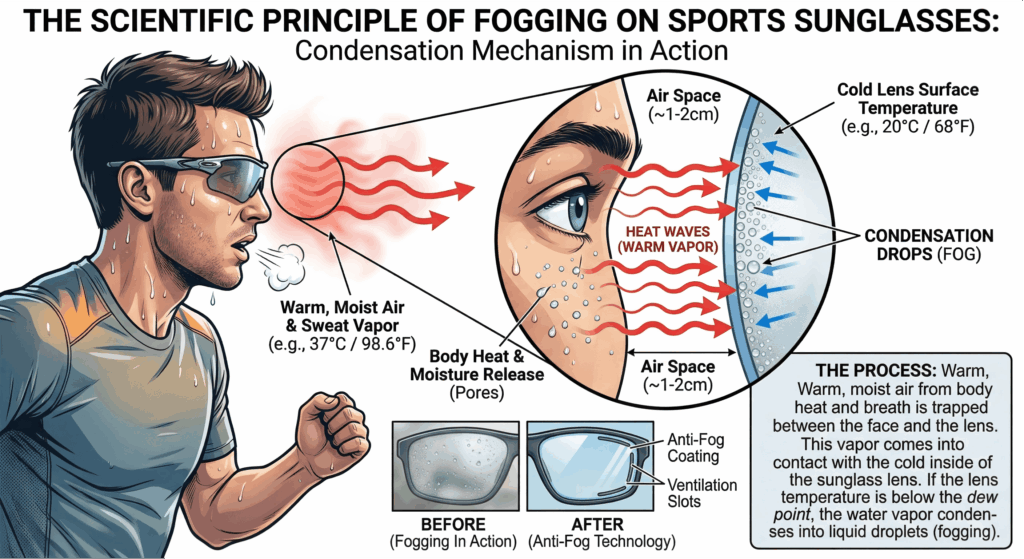
Fog is simply condensation. When you exercise, your body generates heat and moisture (sweat). This warm, humid air rises and hits the cooler inner surface of your sunglasses. Because cold air holds less moisture than warm air, the water vapor rapidly cools and transforms into thousands of microscopic water droplets. These droplets scatter light, creating that blinding white haze.
To create effective anti fog sports sunglasses, engineers must attack this equation: they either need to alter the surface tension of the lens, insulate the cold, or remove the humid air entirely.
Anti Fog Sports Sunglasses

Comparing the 5 Mainstream Anti-Fog Technologies

No technology is perfect. Every solution involves a trade-off between weight, cost, and longevity. Here is the honest breakdown of the top five methods.

Technology 1: Anti-Fog Coatings (Hydrophilic Film)

Manufacturers apply a microscopic chemical layer to the inside of the lens during production. This “hydrophilic” (water-loving) coating reduces surface tension, forcing moisture to spread into a thin, transparent sheet rather than forming individual, blinding droplets.
  • The Good: It adds absolutely no weight to the frame and maintains a sleek, traditional look. It works seamlessly on both dark and clear lenses.
  • The Bad (Cons): The coating is fragile. It naturally degrades over time (usually within a year of heavy use). Wiping the inner lens with a rough cloth or abrasive sweat will strip the coating away prematurely.

Technology 2: Dual-Lens Design (Thermal Insulation)

Borrowed from winter sports goggles, engineers bond two lenses together with a thin pocket of foam or air between them. This air gap acts as a thermal barrier, stopping the cold outside air from chilling the inner lens.
  • The Good: It provides incredible, long-lasting fog prevention in freezing environments, making it ideal for winter mountaineering or fat-bike riding.
  • The Bad (Cons): It makes the glasses significantly bulkier and heavier. The dual layers can also cause slight optical distortion and annoying internal light reflections.

Technology 3: Ventilation Channel Design

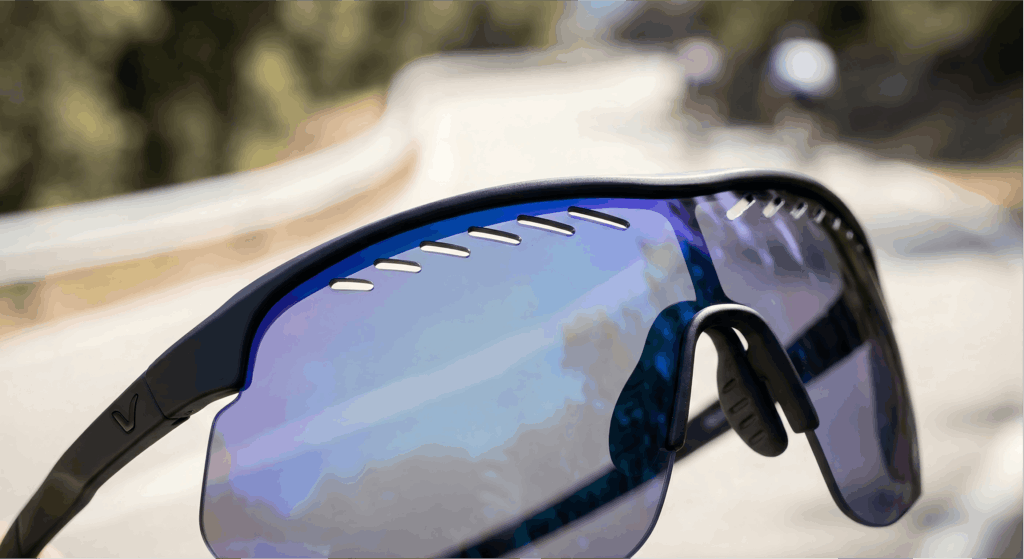
Instead of fighting the moisture chemically, designers cut strategic, aerodynamic vents into the top of the lens or the frame itself. This forces fresh air to sweep across the inner lens, pushing the humid air out.
  • The Good: The ultimate permanent solution. It never wears off and adds zero weight to the glasses.
  • The Bad (Cons): It requires forward momentum to work. The moment you stop at a traffic light or pause your run, the airflow dies, and the glasses immediately fog up. Additionally, in freezing weather, these vents can let in too much cold wind, drying out your eyes.

Technology 4: Anti-Fog Wipes and Sprays (Aftermarket)

Athletes apply a temporary surfactant spray or wipe to the lens right before a workout. This mimics the factory hydrophilic coating.
  • The Good: Highly affordable and works on any frame—whether you wear a classic Tortoise frame for hiking or transparent sports glasses for night running.
  • The Bad (Cons): Extremely high maintenance. The effect rarely lasts longer than an hour or two during heavy sweating. It can also leave a greasy residue if you do not buff it out perfectly.

Technology 5: Electronic Heated Lenses

The newest innovation in high-end cycling and snow gear. A micro-battery hidden in the frame powers a transparent conductive film inside the lens, literally baking the fog away with heat.
  • The Good: It guarantees 100% fog elimination in any weather, even when you are completely stationary.
  • The Bad (Cons): Very expensive and notably heavier than standard frames. Furthermore, you rely entirely on battery life; if the battery dies halfway through a cold ride, you lose your anti-fog protection completely.
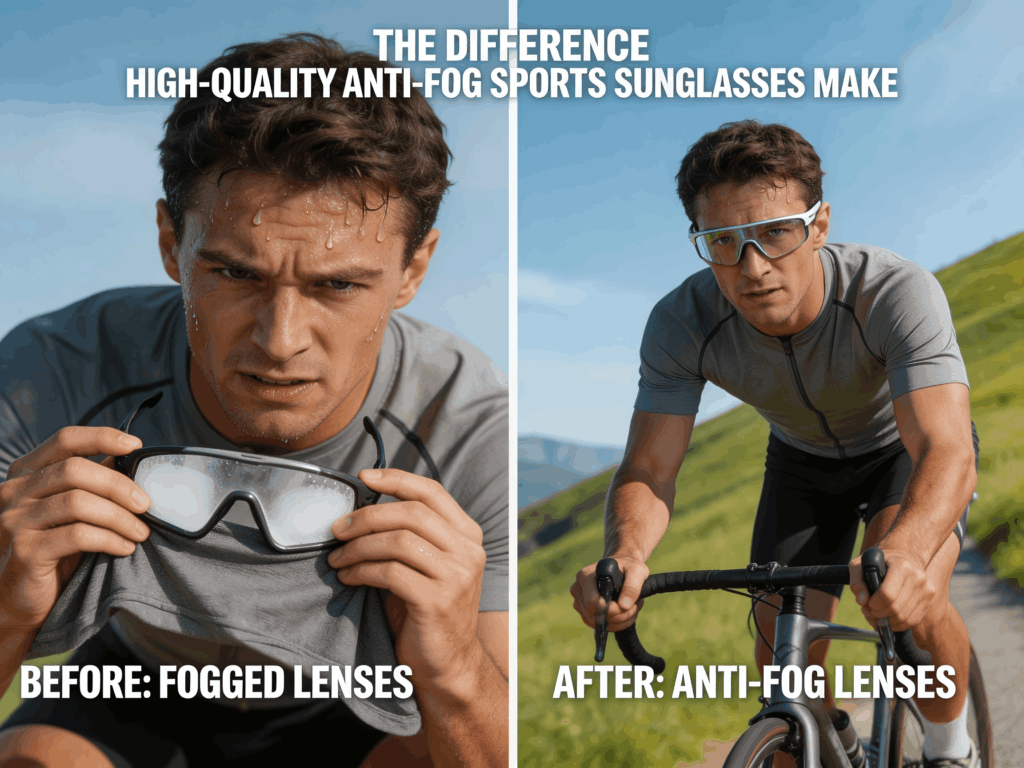
Anti Fog Sunglasses

Real-World Performance: The Duration Test

How do these technologies hold up in actual field conditions? Here is a realistic ranking based on continuous, heavy-sweat activity.
Technology Effective Fog-Free Duration Ideal Scenario Major Drawback
Electronic Heating 4-6 Hours (Battery limit) Extreme humidity / Freezing cold High cost & weight
Dual-Lens System 8+ Hours Snow sports Bulky frame design
Ventilation Channels Infinite (while moving) High-speed cycling / Road running Fails when stationary
Factory Coating 2-4 Hours (Per session) General sports / Trail running Degrades over months
Sprays / Wipes 1-2 Hours Quick emergency fixes

Messy reapplication

Engineering Reliable Vision: Our OEM Solutions

Creating the perfect anti fog sports sunglasses requires matching the right technology to the athlete’s specific environment. You cannot just slap a cheap coating on a lens and call it a day.
At Zhantai Glasses, we focus on hybrid solutions. We engineer precise aerodynamic ventilation channels into our TR90 frames while applying premium, long-lasting hydrophilic coatings to our polycarbonate lenses. This ensures the glasses clear moisture rapidly while you move, and resist fogging when you stop to catch your breath.
Furthermore, we scale this high-level engineering for global brands. From our advanced manufacturing hub and our dedicated Thailand factory, we produce high-volume, performance-driven eyewear that meets rigorous international standards, ensuring your customers never lose sight of their goals.
Recent Posts

Blue Light Glasses Manufacturer: What Brands Need to Know Before Ordering


In 2026, the average professional spends over nine hours a day staring at digital screens. From smartphones and dual-monitor office setups to late-night tablet reading, our daily exposure to high-energy visible (HEV) blue light has reached unprecedented levels. Consequently, consumer demand for protective eyewear has skyrocketed. Blue light blocking glasses have evolved from a niche […]

Blue Light Glasses Manufacturer: What Brands Need to Know Before Ordering
Full Article

Shield Sunglasses & Wrap-Around Frames: A Complete Manufacturing Guide


In the dynamic landscape of fast-fashion and performance accessories, the boundary between athletic gear and high-fashion streetwear has completely dissolved. At the very center of this aesthetic collision sits one definitive silhouette: the shield frame. What began decades ago as strict safety equipment for cyclists and winter athletes has morphed into a dominant force on […]

Shield Sunglasses & Wrap-Around Frames: A Complete Manufacturing Guide
Full Article

Build Your Brand: Custom OEM Solutions for Cat Eye Sunglasses


Cat eye sunglasses have possessed a timeless charm since the 1950s. The design evolved significantly over the decades. Vintage styles featured large and oversized frames. Modern trends often favor sharp, small, and narrow shapes. However, the core spirit remains exactly the same. These glasses remain the ultimate accessory for women. They express pure independence, confidence, […]

Build Your Brand: Custom OEM Solutions for Cat Eye Sunglasses
Full Article

Professional Service Process

OEM/ODM service

Learn about the cooperation process
FAQs

Q1: What is your production capacity for OEM/ODM sunglasses orders?

Our total annual output exceeds 20 million pieces. For our primary injection styles, our capacity is between 800,000 and 1,000,000 pieces per month, while our metal production lines output 400,000 to 600,000 pieces per month. This large-scale capability allows us to support high-volume orders for global supermarkets and chain stores reliably.

Q2: What kind of customization services do you provide for fast-fashion brands?

We offer a complete product and packaging one-stop service. Our R&D team develops over 50 new sample designs per month based on market research and trend analytics. We fully support custom frames, lenses, and LOGO customization to match your exact brand identity.

Q3: How long is the typical lead time for samples and bulk production?

We pride ourselves on speed and efficiency. We offer fast sample-making within 7 to 15 days. If your project requires a new mold, it typically takes 20 to 30 days. For bulk order production, our standard lead time is 30 to 60 days.

Q4: Do your sunglasses meet international quality and safety standards?

Absolutely. We strictly follow quality control steps from raw materials (IQC) to finished products (OQC). Our factory and products hold comprehensive professional qualification certificates, including CE, FDA, ISO 9001, ISO 13485, BSCI, SMETA, and the Global Recycled Standard.

Q5: Do you have experience working with major global retailers?

Yes, Wenzhou Zhantai Glasses has over 30 years of company history and extensive experience manufacturing for top supermarkets, ecommerce platforms, and global brands. Our recognized quality control has earned us partnerships with industry leaders like Walmart, Disney, Muji, Safilo, and QUAY. By working with us, you receive factory prices with no middlemen.

Q6: What types of eyewear materials do you manufacture?

We work with a wide variety of materials across our 3 production lines. Our capabilities include injection PC and TR, metal, acetate, and eco-friendly materials. This diverse material expertise allows us to meet the specific price points and design requirements of different fast-fashion brands and supermarkets.

Q7: What are your main product categories?

Our main products are sunglasses, optical glasses, and reading glasses. While we specialize in injection sunglasses for retail chains, we also have dedicated production lines for optical frames and reading glasses to provide a comprehensive eyewear catalog.

Q8: What is your Minimum Order Quantity (MOQ)?

As an OEM/ODM factory focusing on large-scale production, our standard MOQ is 1200 pieces per model for 3-4 colors. However, we offer flexible solutions for trial orders or specific customization needs. Please contact our sales team to discuss your project.

Q9: Do you have manufacturing facilities outside of China?

Yes, we do. In addition to our main 10,000-square-meter headquarters in Wenzhou, China, we also operate a specialized manufacturing facility in Thailand. Having a dual-country production strategy allows us to provide our global clients with highly flexible supply chain solutions, optimize import logistics, and mitigate international trade risks (such as tariffs). This ensures uninterrupted, high-capacity delivery for major supermarkets and brands.

Q10: What is your company’s background and manufacturing scale?

Wenzhou Zhantai Glasses was founded in 1990, giving us over 30 years of deep expertise in eyewear manufacturing. Our headquarters covers a construction area of over 20,000 square meters and employs more than 500 skilled workers. Thanks to the trust of our global clients, we maintain a highly stable operational status; our annual turnover continues to grow steadily, reaching $40 million in 2025, with a projected figure of $45 million in 2026. We are a financially strong and scalable partner ready for long-term collaboration.

Get in touch

Let’s build your vision together. Backed by 30 years of manufacturing excellence, Zhantai Glasses offers the quality and customization your brand needs to stand out. From concept to global distribution, we handle the details so you can focus on growth.

Let's collaborate for exceptional eyewear. We look forward to a meaningful collaboration.

Wenzhou Zhantai Glasses

Beiwei No.2 Street, Ouhai District, Wenzhou City, Zhejiang Province, China.

[email protected]