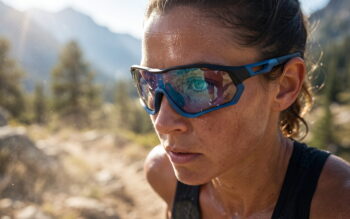
For decades, athletes who required vision correction faced a terrible dilemma. They could wear their daily optical glasses on the trail or the bike, suffering through severe glare and risking shattered glass during a crash. Alternatively, they could wear contact lenses under standard sports shields, battling dry, dust-irritated eyes for hours on end.
Today, serious athletes refuse to accept those compromises. They demand high-performance prescription sport sunglasses that deliver razor-sharp medical vision, aggressive aerodynamic wrap, and impenetrable impact protection all in one seamless unit.
For eyewear brands, offering this hybrid product unlocks an incredibly loyal, high-margin demographic—cyclists, marathoners, and golfers will gladly pay premium retail prices for gear that genuinely improves their athletic performance. However, manufacturing these technical frames requires optical engineering capabilities that stretch far beyond standard sunglass production.
At Wenzhou Zhantai Glasses Co., Ltd., we specialize in solving complex optical-mechanical challenges. Merging high-curve aerodynamics with precise medical optics is our core expertise. In this definitive B2B sourcing guide, we take you straight to the factory floor to reveal exactly how we engineer, surface, and assemble world-class prescription sport sunglasses.
The 8-Base Curve Dilemma: Conquering the Prism Effect
The single greatest hurdle in manufacturing prescription sport sunglasses is the physical curvature of the frame.
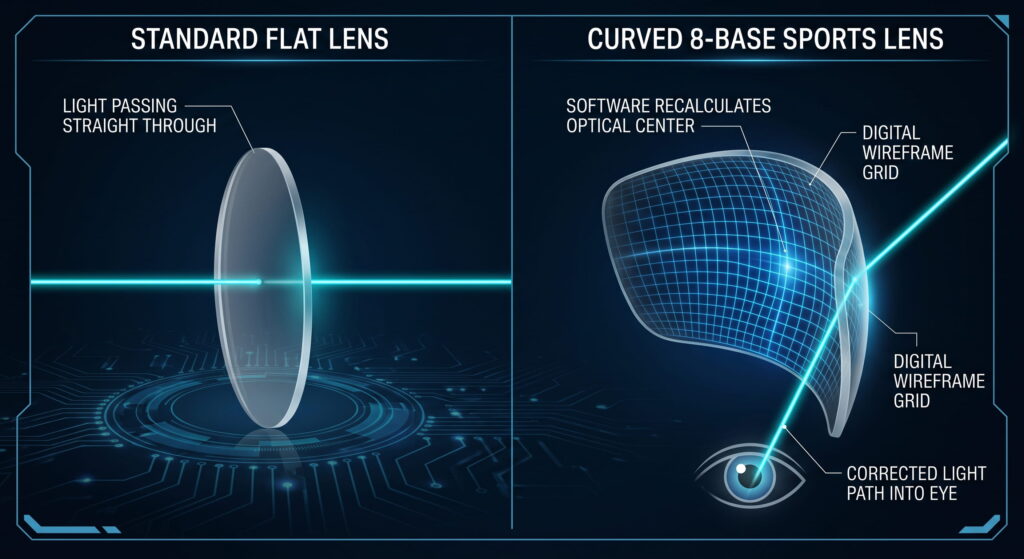
Standard daily eyeglasses feature a relatively flat “4-base curve.” However, true sports sunglasses must wrap aggressively around the athlete’s face to block peripheral wind, dust, and side-angle sunlight. To achieve this aerodynamic wrap, we engineer sports frames with steep “8-base” or even “9-base” curves.
If a budget optical laboratory tries to force a strong prescription into a highly curved 8-base lens blank, physics ruins the product. Because the lens curves sharply away from the eye at the periphery, the light bends incorrectly before it hits the retina. We call this the “prism effect” or “fishbowl distortion.” If a cyclist wears these flawed lenses, their depth perception fails, the ground looks curved, and they experience instant dizziness and nausea.
The Solution: Digital Freeform Surfacing
To completely eliminate the prism effect, our laboratory utilizes Freeform Digital Surfacing. We do not use traditional mechanical grinding wheels.
Instead, our engineers input the athlete’s exact prescription alongside the specific wrap angle and pantoscopic tilt of the sport frame into our CAD software. A 5-axis CNC diamond generator then maps tens of thousands of individual data points across the back of the lens. The diamond cutter actively recalculates and adjusts the prescription power at every single millimeter, mathematically compensating for the steep curve.
This digital wizardry guarantees that the athlete enjoys distortion-free, high-definition vision, whether they look dead ahead or glance over their shoulder to check for passing competitors.
Lens Architecture: Step-Bevels vs. Optical Clip-Ins
When an eyewear brand specifies prescription sport sunglasses, they must choose the structural architecture. We manufacture two primary systems, each serving a different athletic need.
Direct In-Frame (Step-Bevel Integration)
This is the most premium, aesthetically beautiful option. We mount the prescription lenses directly into the aerodynamic sports chassis. Because prescription lenses—especially for nearsightedness—feature thick outer edges, they normally do not fit into the thin grooves of a sleek sports frame.
To solve this, our 5-axis CNC edgers carve a complex “Step-Bevel” along the edge of the lens. We literally mill away the excess thickness on the back edge of the plastic, creating a thin lip that snaps perfectly into the frame groove, while hiding the bulky prescription thickness behind the frame chassis. The final product looks exactly like a standard, aggressive sports sunglass.
The Inner Optical Clip-In (The Versatile Option)
For athletes with extremely high prescriptions (beyond -5.00), an 8-base direct-in-frame lens becomes too thick and heavy. Instead, we utilize an optical clip-in system. We manufacture the main sports frame with interchangeable, high-curve polycarbonate shield lenses. Hidden directly behind the nose bridge, we engineer a secure mechanical anchor. The athlete’s optometrist cuts their strong prescription into a smaller, flatter, clear TR90 optical clip. The athlete snaps this clear clip securely behind the dark sun shield. This allows the athlete to swap the outer sun shields for different weather conditions (like clear lenses for night riding) while keeping their medical prescription locked in place.
Chassis Engineering: Lightweight TR90 and Hydrophilic Grip
When an athlete climbs a mountain on a bicycle, they fight gravity. Every gram matters. You cannot manufacture prescription sport sunglasses out of heavy cellulose acetate or cheap, brittle plastics.
The Power of Swiss TR90
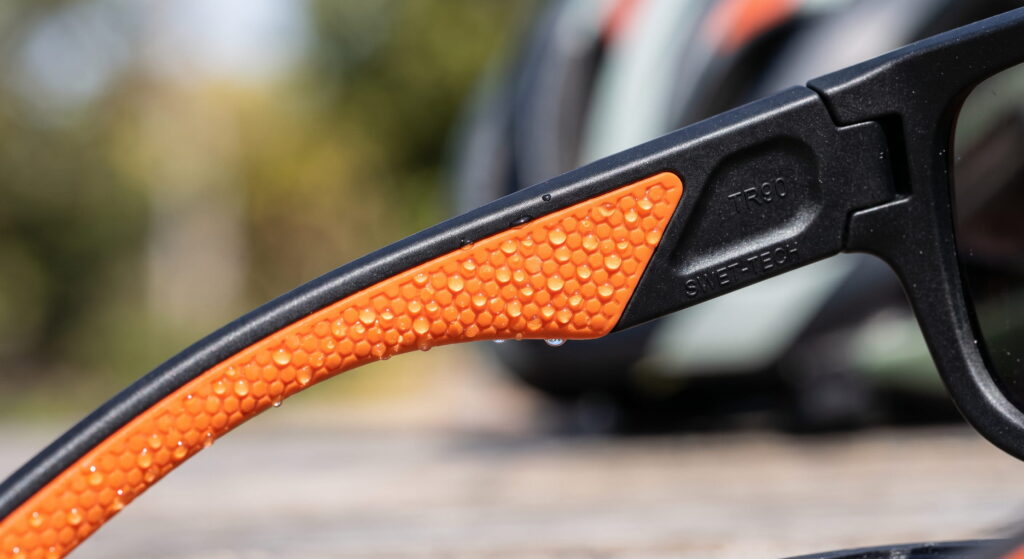
We exclusively inject our high-performance sports chassis using Swiss-grade TR90 polyamide. TR90 boasts a phenomenal strength-to-weight ratio. A thick, aggressive sports frame made of TR90 feels virtually weightless on the face. More importantly, TR90 possesses extreme elastic memory. An athlete can stretch the frame open to fit over a cycling helmet strap, and the TR90 immediately snaps back to its original engineered resting shape without warping or cracking.
Dual-Injection Hydrophilic Rubber
A frame that slips down a sweaty nose bridge is completely useless to a marathon runner. During our injection molding process, we use dual-shot technology to fuse Megol or hydrophilic rubber directly into the TR90 chassis at the nose pads and temple tips. Hydrophilic rubber behaves brilliantly under stress: as it absorbs sweat and body moisture, its molecular friction increases. The harder the athlete works and the more they sweat, the tighter the sunglasses grip their face, ensuring a zero-bounce fit over miles of rugged terrain.
Lens Materials and Impact Resistance
The lenses in your prescription sport sunglasses serve as the athlete’s primary physical defense against flying gravel, low-hanging tree branches, and severe crashes.
Standard CR-39 plastic and glass are strictly banned from our sports assembly lines.
We cut sports prescriptions exclusively into Polycarbonate or Trivex lens blanks. Polycarbonate offers unmatched, military-grade impact resistance. When a piece of trail gravel strikes a polycarbonate lens at high velocity, the polymer flexes and absorbs the kinetic energy. It will dent, but it will never shatter into dangerous shards that could blind the athlete.
We rigorously test our sports lenses against the strict ANSI Z87.1 high-velocity impact standards. In our quality control lab, we routinely fire 1/4-inch steel ball bearings at our lenses to guarantee they protect the athlete under catastrophic impact.
Mandatory Functional Coatings for the Elements
Athletes subject their gear to extreme environmental abuse. To deliver truly premium prescription sport sunglasses, we must apply advanced functional coatings inside our vacuum deposition chambers.
-
Aerodynamic Anti-Fog Vents & Coatings: When an athlete stops at a traffic light, their intense body heat immediately fogs the back of the lenses. We laser-cut strategic ventilation ports along the top rim of the lens to draw cool air in. Furthermore, we apply nano-scale anti-fog chemical coatings that prevent microscopic water droplets from condensing into an opaque wall of fog.
-
Oleophobic and Hydrophobic Top-Coats: A runner cannot stop mid-race to wipe smudges off their lenses. We apply a fluoropolymer top-coat that drastically lowers the surface tension of the plastic. Sweat, rain, and mud bead up into perfect spheres and roll right off the lens without leaving streaks, maintaining crystal-clear vision through severe weather.
-
Backside Anti-Reflective (AR) Coating: The aggressive wrap of a sports frame often allows sunlight to sneak in from behind the wearer’s ears. We apply an AR coating exclusively to the back surface of the prescription lens. This absorbs the rear sunlight, completely eliminating the blinding internal reflections that cause visual fatigue on long rides.

Curating Specific Lens Tints for Different Sports
A professional sports brand never offers a “one size fits all” lens color. Different athletic environments demand different visual spectrums. When we consult with our B2B clients, we tailor the lens chemistry to the specific sport:
-
Road Cycling and Running (Polarized Grey/Green): Asphalt creates brutal horizontal glare. For road athletes, we utilize polarized wafers integrated into the prescription lens. This cuts the road glare, reduces eye strain, and provides true color transmission.
-
Trail Running and Mountain Biking (High-Contrast Rose/Copper): We strongly advise against polarization for trail sports because it flattens depth perception, making it hard to spot wet roots or loose rocks in dappled forest shadows. Instead, we dye the lenses in high-contrast Rose or Amber tints. These colors block flat blue light while heavily amplifying greens and reds, causing the trail topography to pop with intense 3D clarity.
-
Golf (Purple/Brown Contrast): Golfers need to track a tiny white ball against a bright blue sky and read the subtle contours of green grass. We engineer specialized purple-brown tints that specifically enhance the contrast between the white ball and the green turf.
Conclusion: Partnering with Precision Engineering
Developing a line of high-performance prescription sport sunglasses instantly elevates your brand from a fashion label into a serious athletic equipment provider.
However, you cannot source this technical product from a generic fast-fashion factory. Successfully merging an 8-base aerodynamic wrap with precise medical optics requires massive industrial investment. You must partner with a manufacturer equipped with 5-axis digital freeform generators, advanced TR90 dual-injection machinery, and rigorous high-velocity impact testing protocols.
At Wenzhou Zhantai Glasses Co., Ltd., we treat sports eyewear as critical safety gear. We help our global B2B partners navigate the complexities of step-beveling, hydrophilic rubber integration, and terrain-specific lens tinting. When you build your sports catalog with uncompromising technical rigor, you deliver an essential tool that protects athletes, perfects their vision, and empowers them to perform at their absolute peak.