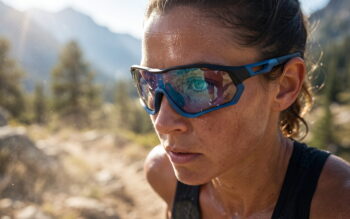
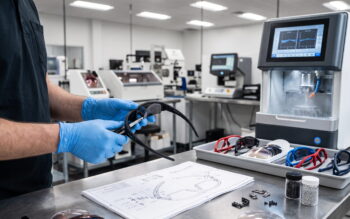
Watch any major marathon or trail ultra, and you will see runners obsessing over every fraction of an ounce. They purchase carbon-plated racing shoes, moisture-wicking aerodynamic apparel, and ultralight GPS watches. Yet, far too many runners still pull on generic lifestyle sunglasses that bounce uncontrollably on their nose bridges, fog up the moment their body heat rises, and slip down their faces the second sweat starts pouring.
When international sports brands come to our factory floor at Wenzhou Zhantai Glasses Co., Ltd., they often ask: “What exact specifications separate a generic active pair of shades from the absolute best sunglasses for running?”
The answer does not lie in flashy neon paint or aggressive marketing campaigns. It lies in strict mechanical physics, specialized polymer chemistry, and precision aerodynamics.
Running places extreme dynamic forces on an optical frame. Unlike cycling, where the head remains relatively stable, running subjects an optical frame to constant vertical oscillation. Every footstrike sends a shockwave up the body directly into the skull. If a frame lacks the correct clamp force, center-of-gravity balance, and hydrophilic grip, it fails immediately.
In this comprehensive manufacturing guide, we take you inside the factory to examine the exact engineering blueprint required to build the best sunglasses for running.
The Physics of Zero Bounce: Center of Gravity and Clamp Force
The primary complaint runners lodge against cheap eyewear is “bounce.” A pair of sunglasses that jostles up and down on your nasal bridge breaks your stride, distracts your focus, and causes painful chafing over a marathon distance.
To engineer the best sunglasses for running, our CAD designers prioritize two critical mechanical variables:
Balancing the Center of Gravity
Standard fashion sunglasses carry up to 70% of their total weight in the front chassis. Heavy glass lenses and thick rims pull the frame forward, forcing the glasses to pivot downward every time a runner’s foot strikes the asphalt.
We engineer running eyewear with an aggressive 50/50 front-to-back weight ratio. We utilize ultra-thin, precision-milled toric lenses in the front and counter-weight the temple arms with co-molded rubber cores. This shifts the physical center of gravity backward toward the ears, stabilizing the frame against vertical momentum.
Calibrating Lateral Clamp Force
A running frame must grip the temporal bones firmly enough to resist vertical shockwaves, yet gently enough to prevent tension headaches over a four-hour race.
We achieve this balance by adjusting the mold curves of the temple arms. Rather than curving sharply inward at the tips (which pinches the mastoid bone behind the ears), we design straight, wrap-around temples that distribute lateral clamp force across the entire length of the skull.
Frame Material Science: Why TR90 and Bio-Nylon Rule the Road
You cannot manufacture high-performance running frames using standard eyewear plastics.
-
Why Cellulose Acetate Fails: Acetate looks gorgeous on a runway, but it weighs twice as much as performance polymers. It becomes brittle in cold morning air, softens under extreme summer heat, and absorbs skin oils, turning slick and unwearable during a run.
-
Why Basic Polycarbonate (PC) Fails: Budget brands often use injected PC because it costs pennies. However, PC lacks elastic memory. If you bend it to fit a wider head, it eventually deforms or snaps under repetitive mechanical stress.
For the best sunglasses for running, we exclusively build frames using high-grade Swiss TR90 polyamide or renewable castor-seed-derived bio-nylons.
TR90 possesses an extraordinary strength-to-weight ratio. A complete TR90 running frame front often weighs less than 15 grams. More importantly, TR90 exhibits true mechanical “memory.” It flexes effortlessly around varying facial widths and instantly snaps back to its engineered resting dimensions without cracking. It resists environmental degradation from acidic human sweat, extreme UV exposure, and wild temperature swings from freezing morning trail runs to scorching midday marathons.
Hydrophilic Grip: The Secret to Sweat Management
Standard rubber degrades rapidly. When cheap rubber encounters the lactic acid and oils found in human sweat, it turns slick, begins melting, and loses its friction coefficient. The sunglasses immediately slide down the wearer’s nose.
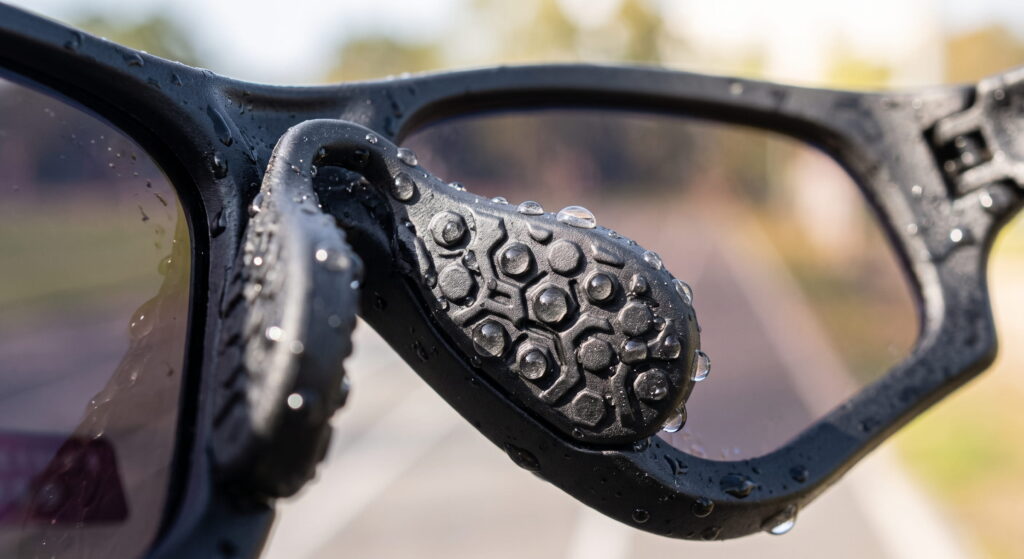
To build the best sunglasses for running, we utilize specialized thermoplastic elastomers (TPE)—often referred to commercially as Megol or hydrophilic rubber.
Hydrophilic materials display a fascinating chemical property: they become tackier and grippier as moisture levels increase.
When a runner breaks into a heavy sweat, the hydrophilic nose pads and temple sleeves absorb microscopic amounts of moisture, increasing their molecular adhesion against the skin. The harder the runner trains and the more they sweat, the tighter the sunglasses grip their face.
We integrate these hydrophilic contact points via dual-shot injection molding. Instead of gluing rubber pads onto a plastic frame (where glue dissolves over time), our machines shoot molten TR90 plastic and molten hydrophilic rubber into the same mold cavity, chemically and physically fusing them into a single, indestructible component.
Aerodynamics and Anti-Fog Venting Systems
Every runner knows the frustration of stopping at a red light or slowing down to tackle a steep trail climb, only to have their lenses instantly turn into an opaque wall of white fog.
Fogging occurs due to thermodynamics. The runner’s face generates intense body heat and humidity. When that hot, moist air gets trapped behind a cold sunglass lens, the moisture condenses into microscopic water droplets across the plastic.
We defeat lens fogging on our production lines using a two-pronged engineering strategy:
Precision Aerodynamic Venting
You cannot trap air behind the lens. We laser-cut or mold strategic aerodynamic vents into the upper rim of the frame and along the top edges of the lenses. As the runner moves forward, these vents scoop ambient air inward, creating a gentle, continuous low-pressure draft behind the lens. This constant airflow whisks away the hot, humid air before it can condense.
Nanoscale Hydrophobic Coatings
For periods of static rest (like waiting at an aid station), vents cannot move air. Therefore, we apply a vacuum-deposited hydrophobic and oleophobic top-coat to the lenses. This nanometer-thin fluoropolymer layer lowers the surface tension of the lens to near zero. Moisture simply cannot cling to the smooth surface; instead of forming an opaque film of micro-droplets, condensation beads into large, flat pools that quickly roll down the lens or evaporate instantly.
Lens Optics: Road vs. Trail Engineering
The best sunglasses for running require vastly different lens optics depending on the running terrain.
Many buyers assume that every running sunglass must feature a polarized lens. On the factory floor, we know this is a dangerous misconception.
The Road Running Setup: High-Contrast Polarization
Road runners face harsh, reflective glare bouncing off asphalt, windshields, and passing vehicles. For road marathons, we recommend TAC or Polycarbonate polarized lenses with a Visible Light Transmission (VLT) of 10% to 15% (Category 3). Polarization cuts the horizontal glare from the pavement, eliminating squinting and reducing optic nerve fatigue over 26.2 miles.
The Trail Running Setup: Non-Polarized Contrast Enhancement
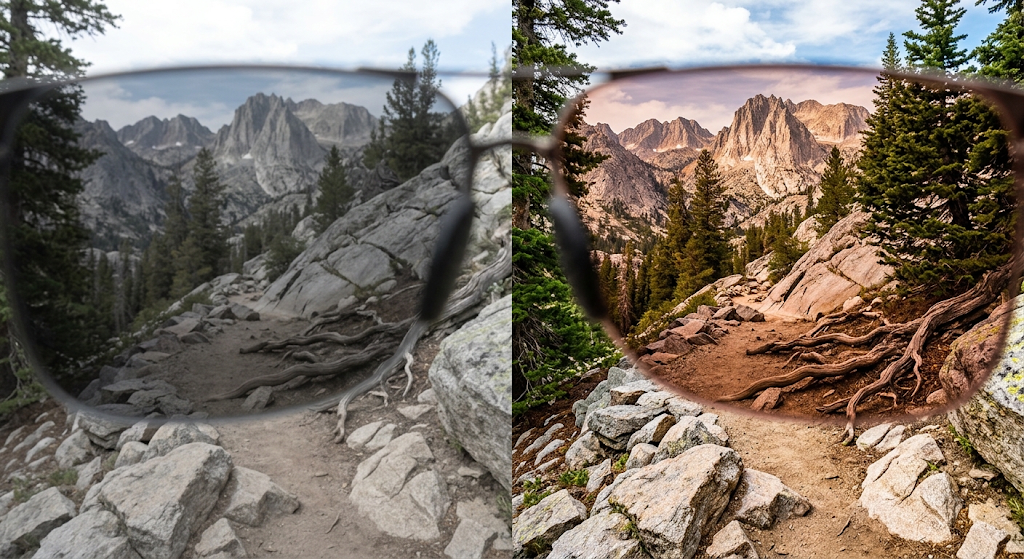
When athletes tackle technical mountain trails, polarized lenses can actually endanger them. Polarization flattens the visual field, making it difficult to judge depth and differentiate between wet rocks, dry mud, tree roots, and loose gravel.
For trail running, we recommend non-polarized contrast lenses dyed in high-definition Rose, Amber, or Copper tints. These wavelengths filter out flat blue light while enhancing green, yellow, and red spectrums. This increases visual depth perception, allowing a runner moving at high speed through dense, dappled forest light to spot dangerous roots and rocks instantly.
Photochromic Versatility
For ultramarathoners who start before dawn and finish after dark, we produce photochromic lenses. These lenses utilize embedded silver halide or naphthopyran molecules that react dynamically to UV rays. The lens starts completely clear (85% VLT) in the pre-dawn darkness and automatically darkens to a deep smoke tint (15% VLT) as the midday sun emerges, eliminating the need to carry two pairs of glasses.
Frame Geometry: Shields vs. Dual-Lens Architecture
When curating your brand’s performance running catalog, you must select the structural layout of the chassis.
-
The Single-Lens Shield (Cylindrical or Toric): Shield designs currently dominate professional road and trail running. By eliminating the center nose bridge frame and utilizing one continuous, panoramic lens, we provide an uninterrupted, 180-degree field of vision. A runner can glance down at their watch, scan the trail ahead, or check for traffic over their shoulder without a plastic frame edge obstructing their view.
-
The Dual-Lens Dual-Base (The Versatile Classic): Dual-lens designs utilize a traditional center bridge. While they offer slightly less peripheral coverage than a shield, they provide superior thermal ventilation around the nose and allow for easy integration of prescription (RX) optical clips, catering to runners who require vision correction.
Factory Quality Control: Stress-Testing for the Long Run
Before we box a production run of running eyewear, our Quality Control technicians subject the frames to rigorous dynamic stress testing:
-
The High-Frequency Vibration Test: We mount the sunglasses onto a mechanical mannequin head and run a motorized vibration platform for hours to simulate hundreds of miles of repetitive vertical footstrike oscillations, verifying that the hinge screws and nose pads do not loosen.
-
The Artificial Sweat Immersion Test: We submerge sample frames into a heated, hyper-saline acidic solution for 72 hours. This simulates months of heavy runner perspiration, guaranteeing that the coatings do not blister and the hydrophilic rubber sleeves do not delaminate.
-
The ANSI Z87.1 High-Velocity Impact Test: Trail runners frequently encounter low-hanging tree branches and flying trail gravel. We fire a 1/4-inch steel ball at high speed directly at the lens. The lens must absorb the kinetic energy without shattering or dislodging from the frame bevel.
Conclusion: Engineering the Runner’s Edge
Building the best sunglasses for running is an exercise in functional minimalism. A runner should put on a pair of sunglasses at mile one and completely forget they are wearing them by mile twenty.
Achieving that level of weightless, zero-bounce performance demands deep engineering expertise. You must prioritize ultralight TR90 polymers, integrate sweat-activated hydrophilic contact points, master aerodynamic anti-fog ventilation, and deploy terrain-specific optical tints.
At Wenzhou Zhantai Glasses Co., Ltd., we combine precision injection tooling with advanced optical manufacturing. We partner with ambitious global sports brands to turn complex biomechanical requirements into world-class, retail-ready running eyewear. When you design and manufacture your active collections with authentic engineering rigor, you deliver an essential piece of equipment that helps every runner chase down their next personal best.
Learn More
The Engineering Behind Prescription Sport Sunglasses: A B2B Factory Manufacturing Guide
5 Key Metrics for Choosing Kids Sports Sunglasses
Running, Cycling, Mountaineering: The Ultimate Sports Sunglasses Buying Guide