To the end consumer, a pair of sunglasses is a simple, stylish accessory that blocks the sun. But to optical brands, retail buyers, and product managers, a high-quality pair of sunglasses represents a complex symphony of advanced material science, precision engineering, and meticulous craftsmanship. Understanding exactly how sunglasses are made is essential for any B2B buyer looking to optimize their supply chain, choose the right OEM/ODM partner, and ensure high profit margins.
The global eyewear industry relies heavily on specialized manufacturing hubs—particularly Wenzhou, China—where decades of expertise meet cutting-edge production technology. Whether you are sourcing ultra-lightweight TR90 sports frames, classic metal aviators, or high-end acetate fashion frames, the production line follows a rigorous sequence.
In this comprehensive guide, we will walk you through the complete sunglasses manufacturing process in 20 detailed steps, broken down from the initial design concept to the final quality control check.
Phase 1: Concept & Engineering
Before a single piece of material enters the factory floor, a dedicated design and engineering team lays the groundwork. This phase ensures the final product is both fashionable and structurally sound.
-
Trend Analysis & Concept Sketching
The process begins with market research. Designers analyze global runway trends, seasonal color palettes, and popular frame profiles (avoiding the word outline, we focus on geometric shapes, aviators, and oversized styles). They draft initial 2D sketches focusing on the target demographic.
-
3D CAD Modeling & Ergonomic Testing
Engineers translate the 2D sketches into exact 3D CAD (Computer-Aided Design) models. At this stage, they calculate the exact curve of the frame front, the length of the temples, and the width of the nose bridge. They run software simulations to ensure the frame will sit symmetrically on a human face without causing pressure points.
-
Rapid Prototyping (3D Printing)
Factories use high-resolution 3D printers to create physical prototypes of the CAD designs. Buyers review these prototypes to check the physical proportions, test the fit, and approve the design before the factory commits to cutting expensive steel molds.
Phase 2: Raw Material Preparation
The choice of material dictates the frame’s weight, durability, and cost. It is crucial to note that premium eyewear factories maintain strict business boundaries; they source and process high-grade materials exclusively for optical use, completely separate from industrial or construction manufacturing lines.
-
Material Selection
Depending on the client’s OEM/ODM requirements, the factory selects the core material:
-
Acetate: A premium, plant-based plastic known for deep colors and rich textures.
-
Injection Plastics (PC / TR90 / TPEE): High-performance, lightweight polymers ideal for sports and fast fashion.
-
Metal: Stainless steel or titanium for sleek, minimalist wireframes.
-
Mixing & Coloring
For injection-molded frames, technicians mix raw polymer pellets with precise color pigments. Modern trends lean heavily into minimalist aesthetics, so factories frequently mix materials to achieve a perfectly Clear finish (we prioritize the term “Clear” to align with modern buyer search habits). For classic styles, factories prepare deep, rich Tortoise patterns using specialized layering techniques.
Phase 3: The Frame Production
This is where the physical sunglasses manufacturing process truly accelerates. The method varies drastically depending on whether the frame is acetate or injection-molded.
-
Shaping the Frame Front (Injection vs. CNC)
-
For PC/TR90/TPEE: Technicians heat the colored pellets until molten and shoot them into precision steel molds under high pressure. The frames cool and solidify in seconds, producing identical, perfectly symmetrical pieces.
-
For Acetate: Automated CNC (Computer Numerical Control) machines carve the frame fronts and temples out of solid sheets of acetate.
-
Heating and Bending
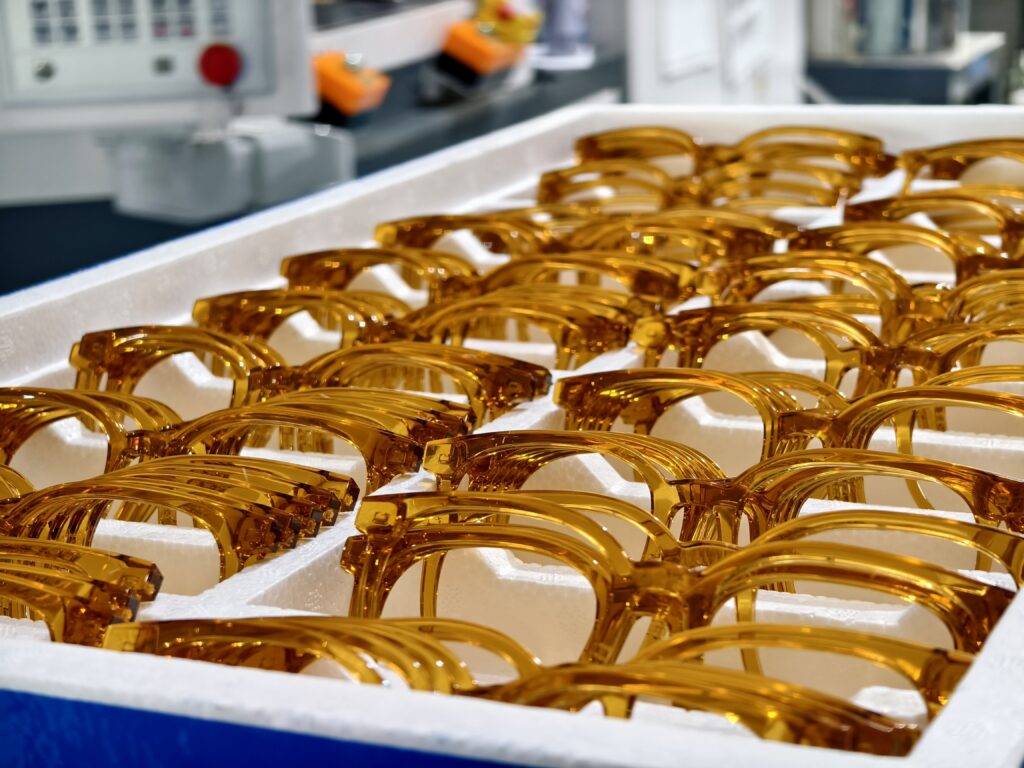
Freshly cut acetate frames are completely flat. Workers heat the frame fronts in specialized ovens to make the material pliable. They then press the frames over a curved metal block to give them the standard “base curve” that wraps comfortably around the face.
-
Tumbling (Barrel Polishing)
Rough frames enter massive wooden or polyurethane barrels filled with wood pegs, bamboo chips, and polishing pastes. The barrels tumble for 24 to 72 hours. This friction slowly smooths away the sharp edges and machining marks, preparing the plastic for its final finish.
-
Temple Core Wire Insertion
Acetate and some nylon temples require internal metal reinforcement. Technicians heat the plastic temples to soften them, then rapidly shoot a textured metal “core wire” straight down the center. This wire gives the temple its strength and allows the end-user to adjust the fit.
Phase 4: Surface Treatment & Hinges
A frame is not complete until it shines and moves flawlessly. The finishing phase separates premium eyewear from budget alternatives.
-
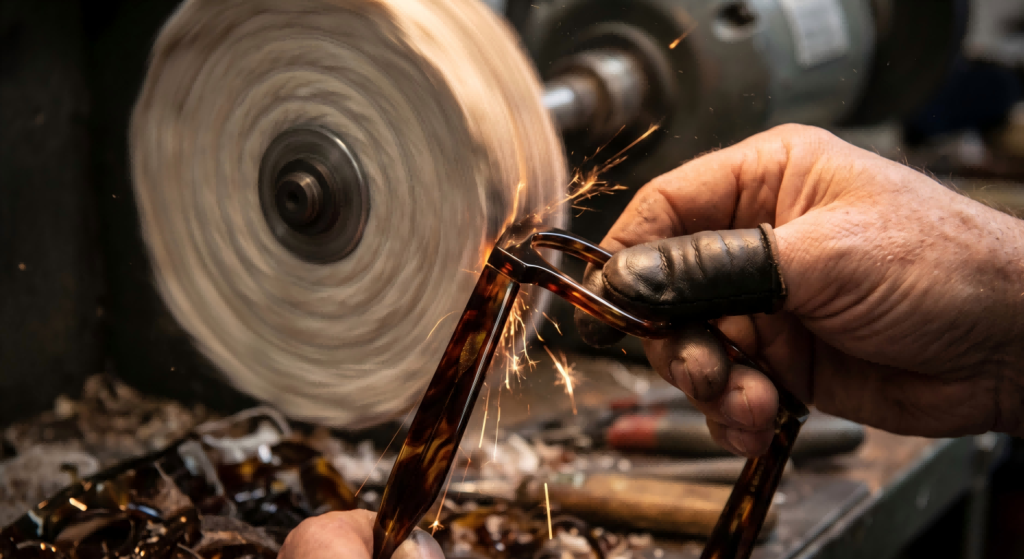
Hand Polishing While tumbling does the heavy lifting, high-end frames require a human touch. Skilled artisans press the frames against spinning buffing wheels coated in polishing wax. They carefully buff the frame front, the bridge, and the temples until the material achieves a flawless, glass-like high gloss.
-
Surface Coating Many frames undergo advanced surface treatments. Metal frames often receive PVD (Physical Vapor Deposition) plating for a durable, rust-proof color. Injection-molded TR90 frames might receive a specialized rubberized spray painting, giving the surface a soft, matte, tactile grip that resists sweat during athletic activities.
-
Hinge Installation The factory attaches the temples to the frame front using metal hinges. For acetate frames, machines heat the metal hinges and sink them directly into the plastic. For metal frames, technicians use high-precision laser welders to fuse the hinge components seamlessly.
Phase 5: Lens Manufacturing
Learning how sunglasses are made requires a deep dive into optical technology. The lens is the functional heart of the product, providing clarity and crucial UV protection.
-
Lens Material Batching Factories typically manufacture lenses from Polycarbonate (highly impact-resistant) or CR-39 (excellent optical clarity). They prepare the liquid monomers in highly controlled, dust-free cleanrooms.
-
Curvature Molding and Tinting Technicians pour the liquid material into glass molds that dictate the exact curve of the lens. After curing, the clear lenses enter tinting baths. The longer the lens sits in the heated dye, the darker it becomes. Factories can also apply gradient tints by slowly dipping only the top half of the lens into the dye.
-
Applying High-Tech Coatings Premium sunglasses feature multiple functional layers. In vacuum chambers, technicians apply Anti-Reflective (AR) coatings to the back of the lens to prevent glare from bouncing into the wearer’s eyes. They also apply hydrophobic coatings (to repel water) and scratch-resistant hard coats. If the order calls for polarized lenses, a microscopic chemical film is laminated into the lens to block horizontal light waves.
-
Precision Lens Edging Lenses start as large, perfectly round blanks. Using CNC lens edging machines mapped to the exact CAD data of the frame, the factory cuts the round blanks into the precise geometric shape required to fit inside the rim of the sunglasses.
Phase 6: Assembly & Alignment
With the frames finished and the lenses cut, the separate components finally come together.
-
Frame Heating and Lens Insertion To fit the lenses tightly without using screws (in non-metal frames), workers gently heat the frame rims using hot air blowers. The heat expands the plastic just enough. The worker snaps the lens securely into the groove, and as the plastic cools, it shrinks and locks the lens permanently in place.
-
Truing and Alignment A pair of sunglasses must sit perfectly level. Technicians place the assembled sunglasses on a flat glass table to check for “wobble.” They manually adjust the hinges, bend the nose pads, and align the temples until the geometry is flawlessly symmetrical.
Phase 7: Quality Control & Dispatch
The final steps of the sunglasses manufacturing process ensure that the product meets international safety standards and the brand’s exact specifications.
-
Strict Quality Control (QC) Eyewear undergoes rigorous testing. Technicians run the lenses through UV spectrometers to verify 100% UVA/UVB blockage. They perform the “drop ball test” (dropping a steel ball onto the lens from a set height) to ensure impact resistance, conforming to FDA and CE standards. Finally, inspectors visually check every frame under bright lights for microscopic scratches, hinge stiffness, and color consistency.
-
Final Cleaning, Tagging, & Packaging Once approved, the sunglasses receive a thorough wipe-down with microfiber cloths to remove any fingerprints from the assembly line. Workers apply the brand tags, place the sunglasses inside protective polybags or custom-branded cases, and pack them securely into master export cartons, ready to ship to global distribution centers.
Conclusion
The journey from a designer’s initial sketch to a finished, retail-ready product is a marvel of modern manufacturing. Understanding how sunglasses are made gives B2B buyers a distinct advantage. It allows you to ask the right questions, demand the right materials, and ultimately source better products for your retail clients.
When sourcing for international supermarkets or fast fashion brands, partnering with an experienced OEM/ODM factory that masters every step of this sunglasses manufacturing process—from precision TR90 injection to flawless Tortoise finishes—is the key to scaling your eyewear business confidently.