Just a few years ago, the term “smart glasses” conjured images of bulky, awkward headsets that looked more like science fiction props than everyday fashion. Today, the landscape has completely transformed. Consumers no longer accept a compromise between cutting-edge technology and aesthetic appeal. They expect their smart eyewear to look identical to high-end designer frames while seamlessly integrating artificial intelligence, spatial audio, and augmented reality (AR).
For eyewear brands, tech startups, and consumer electronics distributors, this rapid evolution presents a massive market opportunity. However, building these devices requires an entirely new manufacturing playbook. You can no longer rely solely on a traditional optical factory, nor can you depend exclusively on a standard consumer electronics plant.
Sourcing successfully in this new era requires a partner who masters the delicate marriage of optics and microelectronics. This comprehensive guide breaks down exactly what a top-tier smart sunglasses manufacturer can deliver today, the engineering challenges they solve, and how you can strategically navigate the tech eyewear OEM China 2026 landscape to build a market-leading product.
The Modern Baseline: What Does “Smart” Actually Mean Now?
If you plan an upcoming product launch, you must understand the current technological baseline. Basic Bluetooth connectivity no longer qualifies as a premium feature; it serves as the absolute minimum standard.
When you partner with an advanced smart sunglasses manufacturer, you can integrate the following technologies directly into the chassis of standard-looking frames:
-
Directional Open-Ear Audio
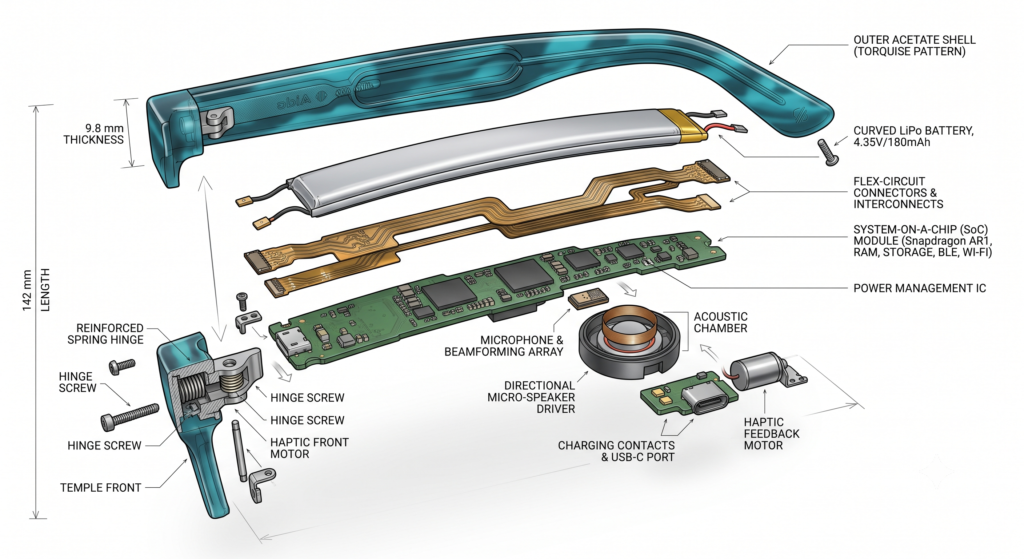
Modern tech eyewear completely eliminates the need for uncomfortable earbuds. Engineers embed microscopic, directional speakers into the temples (the arms) of the glasses. These speakers use acoustic beamforming to project sound precisely into the wearer’s ear canal. The user enjoys music, podcasts, and turn-by-turn navigation with crystal clarity, while the person sitting next to them hears absolutely nothing.
-
AI Voice Assistant Integration
With the explosion of conversational AI, smart sunglasses now serve as the ultimate wearable interface. Factories integrate high-fidelity, noise-canceling microphone arrays into the nose bridge and frame front. These microphones actively filter out wind and street noise. This allows the wearer to converse seamlessly with AI assistants, translate languages in real-time, draft messages, or query the internet without ever pulling a smartphone out of their pocket.
-
Lightweight Heads-Up Displays (HUDs) and AR
While fully immersive AR remains complex and heavy, lightweight HUDs stand as highly accessible technologies today. Manufacturers use micro-OLED projectors hidden in the frame to bounce digital information off specialized holographic lenses. The wearer sees minimalist notifications, fitness metrics, or navigation arrows floating transparently in their field of vision, perfectly integrated with their natural surroundings.

The Engineering Challenge: Merging Optics with Electronics
Designing a smart frame on a computer screen looks easy; manufacturing it in the real world proves incredibly difficult. A standard pair of sunglasses features solid plastic or metal components. Smart sunglasses, however, function as wearable computers housing batteries, printed circuit boards (PCBs), antennas, and fragile wiring.
A premium facility operating within the tech eyewear OEM China 2026 sector overcomes several distinct engineering hurdles to make these products a reality:
The Miniaturization and Weight Distribution Problem
Consumers flatly refuse to wear heavy glasses that slide down their noses. A skilled smart sunglasses manufacturer must distribute the weight of the electronics perfectly across the frame. Typically, engineers house the microprocessor and Bluetooth antenna in the thicker part of the temples near the hinge. They then place high-density, curved lithium-polymer batteries at the very end of the temple tips (behind the ear) to counterbalance the weight of the frame front. This precise weight distribution ensures the glasses feel completely natural on the face.
The “Smart Hinge” Dilemma
How do you pass a delicate wire from the battery in the temple to the microphone in the frame front without it snapping when the user folds the glasses? The industry calls this the smart hinge dilemma. Leading factories abandon traditional optical barrel hinges. Instead, they engineer custom flex-cables or specialized pogo-pin connectors. These advanced hinges allow the glasses to fold thousands of times without degrading the electronic connection, all while maintaining the sleek aesthetic of a classic optical hinge.
Thermal Management
Processors generate heat. If a user takes a two-hour phone call, the electronics inside the temple will naturally warm up. Professional factories engineer microscopic heat sinks and utilize thermally conductive polymers in the frame chassis. These materials safely dissipate heat away from the wearer’s skin, ensuring total comfort and safety during extended use.
Sourcing Strategy: Navigating Tech Eyewear OEM China 2026
China remains the undisputed epicenter for tech eyewear manufacturing. However, the supply chain historically suffered from a geographic divide.
For decades, Wenzhou dominated traditional optical frame manufacturing and lens cutting, while Shenzhen dominated consumer electronics, PCBs, and battery technology. Brands previously struggled to coordinate production between these two massive, distinct hubs.
The defining characteristic of the tech eyewear OEM China 2026 landscape is complete convergence. The best factories have finally bridged this gap. When sourcing a manufacturing partner, you must look for a facility that brings both optical craftsmanship and electronic engineering under one roof.
-
Demand Double-Injection Molding Capabilities
Waterproofing dictates the lifespan of wearable tech. Sweat, rain, and humidity destroy exposed circuitry rapidly. Top-tier factories solve this using double-injection molding machines. They first mold a rigid plastic skeleton around the delicate electronics to lock them safely in place. Next, they inject a second layer of softer, skin-friendly polymer to seal the frame completely. This process achieves IP67 water and dust resistance without relying on messy glues or fragile rubber gaskets that degrade over time.
-
Verify True Optical Lens Expertise
Many standard electronics factories try to enter the smart glasses market, but they fundamentally fail to understand optical science. A smart sunglass remains, first and foremost, a visual tool. Your manufacturer must understand pupillary distance, lens base curves, and how to apply anti-reflective (AR) coatings properly. If a factory produces a brilliant Bluetooth system but installs cheap, distorted lenses, consumers will return the product immediately.
-
Require Rigorous Electronic QC Testing
Standard eyewear quality control involves checking for cosmetic scratches and hinge stiffness. Smart eyewear demands a much more intense, technical QC protocol. Your smart sunglasses manufacturer must possess specialized testing laboratories on-site.
-
Acoustic Chambers: Engineers use these soundproof rooms to test speaker frequency response and microphone noise-cancellation capabilities.
-
Battery Aging Ovens: Technicians bake the glasses to ensure the lithium batteries do not swell, leak, or fail under extreme summer temperatures.
-
Signal Testers: Equipment verifies that the Bluetooth antenna maintains a strong, uninterrupted connection with the user’s phone, even when obscured by thick hair or hats.
The Fast Path to Market: White-Label vs. Custom Development
If you want to launch a smart eyewear brand, you face a critical strategic choice regarding your development timeline and budget.
Custom OEM Development: If you decide to engineer a proprietary PCB, a custom battery shape, and a completely unique frame design from scratch, you will face massive tooling costs. Electronic molds often exceed $50,000, and the development cycle usually stretches from 9 to 12 months.
White-Label/ODM Acceleration: To move quickly and preserve capital, leverage the existing research and development of an established partner within the tech eyewear OEM China 2026 ecosystem. The best factories already possess fully engineered, heavily tested electronic temples (the “smart” arms of the glasses). They allow you to select these pre-engineered tech temples and attach them to custom-designed frame fronts (such as a unique cat-eye or a bold geometric front).
This strategy slashes your R&D costs, bypasses the headaches of electronic certification (the factory already holds FCC or CE marks for the internal components), and cuts your time-to-market down to just 3 or 4 months. You get a unique, fashion-forward product powered by proven, reliable technology.
Conclusion: Partnering for the Future
Smart eyewear no longer lives in the realm of futuristic concepts; it drives current retail reality. Consumers stand ready to replace their earbuds and smartwatches with a single, stylish pair of connected sunglasses.
However, capitalizing on this explosive trend requires a manufacturing partner that speaks two very different languages perfectly: the traditional craftsmanship of optical design and the hyper-precise engineering of microelectronics.
By understanding the current technological baseline and strategically navigating the modern supply chain, you can bring a highly sophisticated product to market rapidly. Choose a dedicated smart sunglasses manufacturer that proves their expertise in both realms. This ensures your final product not only sounds incredible and functions flawlessly but looks exactly like the high-fashion accessory your customers desire.