You spent months defining your niche, selecting the perfect manufacturer, agonizing over frame colors, and finalizing your logo placement. Finally, the factory informs you that your 1,200-unit bulk order of sunglasses is complete and ready for export. They send you the final invoice and ask for the remaining 70% balance.
This is the most critical moment in your entire supply chain.
Wiring that final payment before verifying the condition of your inventory is a massive gamble. Once the master cartons leave the factory floor and load onto a cargo ship, rectifying manufacturing errors becomes practically impossible—and incredibly expensive. If your customers receive scratched lenses, stiff hinges, or crooked frames, your brand reputation will suffer immediate damage, followed by a wave of costly returns.
To protect your investment, you must implement rigorous eyewear quality control. Whether you hire a third-party inspection agency or demand extensive video proof from the factory, understanding the mechanics of a professional sunglasses inspection China protocol is essential.
This comprehensive guide breaks down the exact steps, stress tests, and visual checks required to ensure your eyewear order meets international standards and your brand’s strict expectations before it ever leaves the factory.
Step 1: The AQL Standard (Acceptable Quality Limit)
You cannot expect a factory to produce 10,000 pairs of sunglasses with zero flaws. Mass production naturally incurs a tiny margin of error. The industry manages this reality using the AQL (Acceptable Quality Limit) system.
Before the inspection begins, you must agree on the AQL threshold with your factory or third-party inspector. The AQL dictates how many defective units you will accept in a randomly selected sample before you reject the entire batch.
Professional buyers typically use AQL 2.5 / 4.0 for eyewear:
-
Major Defects (AQL 2.5): These are flaws that make the glasses unwearable or unsellable (e.g., deep lens scratches, broken hinges, missing logos). If more than 2.5% of the sampled batch has major defects, you reject the order.
-
Minor Defects (AQL 4.0): These are small aesthetic flaws that do not impact usability (e.g., a tiny dust speck near the edge of the lens, slight color variance). You accept a slightly higher percentage (4.0%) of these before failing the batch.
Understanding your AQL gives your sunglasses inspection China process a mathematical, objective foundation rather than relying on subjective opinions.
Step 2: The Visual and Cosmetic Inspection
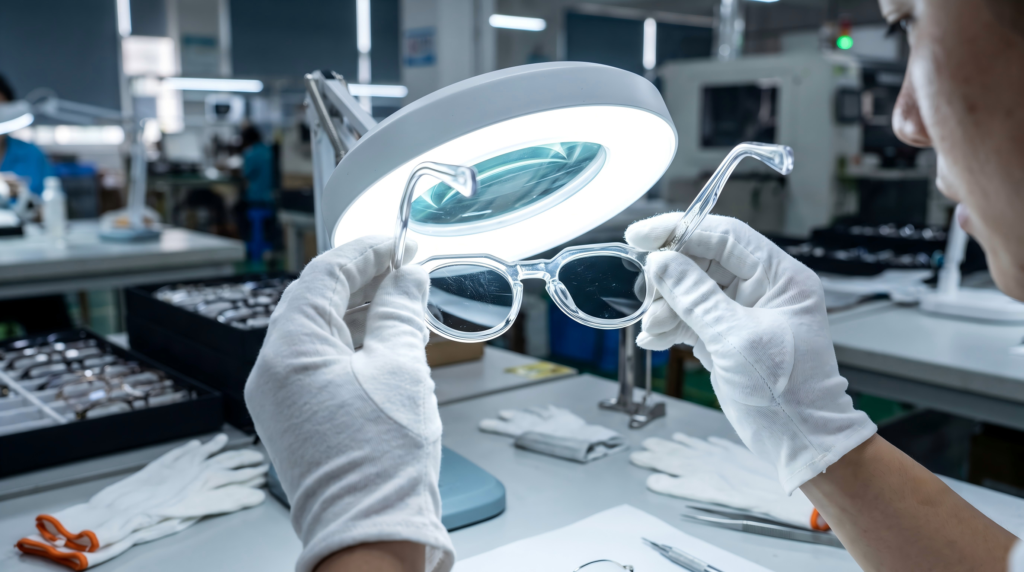
The first physical step in eyewear quality control involves the human eye. Inspectors pull random samples from the master cartons and examine them under bright, standardized lighting.
They look for flaws that would instantly disappoint a retail customer during an unboxing.
Frame Integrity
Inspectors check the frame front and temples for injection molding errors or CNC routing mistakes.
-
Acetate Frames: Are there any rough edges? Did the tumbling and polishing process leave the frame with a high-gloss finish, or does it look dull?
-
Plastic/TR90 Frames: Are there visible “flash” marks (excess plastic seeping out of the mold seams)? Are there sink marks or tiny air bubbles trapped in the material?
-
Metal Frames: Does the PVD plating look even? Are there any scorch marks or messy weld joints around the hinges?
Lens Perfection
The lens is the functional heart of the product. Inspectors hold the glasses up to the light, checking for hairline scratches, smudges, or coating defects. If you ordered mirrored or REVO lenses, the inspector ensures the color gradient transitions smoothly without peeling or flaking at the edges.
Branding and Pad Printing
A skewed logo instantly cheapens a premium product. Inspectors verify that the laser engraving or pad printing on the temples perfectly matches the artwork file you provided. They check that the CE marks, FDA logos, and model numbers on the inside of the arms are crisp and legible.
Step 3: Mechanical and Stress Testing
A pair of sunglasses might look perfect on the table, but how do they handle daily wear and tear? Thorough eyewear quality control requires subjecting the frames to mechanical stress.
The Hinge Test
The hinge represents the most vulnerable point on any frame. The inspector will open and close the temples dozens of times.
-
Standard Hinges: The movement should feel smooth with a slight, consistent friction. The temple should not flop open loosely, nor should it require excessive force to close.
-
Spring Hinges: The inspector will pull the temple outward past 90 degrees. The internal spring should snap the temple back into its resting position instantly, without any grinding noises or sluggish movement.
Frame Symmetry and “Wobble”
Humans have highly sensitive faces; even a one-millimeter misalignment will make the glasses sit crookedly. Inspectors place the open sunglasses upside down on a perfectly flat glass table. All four touchpoints (the top of the two rims and the tips of the two temples) must touch the glass simultaneously. If the glasses rock back and forth, the frame is warped, and the user will complain of a poor fit.
The Tape Test (Coating Adhesion)
If you ordered painted frames or mirrored lenses, the factory must prove the coating is durable. Inspectors perform a standard cross-hatch tape test. They apply a piece of strong 3M adhesive tape directly over the logo or the lens coating, rub it down firmly, and rip it off rapidly. If the logo ink or lens coating peels off onto the tape, the factory failed the curing process, and the batch fails the inspection.
Step 4: Lens Functionality and Safety Compliance
When you import sunglasses, you are legally responsible for their safety. A proper sunglasses inspection China protocol verifies that the lenses perform exactly as advertised and meet international regulatory standards.
UV Protection Verification
Inspectors place the sample lenses into a UV spectrometer. They verify that the lens blocks 100% of UVA and UVB rays up to 400 nanometers (UV400). If the machine registers anything less than 100% blockage, the factory likely used cheap, untreated lenses, and you cannot legally sell them as protective eyewear.
Polarization Testing
If you ordered polarized lenses for a watersports or driving collection, the inspector will look through the lens at a specialized polarization test card (usually an image that remains invisible to the naked eye but appears clearly through a polarized filter). They will also rotate the lens 90 degrees to ensure the polarization axis aligns perfectly horizontally. If the axis is skewed, the wearer will experience severe optical distortion and headaches.
The Drop Ball Test (FDA Requirement)
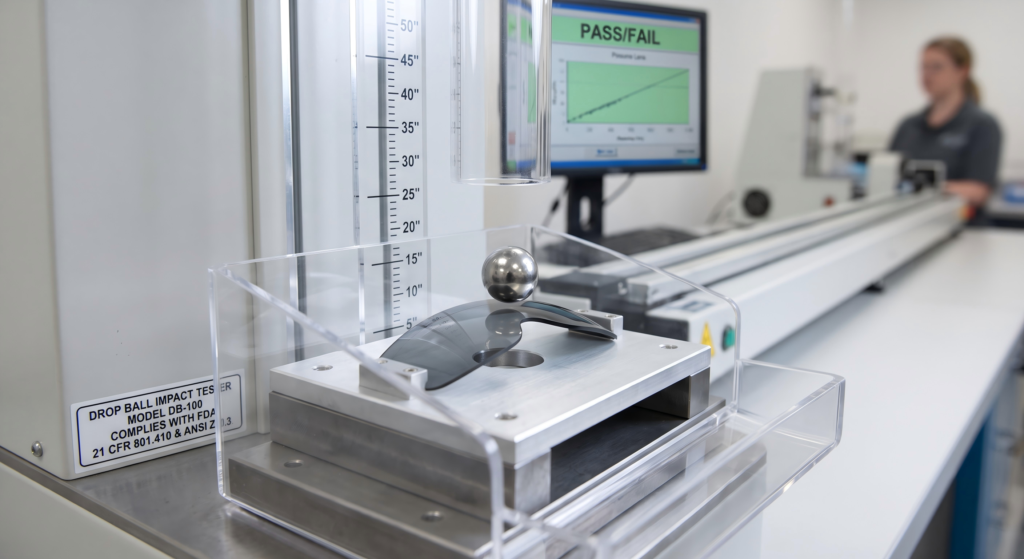
If you plan to sell your sunglasses in the United States, passing the FDA Drop Ball Test is non-negotiable. The inspector places the lens on a specialized testing rig and drops a 5/8-inch (16mm) solid steel ball bearing from a height of 50 inches directly onto the center of the lens. The lens must not shatter, crack, or chip. This test ensures the eyewear provides basic impact protection and protects you from liability lawsuits.
Step 5: Packaging and Shipping Verification
The final phase of eyewear quality control ensures your products will survive the bumpy, weeks-long journey across the ocean.
-
Barcode and Labeling: The inspector scans the UPC barcodes on the exterior retail boxes to ensure they route to the correct product variants in your inventory system. They verify that the shipping marks on the master cartons match your freight forwarder’s exact requirements.
-
Drop Testing the Master Carton: The inspector drops the fully loaded, sealed master carton from various angles and heights onto a concrete floor. They then open the carton to verify that the internal packaging (cases, polybags, and bubble wrap) successfully protected the sunglasses from crushing or scratching.
Conclusion: Inspect What You Expect
You cannot build a reputable brand on trust alone. Assuming that a factory will execute every minor detail flawlessly without oversight is a dangerous business strategy.
By implementing a strict, documented eyewear quality control procedure, you shift the risk back to the manufacturer. When factories know that a third-party inspector will perform tape tests, drop ball tests, and symmetry checks before you release the final payment, they prioritize your production run and assign their best technicians to your assembly line.
Whether you fly to Wenzhou yourself, hire a specialized agency, or demand detailed video evidence, mastering the sunglasses inspection China process guarantees that when your inventory finally arrives at your warehouse, it is ready to sell, ready to impress, and ready to scale your brand.