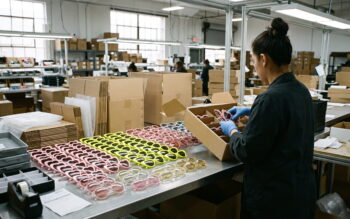
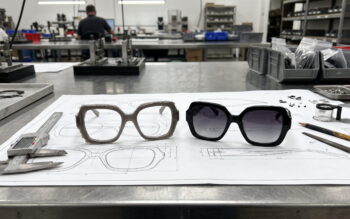
In the highly competitive eyewear market, consumers no longer view prescription sunglasses as a clunky, purely medical necessity. Today, they expect high fashion, seamless integration, and advanced optical performance. For eyewear brands, boutique owners, and optical distributors, offering a robust line of prescription sunglasses is essential for capturing a high-margin demographic.
However, transforming a standard sun frame into a precision optical instrument requires far more than just swapping out a pair of tinted plastics. Partnering with a professional prescription sunglasses manufacturer demands a deep understanding of the complex engineering and quality control processes that occur on the factory floor.
This comprehensive guide takes you inside the RX sunglasses OEM production process. We will explore the critical design differences between standard and RX frames, how factories manage lens base curves, the intricacies of progressive lens integration, and what you must know before placing your next bulk order.
The Core Difference: Standard Sunglasses vs. RX-Ready Frames
Many new eyewear brands assume they can take any sunglasses design, send it to an optical lab, and insert prescription lenses. This is a costly misconception. There is a fundamental architectural difference between standard sunglasses and “RX-Ready” frames.
Manufacturers design standard, off-the-shelf sunglasses (often called “plano” sunglasses) to hold flat, non-prescription lenses. The factory prioritizes aesthetic appeal and basic UV protection. Factories often injection-mold these frames as a single, solid piece, or design them with shallow lens grooves.
An RX-Ready frame, on the other hand, is engineered specifically to accommodate the complex physics of corrective lenses. A true prescription sunglasses manufacturer builds these frames with the following distinct features:
-
Deeper V-Grooves (Bevels): Prescription lenses, especially those for higher diopters, are significantly thicker at the edges (for myopia/nearsightedness) or the center (for hyperopia/farsightedness). An RX-ready frame features a deeper, meticulously routed V-groove inside the rim to secure these thicker lenses securely without warping the frame.
-
Adjustable Components: While a standard sunglass frame might have fixed, molded nose pads, an RX frame often features adjustable metal pad arms or heavily contoured acetate bridges. This allows the optician to precisely align the optical center of the lens with the wearer’s pupil.
-
Demo Lenses: RX-ready frames ship from the factory with clear, flat “demo lenses.” These exist purely to maintain the structural integrity of the frame during shipping and are meant to be popped out and discarded by the optical lab.
-
Robust Hinge Architecture: Because prescription lenses add substantial weight to the frame, the hinges must be upgraded. OEM factories use heavy-duty barrel hinges or premium spring hinges to handle the increased load and maintain a secure fit.
Engineering the Fit: Base Curves and PD Ranges
When integrating prescription lenses into sunglasses, the frame’s curvature is one of the most critical engineering hurdles.
Understanding the Base Curve
The “base curve” refers to the front curvature of the lens and the corresponding wrap of the frame. The human eye naturally operates at roughly a 6-base curve.
-
4-Base to 6-Base: Most standard optical glasses and fashion sunglasses use a 4 or 6-base curve. These relatively flat frames are highly compatible with almost all prescription lenses.
-
8-Base (Wrap-Around): Sports sunglasses and high-coverage frames typically use an 8-base curve, wrapping tightly around the face.
The Engineering Challenge: Fitting high prescriptions into an 8-base frame is notoriously difficult. If a strong prescription lens is bent to fit a highly curved frame, it induces extreme peripheral distortion and a “fish-bowl” effect for the wearer. A skilled prescription sunglasses manufacturer will advise brands to design their RX collections around a 6-base curve. If an 8-base design is strictly required, the factory must utilize specialized digital freeform lens generation to compensate for the wrap angle.
The PD (Pupillary Distance) Range
For RX lens integration to be successful, the frame’s dimensions must align with standard human Pupillary Distances (the distance between the centers of the pupils, usually between 58mm and 68mm).
If a brand designs an oversized, massive fashion frame, the geometric center of the lens may sit far outside the wearer’s actual PD. When the optical lab cuts the prescription lens to match the wearer’s PD, the thickest part of the lens is forced to the extreme outer edge of the frame, resulting in an incredibly heavy and cosmetically unappealing pair of sunglasses. OEM designers must calculate the “Frame PD” (Lens Width + Bridge Width) to ensure it can comfortably accommodate standard optical prescriptions.
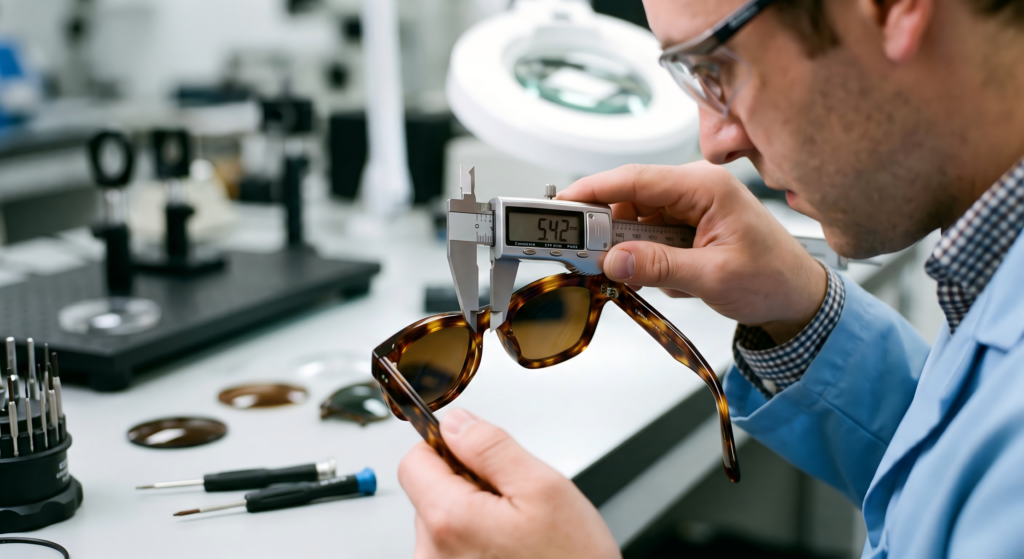
Selecting the Right Lens Material for RX Sunglasses
Once the frame architecture is finalized, the choice of lens material dictates the weight, durability, and optical clarity of the final product. When partnering with an RX sunglasses OEM, you will typically choose from these primary materials:
-
CR-39 (Standard Plastic): The traditional standard for optical lenses. CR-39 offers excellent optical clarity (high Abbe value) and takes tints beautifully, making it ideal for custom sunglass colors. However, it is relatively thick and not highly impact-resistant. It is best suited for low-to-moderate prescriptions in fashion frames.
-
Polycarbonate (PC): The undisputed king of impact resistance. PC lenses are up to 10 times more impact-resistant than CR-39, making them the mandatory choice for sports sunglasses, children’s eyewear, and safety glasses. They are lighter and thinner than CR-39, though their optical clarity is slightly lower.
-
Nylon (Polyamide): Nylon offers a premium middle ground. It combines the extreme impact resistance and lightweight properties of Polycarbonate with the superior optical clarity of CR-39. Nylon is highly flexible and resistant to chemical cracking, making it the preferred choice for high-end, rimless, or drill-mount RX sunglasses.
-
High-Index Plastics (1.60, 1.67, 1.74): For customers with very strong prescriptions (high myopia or hyperopia), standard materials result in lenses that are “coke-bottle” thick. High-index materials bend light more efficiently, allowing the factory to produce much thinner, lighter lenses. While more expensive, integrating high-index options is crucial for premium RX brands.
The Complexity of Progressive RX Sunglasses
While single-vision lenses (correcting for one distance) are straightforward, manufacturing progressive prescription sunglasses (correcting for distance, intermediate, and near vision seamlessly) represents the pinnacle of RX lens integration.
In an OEM environment, manufacturing progressive sun lenses requires state-of-the-art Freeform Digital Surfacing. Instead of casting the lens in a standard mold, the factory uses multi-axis CNC generators. A diamond-tipped tool carves the complex, multi-focal prescription directly onto the back surface of the lens blank, pixel by pixel.
This digital precision is critical for sunglasses because the dark tint of the lens naturally reduces the amount of light entering the eye, which can shrink the wearer’s depth of field. Optical technicians must perfectly fit the progressive channel (the zone of clear vision) based on the wearer’s precise measurements and the specific face-form angle of the sunglass frames, ensuring a comfortable visual experience whether reading poolside or glancing at a car’s dashboard.
Quality Control: Optical Centers and the Prism Effect
In standard sunglass manufacturing, Quality Control (QC) focuses primarily on cosmetic flaws: checking for scratches, testing hinge tension, and verifying UV400 coatings. In prescription sunglasses manufacturing, the QC process becomes a rigorous medical inspection.
Verifying the Optical Center
The optical center of a lens is the exact point where light passes through without bending—the “sweet spot” of the prescription. During final assembly, the factory technicians use a specialized device called a lensometer. They must verify that the optical center of the cut lens aligns perfectly with the specified Pupillary Distance of the end-user. If the optical center is misaligned by even a few millimeters, the wearer will experience immediate eye strain, headaches, and blurred vision.
Managing the Prism Effect
If a technician improperly decenters the optical center, or forces a strong prescription into a highly curved frame, the lens induces an unwanted “prism effect.” This effect causes light to bend improperly, effectively displacing the image the wearer sees.
While optometrists sometimes intentionally prescribe prisms to correct eye alignment issues (like heterophoria), an unwanted prism effect represents a critical manufacturing failure. A premium RX sunglasses OEM utilizes advanced digital mapping to ensure their edging machines cut the lens perfectly to eliminate unwanted prismatic deviation, guaranteeing true, undistorted vision.
Sourcing Strategy: MOQ and the Custom OEM Process
Transitioning from standard fashion frames to a customized RX-ready line requires careful strategic planning with your manufacturing partner.
-
Minimum Order Quantities (MOQ): Because RX-ready frames require precise CNC routing for deep V-grooves and upgraded hinge hardware, factories typically require higher MOQs than they do for basic, injection-molded promo glasses. Expect MOQs for high-quality acetate or titanium RX frames to start between 300 to 500 pieces per model. (Often split across several colorways).
-
The Prototyping Phase: Do not rush the sample phase. When you receive your RX-ready prototypes, do not just check the colors. Take the prototype to a local optician. Ask them to cut and mount a strong prescription lens (+4.00 or -4.00) into the sample. If the frame warps, the groove is too shallow, or the hinges stress, you must correct the tech pack before approving mass production.
-
Packaging Integration: Remember that consumers purchasing prescription sunglasses expect a premium unboxing experience. Work with your OEM partner to design durable hard cases that protect the heavy frames, and ensure your branded cleaning cloths are safe for high-end anti-reflective (AR) coatings.
Conclusion: Engineering Vision and Style
The market for prescription sunglasses represents a highly lucrative convergence of medical necessity and high fashion. Modern consumers refuse to compromise; they demand frames that look like they belong on a runway but perform flawlessly as corrective medical devices.
Succeeding in this space requires moving beyond basic trading companies and partnering with a dedicated prescription sunglasses manufacturer that truly understands optical physics. By mastering the nuances of RX-ready frame architecture, base curve limitations, and rigorous lens integration quality control, you can deliver a product that offers your customers perfect vision and unparalleled style. When vetting your next RX sunglasses OEM, focus on their engineering capabilities just as much as their aesthetic designs—because in the world of prescription eyewear, precision is the ultimate luxury.
Learn More