Walk into almost any major pharmacy chain or big-box retailer stretching from the East Coast all the way to growing western hubs like Salt Lake City, Utah, and you will see the same thing: a spinning rack of reading glasses. For decades, this display served as a simple, low-tech solution for customers experiencing presbyopia—the natural aging of the eyes.
But the retail landscape in 2026 looks vastly different. Today’s consumers live entirely on their screens. A standard pair of single-vision reading glasses forces a customer to constantly take their glasses on and off as they switch between looking at their smartphone, their computer monitor, and the world across the room.
Shoppers now actively hunt for multi-focal solutions right off the shelf. They want the convenience of bifocals and the seamless power of progressives without paying premium optometrist prices. For retail buyers and pharmacy procurement teams, upgrading your optical displays to include these advanced lenses represents a massive leap in profit margins and customer loyalty.
However, sourcing these complex lenses requires a deep understanding of optical manufacturing. If you partner with the wrong progressive reading glasses manufacturer, you risk stocking lenses that cause dizzy spells and trigger massive return rates.
This guide strips away the technical jargon. We will break down exactly how these lenses work, explore the frame trends dominating 2026, and show you exactly how to scale your inventory by purchasing premium bifocal reading glasses wholesale.
The Anatomy of Multi-Focal Lenses: What You Are Actually Selling
Before you submit a purchase order, you need to know exactly what you are putting on your pharmacy shelves. While both lens types help people see up close and far away, they achieve this in completely different ways.
Bifocal Reading Glasses: The Classic Workhorse
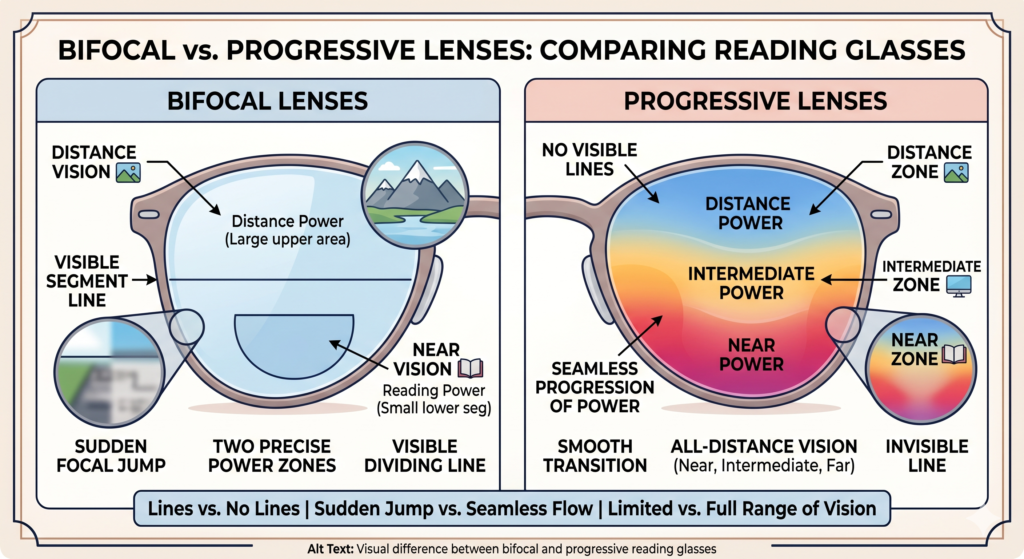
Bifocals represent the traditional approach to multi-focal vision. The manufacturer divides the lens into two distinct optical zones, separated by a visible horizontal line.
-
The Top Zone: This area features zero magnification (plano). The wearer looks straight ahead through this clear glass to watch television, drive, or talk to someone across the room.
-
The Bottom Zone: This small “D-shaped” segment sitting at the bottom of the lens contains the magnification power (e.g., +1.50, +2.00). The wearer drops their eyes down to read a menu or a text message.
-
The Retail Advantage: Bifocals are incredibly easy for new users to adapt to. The sharp line tells their brain exactly where to look. They are also highly cost-effective to produce, making them an excellent entry-level product when you order bifocal reading glasses wholesale.
Progressive Reading Glasses: The Modern Upgrade
Progressives offer the ultimate optical experience. Instead of a harsh dividing line, a progressive reading glasses manufacturer engineers a seamless, invisible gradient of power straight down the lens.
-
The Top Zone: Zero magnification for distance viewing.
-
The Middle Zone (The Corridor): As the eye moves downward, the magnification slowly increases. This middle section perfectly captures the “intermediate” distance—roughly arm’s length, which is exactly where computer monitors sit.
-
The Bottom Zone: The bottom of the lens hits the maximum magnification power for reading fine print.
-
The Retail Advantage: Progressives look like normal glasses because they lack the “old-fashioned” bifocal line. Customers gladly pay a premium retail price for this aesthetic and the added benefit of computer-distance viewing.
Behind the Factory Doors: How We Manufacture Complex Lenses
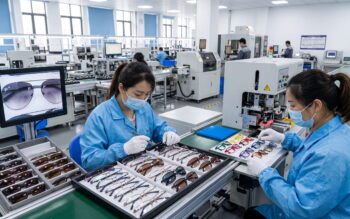
Creating a single-vision reader is easy; you simply pop a standard magnifying lens into a plastic frame. Manufacturing multi-focal lenses for over-the-counter retail requires extreme precision. As a premier progressive reading glasses manufacturer, we rely on advanced technology and meticulous quality control to protect your brand’s reputation.
The Casting and Grinding Process
To create a progressive gradient, we cannot just use a standard mold. Our engineers use digital free-form surfacing technology. Computer-controlled diamond lathes grind the back surface of a polycarbonate or CR-39 lens blank, carving the exact, microscopic curves needed to create that seamless transition from zero power to full magnification.
The Optical Center Challenge
When an optometrist custom-makes a progressive lens, they measure the patient’s exact Pupillary Distance (PD). In over-the-counter retail, we must engineer a “universal” fit. We extensively analyze demographic facial data to map the optical center perfectly in the middle of the frame. This ensures that when a shopper in a North American pharmacy tries the glasses on, their eyes naturally align with the correct viewing corridors. If a factory gets this centering wrong, the glasses will induce immediate nausea.
Collaborative Design Workflows
Bringing a new collection of complex readers to market requires tight collaboration between our engineering team and your retail buyers. We streamline this by utilizing modern digital design platforms. Instead of sending confusing spreadsheets, we share interactive, highly visual tech packs. When our retail partners sit down to review our latest offerings—like a comprehensive “2026 Jan. recommendation” deck shared directly through collaborative cloud software—they can visually inspect the frame CADs, verify the lens mapping, and approve the designs rapidly. This modern workflow eliminates miscommunication and drastically speeds up your time-to-market.
Merchandising Strategy: Why Pharmacies Need Both
If progressives are visually superior, why should a retailer stock bifocals at all? The answer lies in consumer psychology and price architecture.
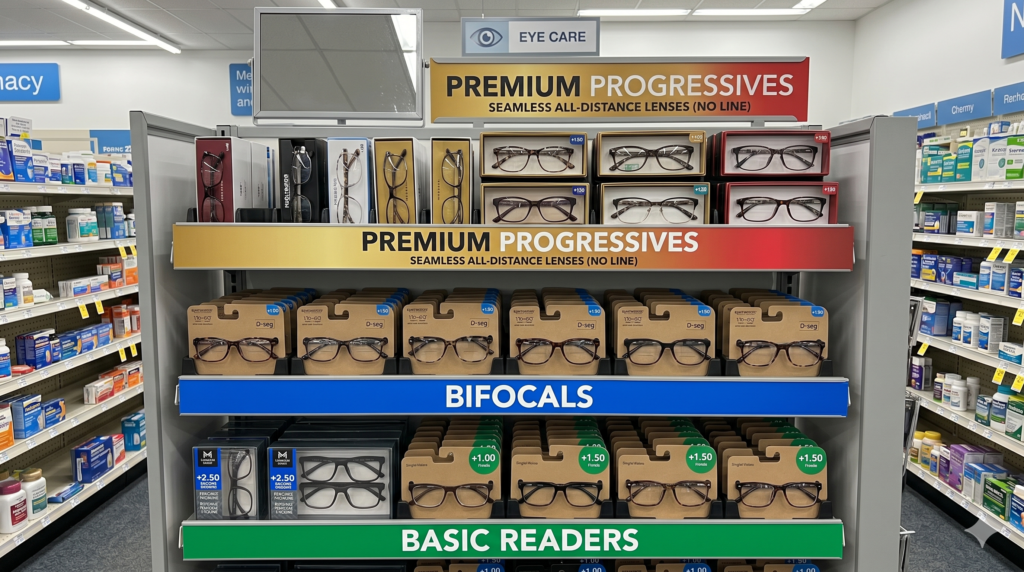
To maximize your shelf space, you need a tiered “Good, Better, Best” pricing strategy.
-
The “Good” Tier (Basic Readers): Standard single-vision readers for the budget-conscious shopper who only reads in bed.
-
The “Better” Tier (Bifocals): Sourcing bifocal reading glasses wholesale allows you to offer a functional multi-focal option at a highly accessible price point. Many senior customers actively prefer the distinct line because they have worn them for decades and do not want to retrain their brains to use a progressive lens.
-
The “Best” Tier (Progressives): This is your premium, high-margin product. You target the 40-to-55-year-old demographic—professionals who spend all day on computers and refuse to wear glasses that make them look “old.”
By offering both, you capture every single demographic walking down the pharmacy aisle.

2026 Frame Trends for Over-the-Counter Readers
A phenomenal progressive lens will not sell if you mount it inside an ugly, outdated frame. Consumers treat reading glasses as fashion accessories. They buy multiple pairs to match different outfits and leave them scattered around their homes and offices.
For 2026, the market has completely shifted away from flimsy wireframes and heavy, uncomfortable plastics.
The Dominance of Transparent TR90
Consumers want frames that feel invisible. We highly recommend utilizing TR90—a Swiss-engineered thermoplastic that is incredibly flexible and practically weightless. When you inject TR90 with a high-gloss clear or transparent finish, the resulting frame instantly brightens the wearer’s face. Transparent frames never clash with clothing, making them the ultimate safe, high-turnover choice for retail buyers.
The Professional Polish of Tortoise
When a customer needs reading glasses for the boardroom or a nice restaurant, they reach for the Tortoise pattern. Modern injection molding allows us to create rich, multi-dimensional tortoise patterns that look like expensive, handmade acetate. An oversized, geometric Tortoise frame equipped with a progressive lens offers the ultimate blend of high-end fashion and practical utility.
Blue Light Integration
In 2026, every progressive reading glass you stock should include a blue light blocking coating. Since the middle corridor of a progressive lens is designed explicitly for computer use, adding a blue-light filter creates a highly marketable “Digital Reader.” This dual-functionality instantly justifies a higher retail price point.
Global Logistics: Getting Your Inventory to the Shelf
Designing the perfect collection is only half the battle. As a retail buyer, your ultimate concern is landing the product safely in your distribution centers without destroying your margins on freight and tariffs.
Navigating international supply chains requires a resilient manufacturing partner. At Zhantai Glasses, we operate a sophisticated dual-hub production model to ensure global stability.
While our headquarters in Wenzhou, China, houses our core engineering and mold-making expertise, we also operate a state-of-the-art Thailand factory. This dual presence is a massive strategic advantage for buyers in the North American market. By routing major wholesale orders through our Thailand facility, we help our corporate clients bypass specific regional export tariffs. Whether you are shipping to a centralized distribution hub in the Midwest or supplying a network of retail pharmacies across Utah and the West Coast, our logistics team ensures a streamlined, cost-effective, and legally compliant delivery process.
How to Execute a Bifocal Reading Glasses Wholesale Order
Partnering with an expert OEM/ODM factory guarantees product quality and consistency. Here is exactly how we guide our retail partners through the bulk ordering process.
Step 1: Design and Specification Review
You tell us your target demographic and retail price point. We help you curate a specific collection, utilizing our latest trend data. You choose the frame styles (like classic Tortoise or modern transparent shapes) and we lock in the specific magnification powers you want to offer—typically ranging from +1.00 to +3.00.
Step 2: Prototyping and Optical Testing
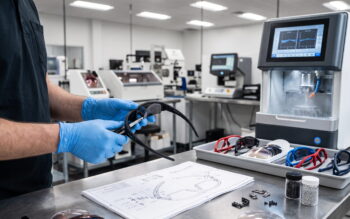
Before we manufacture a single unit for retail, we produce physical prototypes. We do not just check the frame color; our Quality Control technicians run the progressive and bifocal lenses through highly calibrated lensometers. We map the optical centers to ensure the transition corridors are smooth and completely free of peripheral distortion. You receive these prototypes to test on actual faces.
Step 3: Mass Production and The MOQ
Once you approve the prototypes, we cut the steel injection molds and begin mass production. Because engineering flawless multi-focal lenses and setting up automated production lines requires significant industrial calibration, we operate with a strict Minimum Order Quantity (MOQ) of 1200 units per style. This scale allows us to run the machines efficiently, providing you with the aggressive unit pricing necessary to thrive in the competitive pharmacy retail sector.
Step 4: Custom Retail Packaging
We do not just ship loose glasses. We act as a full-service partner, printing your custom folding cartons, designing your branded microfiber pouches, and applying UPC barcodes directly to the packaging. When your bifocal reading glasses wholesale shipment arrives at your receiving dock, the units are completely retail-ready, saving your warehouse team hundreds of hours of manual labor.
Conclusion
The era of the simple, basic reading glass is over. Today’s dynamic consumers demand sophisticated optical solutions that keep up with their screen-heavy lifestyles. By upgrading your pharmacy or retail displays to include high-quality bifocal and progressive lenses, you instantly capture a highly motivated demographic willing to pay premium prices for visual comfort.
However, delivering this comfort requires absolute manufacturing precision. A poorly centered progressive lens will ruin your brand’s reputation instantly. You must source your inventory from a dedicated progressive reading glasses manufacturer who understands the exact science of free-form surfacing, optical centering, and precision injection molding.
At Zhantai Glasses, we merge decades of Wenzhou optical heritage with modern, tariff-efficient global logistics. From reviewing initial 2026 design decks to delivering fully packaged, retail-ready units at an MOQ of 1200, we provide the manufacturing horsepower you need to dominate the retail optical market.