When an athlete steps out the door, their eyewear is as critical to their performance as their footwear. However, treating sports eyewear as a universal, “one-size-fits-all” accessory is a guaranteed way to ruin a workout—or worse, risk an injury.
The aerodynamic needs of a cyclist descending a mountain pass at 60 km/h are fundamentally different from the glare-reduction needs of an alpinist crossing a high-altitude glacier. Before you can choose the perfect pair of running sunglasses or riding sunglasses, you first need to understand what separates a true piece of sports equipment from standard fashion eyewear.
The Anatomy of True Sports Sunglasses
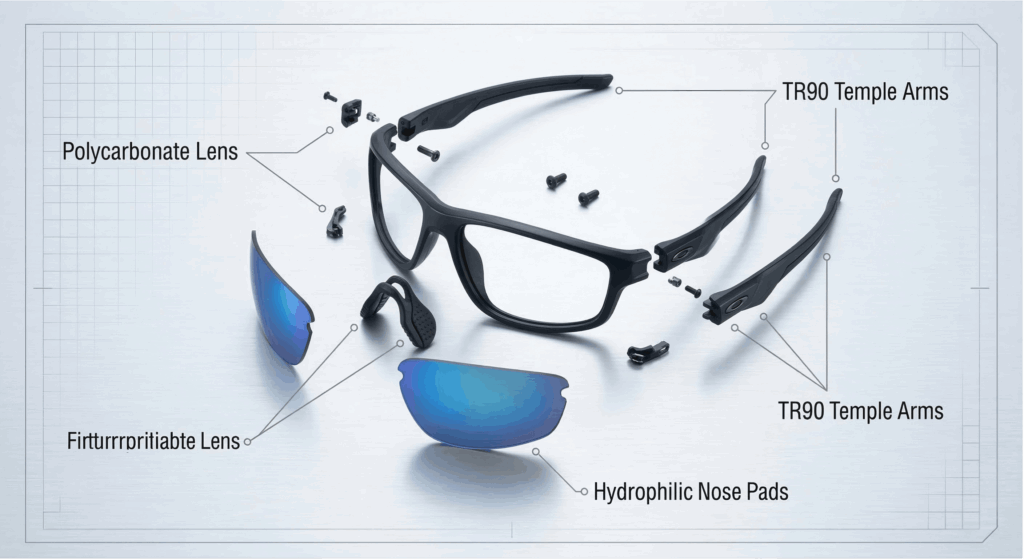
Every high-performance sports frame, regardless of the specific activity, is built on three foundational pillars: Materials, Grip, and Optics.
Shatterproof Optics
Standard sunglasses often use glass or basic plastic, which can shatter upon impact. Professional sports lenses are constructed from Polycarbonate or Trivex—materials that can withstand a direct hit from a pebble or a branch without sending shards into the eye.
Ultra-Lightweight Frames
Heavy materials like acetate or metal are replaced by advanced polymers like TR90. TR90 is highly flexible, heat-resistant, and incredibly light, allowing the frame to absorb shock rather than snap.
Hydrophilic Grip
Sweat is the enemy of stability. Sports frames utilize hydrophilic rubber on the nose pads and temple tips. Unlike standard plastic, this material becomes tackier when exposed to moisture, effectively locking the frame to the athlete’s face.
Once these foundational elements are in place, manufacturers tweak the geometry, lens tint, and structural coverage to adapt to specific environments. Let’s break down the three most demanding outdoor scenarios.
Running Sunglasses – The Battle Against Gravity and Bounce
The Environment: High-impact, repetitive vertical motion, heavy perspiration, and frequently changing micro-climates (moving from direct sun to tree cover).
When you run, your body experiences forces up to three times your body weight with every footstrike. If your eyewear isn’t engineered for this, it will bounce, slide, and chafe.
Core Functional Requirements:
The Anti-Bounce Architecture
The defining feature of elite running sunglasses is weight distribution. Manufacturers achieve this by utilizing half-rim or completely rimless designs. By removing the bottom half of the frame, the glasses shed unnecessary grams and shift the center of gravity closer to the brow, preventing the “seesaw” bouncing effect.
Adjustable, Tack-Heavy Nose Pads
Because human nose bridges vary wildly, running sunglasses must have adjustable wire-core nose pads wrapped in thick hydrophilic rubber. This allows the runner to pinch the pads for a custom, vice-like grip that won’t slip, even during a humid, sweaty marathon.
Optimal VLT (Visible Light Transmission)
Runners frequently transition between bright asphalt and shaded trails. Lenses with a VLT of 15% to 30% (Category 2 to 3) are the sweet spot. Many runners opt for photochromic lenses, which automatically darken in UV light and lighten in the shade, eliminating the need to take the glasses off mid-run.
Riding Sunglasses – Aerodynamics and High-Speed Defense
The Environment: High speeds, constant headwind, flying debris (dust, bugs, gravel), and the need for extreme peripheral awareness.
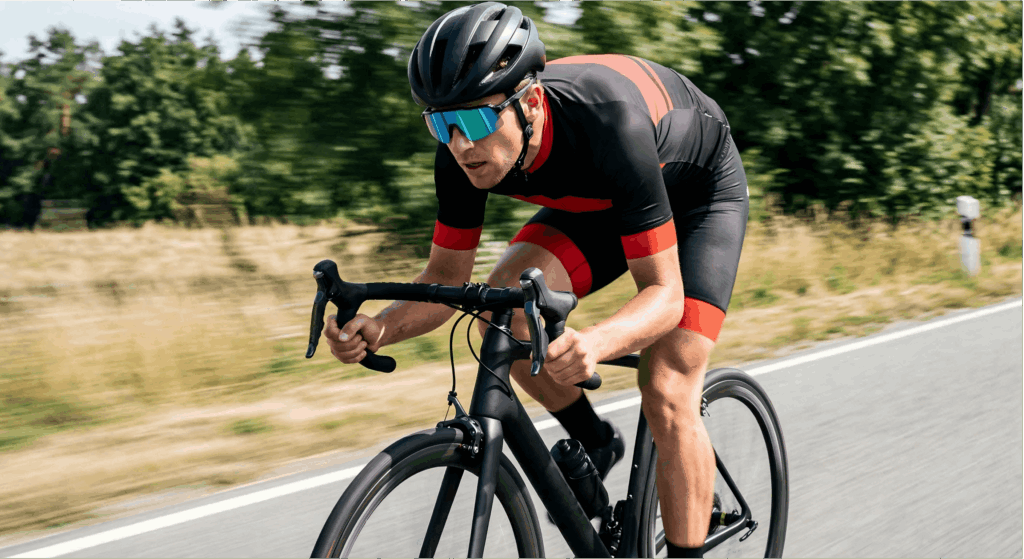
A cyclist on the road or trail is essentially a human vehicle. At speeds exceeding 30 km/h, the primary enemy is wind. If air gets behind the lens, it rapidly dries out the eyes, causing excessive tearing and blurred vision—a catastrophic risk on a bicycle.
Core Functional Requirements:
The Shield and Wrap-Around Design
Standard frames allow wind to vortex behind the glass. Professional riding sunglasses feature a high base curve (often an 8-base or higher) or a massive, single-piece cylindrical shield lens. This creates an aerodynamic barrier that forces wind around the face, protecting the eyes from high-velocity dust and insects.
Helmet-Compatible Geometry
Cyclists wear helmets with complex retention systems. The temple arms (the sides) of riding glasses must be perfectly straight, thin, and slightly shortened so they can slide smoothly over or under helmet straps without digging into the skull.
Anti-Fog Ventilation
A massive shield lens traps body heat. To prevent fogging during steep, slow climbs, riding frames incorporate precise aerodynamic vents cut directly into the top or sides of the lens. This creates a micro-airflow that clears moisture without blasting the eyes.
High-Contrast Lens Tints
Cyclists need to spot the difference between smooth asphalt, loose gravel, and dangerous oil slicks in milliseconds. Lenses with rose, amber, or copper base tints naturally heighten contrast and depth perception, making road textures pop.
Mountaineering Glasses – Extreme Altitude & UV Isolation
The Environment: High altitudes with thin atmosphere, intense and unfiltered UV radiation, blinding omnidirectional glare from snow/ice, and unpredictable alpine weather.
In mountaineering, eyewear isn’t just about comfort; it is a critical survival tool. Exposure to high-altitude sun reflecting off snow can cause photokeratitis (snow blindness)—a painful condition where the cornea is literally sunburned.
Core Functional Requirements:
Category 4 Lens Protection
For high-altitude environments, the standard Category 3 lenses used in running and cycling are dangerous. Mountaineers require Category 4 lenses, which have a VLT of just 3% to 8%, blocking out almost all visible light. (Note: Because they are so dark, Cat 4 lenses are illegal to wear while driving a car).
Total Peripheral Sealing
In the mountains, UV rays don’t just come from the sky; they bounce upward off the glacier. Mountaineering sunglasses must feature side shields (often made of leather, spandex, or plastic) and a center brow-blocker to create a completely sealed optical chamber. No light should enter from the top, bottom, or sides.
Polarization
While road cyclists sometimes avoid polarized lenses (to better see wet patches on asphalt), mountaineers rely on them. Polarization is the only way to effectively neutralize the blinding, horizontal glare reflecting off ice and snow.
Fail-Safe Security
If you drop your glasses down a crevasse, you are in immediate danger. These frames feature curved temple tips that wrap securely around the back of the ear, often paired with an integrated retention lanyard around the neck.
The Ultimate VLT & Feature Comparison Matrix
To summarize the technical specifications, use this quick-reference guide when selecting your next frame:
| Feature / Environment | Running Sunglasses | Riding Sunglasses | Mountaineering Glasses |
| Primary Challenge | Vertical Bounce & Sweat | Wind, Speed & Debris | Extreme UV & Glare |
| Ideal Frame Style | Half-rim or Minimalist | Oversized Shield / Wrap | Full-rim with Side Shields |
| Ventilation Needs | Moderate | High (Strategic Vents) | Low (Sealed against elements) |
| Ideal VLT | 15% – 30% (Cat 2-3) | 10% – 30% (Cat 2-3) | 3% – 8% (Cat 4) |
| Best Lens Tech | Photochromic | High-Contrast (Rose/Amber) | Polarized / Mirror Coated |
| Crucial Hardware | Hydrophilic nose pads | Straight, thin helmet temples | Ear hooks & Retention cord |
Conclusion
The difference between an amateur setup and a professional kit lies in the specialization of the gear. You wouldn’t wear heavy hiking boots for a track sprint, and you shouldn’t wear casual fashion shades for a grueling triathlon.
By understanding the physics of your sport—whether it’s the vertical impact of running, the high-speed aerodynamics of cycling, or the extreme UV exposure of mountaineering—you can select eyewear that actively enhances your performance rather than holding you back.