Newsroom

News Release |

Why Professional Cycling Sunglasses Use One-Piece Shield Lenses?

The “Invisible” Nose Pad: Unveiling the Science Behind One-Piece Cycling Sunglasses

If you watch any professional cycling race today, you will immediately notice a dominant trend: the riders are wearing massive, futuristic eyewear that looks more like a ski goggle than traditional sunglasses. From a distance, these giant visors appear to float on the face, leading to a common question among cycling enthusiasts: Why do professional cycling sunglasses have no nose pads?
First, let’s gently correct a common optical illusion. These high-performance glasses do have nose pads—they just aren’t the traditional, bulky metal wires or plastic bridges you see on everyday eyewear. Instead, the nose piece is stealthily integrated behind a massive one-piece shield lens (also known as a monolens).
This shift away from dual-lens frames isn’t just a fashion statement. It is a calculated engineering choice designed to maximize speed, safety, and vision. Here is a deep dive into the aerodynamic and optical advantages of the one-piece shield lens in professional cycling.
Why Professional Cycling Sunglasses Use One-Piece Shield Lenses?

The Optical Advantage: Eliminating the “Dead Zone”

The most significant flaw of traditional, dual-lens sunglasses in cycling is the frame itself.
When you ride a road bike, particularly when you are in the “drops” (leaning low over the handlebars for speed), your head is tilted downward, but your eyes must look upward to see the road ahead.

The Problem with Traditional Frames

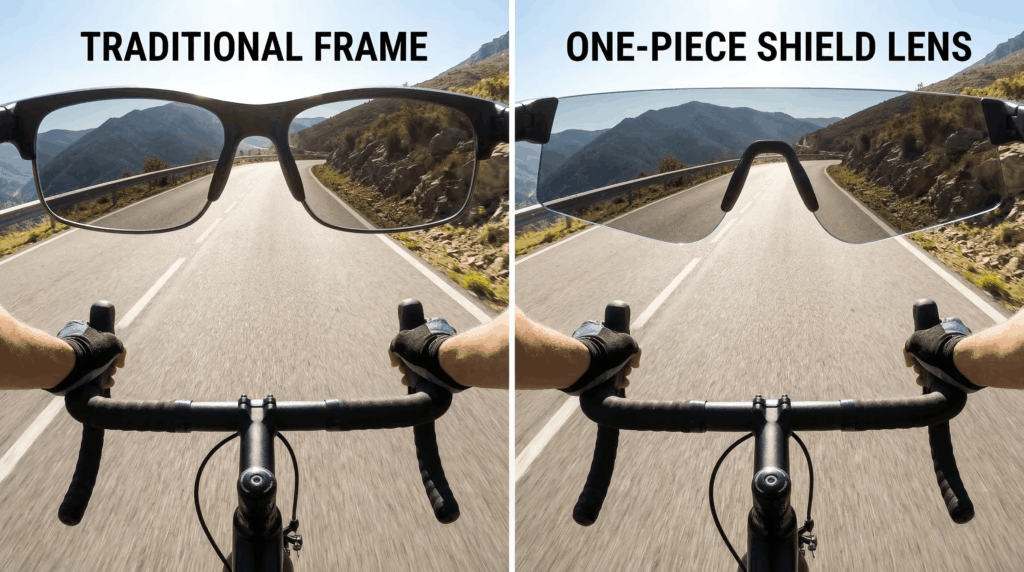
If you wear normal sunglasses in this aggressive posture, your line of sight goes directly into the upper rim of the frame or the central nose bridge. This creates a dangerous “dead zone” or blind spot right in the center of your vision.

The One-Piece Solution

A frameless cycling sunglass or a one-piece shield lens completely removes the central bridge and the upper rim. By extending a single, uninterrupted sheet of polycarbonate across the entire face, cyclists gain an infinite, unobstructed field of vision. Whether looking over their shoulder for an attack or staring down a steep descent, there is no plastic frame blocking the view.

Aerodynamics: Slicing Through the Wind

In cycling, aerodynamic drag is the ultimate enemy. When speeds exceed 40 kilometers per hour, most of a cyclist’s energy is expended solely on overcoming air resistance.
Aerodynamic cycling eyewear functions exactly like the windshield of a sports car.
A traditional dual-lens frame has ridges, gaps, and a protruding central bridge. These structural interruptions create micro-turbulences and vortexes as air hits the face, adding drag.
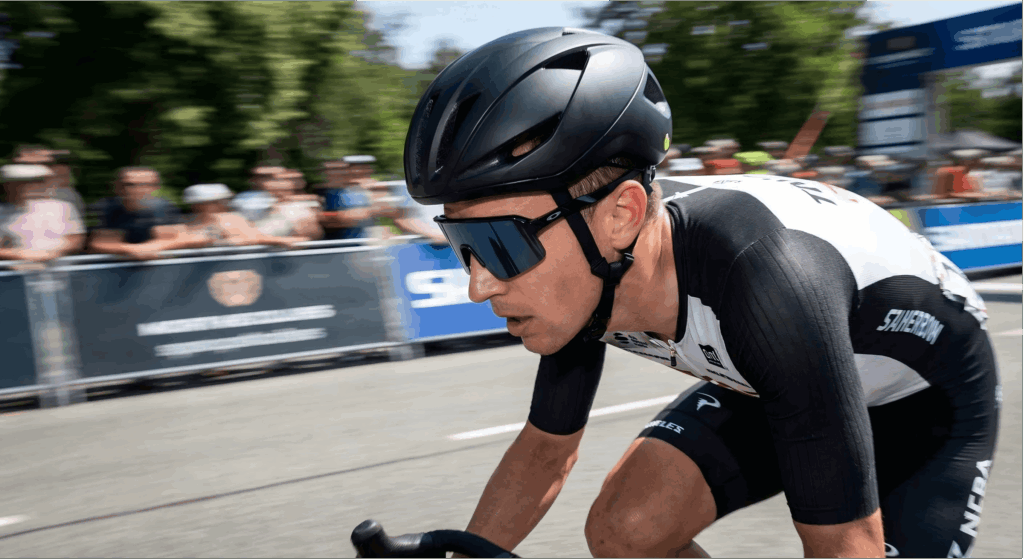
A one-piece shield lens offers a continuous, smooth surface. The air hits the curved center of the lens and slips cleanly around the sides of the rider’s head. By hiding the nose pad behind the lens and extending the glass to the temples, manufacturers drastically reduce aerodynamic drag.
Cycling Sunglasses

The “Micro-Climate” and Windshield Effect

Cycling exposes the eyes to a relentless assault of wind, dust, insects, and road spray. A continuous shield lens provides a vastly superior physical barrier compared to two smaller lenses.
Total Coverage: The oversized nature of the one-piece lens wraps tightly around the cheekbones and up to the eyebrow line, preventing wind from sneaking under or over the glasses.
Tear Prevention: By sealing off the eye area, the shield prevents high-speed wind from drying out the cornea, which causes excessive, vision-blurring tearing.
Fog Management: Because the shield sits further off the face and utilizes hidden nose bumpers, engineers can laser-cut precise ventilation holes at the top or bottom of the single lens. This creates a controlled airflow that prevents fogging on long, sweaty climbs without blasting the eyes with wind.


Weight Distribution: Lighter and Faster

It might seem counterintuitive that a massive piece of glass is lighter than smaller glasses, but the secret lies in the frame structure (or lack thereof).
By relying on the structural integrity of a single, thick polycarbonate or Trivex lens, manufacturers can eliminate the heavy plastic or metal rims that usually encircle the lenses. The lens itself becomes the frame. The temple arms and the hidden, minimalist rubber nose grip are attached directly to the lens. This minimalist, frameless cycling sunglass approach shaves off crucial grams, ensuring the glasses don’t slide down the rider’s face during intense, bumpy, and sweaty efforts.

Summary: The Evolution of Speed

The shift to the one-piece shield lens is a perfect example of form following function. What looks like a bold fashion choice is actually the result of rigorous wind-tunnel testing and optical engineering.
Feature Traditional Dual-Lens Glasses One-Piece Shield Lenses
Field of Vision Restricted by central bridge and top rim 100% Unobstructed panoramic view
Aerodynamics Creates turbulence at the bridge Smooth, uninterrupted airflow
Debris Protection Vulnerable at the center and edges Maximum “windshield” coverage
Weight Structure Requires heavy rims to hold lenses Lens acts as its own lightweight frame
Next time you see a rider wearing glasses that seem to have no nose pads, you’ll know the truth: the hardware is hidden, and the massive shield is doing the heavy lifting to keep them fast, safe, and focused on the finish line.

Recent Posts

Blue Light Glasses Manufacturer: What Brands Need to Know Before Ordering


In 2026, the average professional spends over nine hours a day staring at digital screens. From smartphones and dual-monitor office setups to late-night tablet reading, our daily exposure to high-energy visible (HEV) blue light has reached unprecedented levels. Consequently, consumer demand for protective eyewear has skyrocketed. Blue light blocking glasses have evolved from a niche […]

Blue Light Glasses Manufacturer: What Brands Need to Know Before Ordering
Full Article

Shield Sunglasses & Wrap-Around Frames: A Complete Manufacturing Guide


In the dynamic landscape of fast-fashion and performance accessories, the boundary between athletic gear and high-fashion streetwear has completely dissolved. At the very center of this aesthetic collision sits one definitive silhouette: the shield frame. What began decades ago as strict safety equipment for cyclists and winter athletes has morphed into a dominant force on […]

Shield Sunglasses & Wrap-Around Frames: A Complete Manufacturing Guide
Full Article

Build Your Brand: Custom OEM Solutions for Cat Eye Sunglasses


Cat eye sunglasses have possessed a timeless charm since the 1950s. The design evolved significantly over the decades. Vintage styles featured large and oversized frames. Modern trends often favor sharp, small, and narrow shapes. However, the core spirit remains exactly the same. These glasses remain the ultimate accessory for women. They express pure independence, confidence, […]

Build Your Brand: Custom OEM Solutions for Cat Eye Sunglasses
Full Article

Professional Service Process

OEM/ODM service

Learn about the cooperation process
FAQs

Q1: What is your production capacity for OEM/ODM sunglasses orders?

Our total annual output exceeds 20 million pieces. For our primary injection styles, our capacity is between 800,000 and 1,000,000 pieces per month, while our metal production lines output 400,000 to 600,000 pieces per month. This large-scale capability allows us to support high-volume orders for global supermarkets and chain stores reliably.

Q2: What kind of customization services do you provide for fast-fashion brands?

We offer a complete product and packaging one-stop service. Our R&D team develops over 50 new sample designs per month based on market research and trend analytics. We fully support custom frames, lenses, and LOGO customization to match your exact brand identity.

Q3: How long is the typical lead time for samples and bulk production?

We pride ourselves on speed and efficiency. We offer fast sample-making within 7 to 15 days. If your project requires a new mold, it typically takes 20 to 30 days. For bulk order production, our standard lead time is 30 to 60 days.

Q4: Do your sunglasses meet international quality and safety standards?

Absolutely. We strictly follow quality control steps from raw materials (IQC) to finished products (OQC). Our factory and products hold comprehensive professional qualification certificates, including CE, FDA, ISO 9001, ISO 13485, BSCI, SMETA, and the Global Recycled Standard.

Q5: Do you have experience working with major global retailers?

Yes, Wenzhou Zhantai Glasses has over 30 years of company history and extensive experience manufacturing for top supermarkets, ecommerce platforms, and global brands. Our recognized quality control has earned us partnerships with industry leaders like Walmart, Disney, Muji, Safilo, and QUAY. By working with us, you receive factory prices with no middlemen.

Q6: What types of eyewear materials do you manufacture?

We work with a wide variety of materials across our 3 production lines. Our capabilities include injection PC and TR, metal, acetate, and eco-friendly materials. This diverse material expertise allows us to meet the specific price points and design requirements of different fast-fashion brands and supermarkets.

Q7: What are your main product categories?

Our main products are sunglasses, optical glasses, and reading glasses. While we specialize in injection sunglasses for retail chains, we also have dedicated production lines for optical frames and reading glasses to provide a comprehensive eyewear catalog.

Q8: What is your Minimum Order Quantity (MOQ)?

As an OEM/ODM factory focusing on large-scale production, our standard MOQ is 1200 pieces per model for 3-4 colors. However, we offer flexible solutions for trial orders or specific customization needs. Please contact our sales team to discuss your project.

Q9: Do you have manufacturing facilities outside of China?

Yes, we do. In addition to our main 10,000-square-meter headquarters in Wenzhou, China, we also operate a specialized manufacturing facility in Thailand. Having a dual-country production strategy allows us to provide our global clients with highly flexible supply chain solutions, optimize import logistics, and mitigate international trade risks (such as tariffs). This ensures uninterrupted, high-capacity delivery for major supermarkets and brands.

Q10: What is your company’s background and manufacturing scale?

Wenzhou Zhantai Glasses was founded in 1990, giving us over 30 years of deep expertise in eyewear manufacturing. Our headquarters covers a construction area of over 20,000 square meters and employs more than 500 skilled workers. Thanks to the trust of our global clients, we maintain a highly stable operational status; our annual turnover continues to grow steadily, reaching $40 million in 2025, with a projected figure of $45 million in 2026. We are a financially strong and scalable partner ready for long-term collaboration.

Get in touch

Let’s build your vision together. Backed by 30 years of manufacturing excellence, Zhantai Glasses offers the quality and customization your brand needs to stand out. From concept to global distribution, we handle the details so you can focus on growth.

Let's collaborate for exceptional eyewear. We look forward to a meaningful collaboration.

Wenzhou Zhantai Glasses

Beiwei No.2 Street, Ouhai District, Wenzhou City, Zhejiang Province, China.

[email protected]