In the dynamic landscape of fast-fashion and performance accessories, the boundary between athletic gear and high-fashion streetwear has completely dissolved. At the very center of this aesthetic collision sits one definitive silhouette: the shield frame.
What began decades ago as strict safety equipment for cyclists and winter athletes has morphed into a dominant force on the 2026 fashion runways. Today, consumers demand massive, face-hugging wrap-around sunglasses for music festivals, urban commutes, and everyday luxury styling. For international supermarkets, department stores, and fast-fashion retailers, stocking these high-turnover, high-margin items is absolutely essential for driving seasonal revenue.
However, moving a highly curved, single-lens design from a conceptual sketch to a physical retail display requires overcoming significant optical and structural engineering hurdles. Choosing the right shield sunglasses manufacturer dictates the quality, profitability, and delivery speed of your entire collection.
This comprehensive guide explores the structural mechanics of the wrap-around shape, breaks down the dominant aesthetic trends for 2026, and provides a detailed roadmap for executing high-volume bulk orders tailored for rapid international distribution.
The Anatomy of Shield & Wrap-Around Sunglasses
To understand why retailers aggressively hunt for this specific style, we must dissect how its extreme geometry interacts with the human face and the surrounding environment.
Wrap-around sunglasses break the traditional rules of optical design. Instead of utilizing a flat front with two separate lenses, they rely on extreme base curves.
-
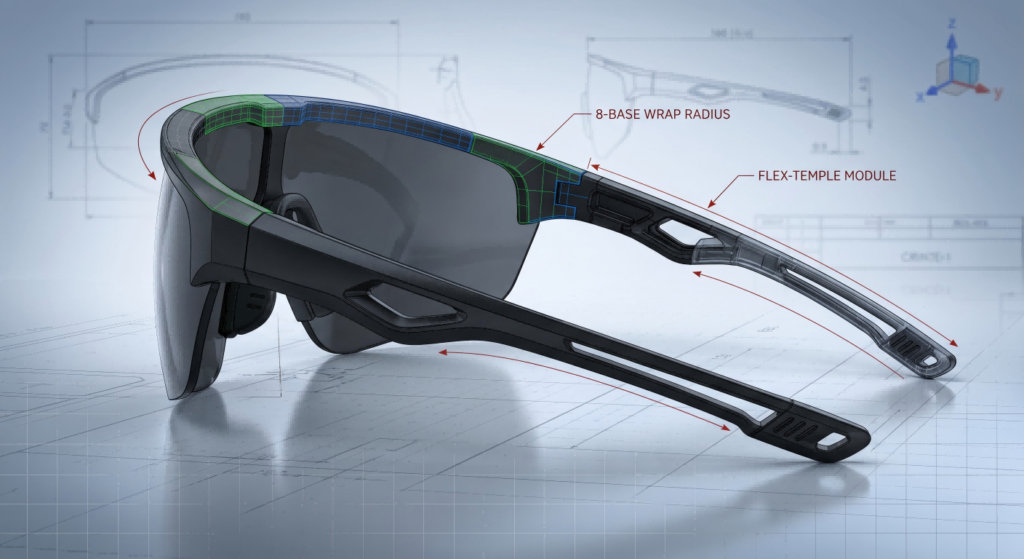
The High Base Curve (8-Base and 9-Base): Traditional fashion sunglasses usually feature a 4-base or 6-base curve, which keeps the front of the frame relatively flat. Shield and wrap-around styles utilize an 8-base or 9-base curve. This extreme curvature allows the frame to contour tightly against the wearer’s skull, wrapping around the temples to eliminate peripheral light leakage.
-
The Monolens (One-Piece Shield): The defining feature of a shield frame is the single, continuous lens spanning across the entire face. This completely removes the central nose bridge from the wearer’s line of sight, providing an infinite, unobstructed panoramic view.
-
Aerodynamic Profile: The flush, contoured fit creates a seamless aerodynamic barrier. It prevents wind, dust, and debris from vortexing behind the lens, making it functionally superior for active consumers while providing a highly aggressive, futuristic aesthetic.
Because these frames provide massive surface area coverage and a striking visual impact, they command immediate attention on retail display racks. Shoppers gravitate toward them because they offer instant, effortless anonymity and a powerful modern edge.
Defining the 2026 Trends for Wrap-Around Eyewear
While the oversized, face-hugging shape serves as the main attraction, the materials and colorways dictate whether the frame actually sells. Buyers must curate their inventory based on current material science and color trends to ensure rapid inventory turnover.
The Rise of Clear and Transparent Polymers
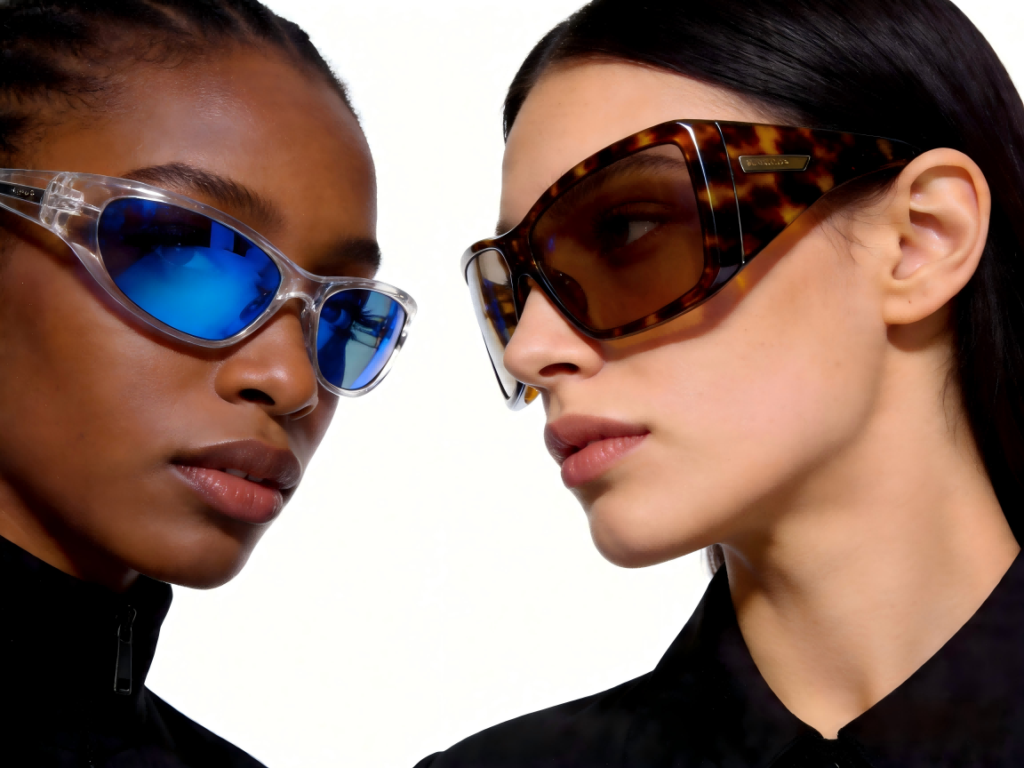
Consumers actively move away from visually oppressive, heavy black frames. In 2026, the market demands high-gloss clear and transparent injection-molded plastics.
When you apply a transparent finish to an aggressive shield frame, the result is spectacular. The sleek, curved lines of the frame catch the sunlight, refracting it beautifully while lightening the overall visual weight on the face. For retail buyers, stocking transparent options dramatically reduces inventory risk. Clear frames seamlessly match any seasonal clothing palette, guaranteeing strong sales across all retail seasons.
The Unexpected Fusion: Classic Tortoise on Futuristic Shapes
Typically, designers reserve the Tortoise pattern for classic retro squares or vintage cat-eyes. However, 2026 introduces a brilliant juxtaposition: applying rich, classic Tortoise finishes to highly aggressive, futuristic wrap-around frames. This fusion creates a unique aesthetic that bridges the gap between activewear and traditional luxury. Advanced injection molding technology allows factories to create multi-dimensional Tortoise designs that look incredibly expensive, elevating the perceived value of the product instantly.
Vibrant Mirror Coatings and Gradient Shields
Because the one-piece lens on a shield frame is so massive, it serves as a giant canvas for color. Brands pair clear frames with high-impact mirrored lenses in colors like electric blue, fiery orange, or bright silver. The mirror coating reflects intense glare and completely hides the wearer’s eyes. Alternatively, gradient tints—which fade from a dark tint at the top to a lighter tint at the bottom—allow the wearer to block harsh overhead sunlight while clearly reading their smartphone screen.
The Engineering Challenge: Precision Injection Molding
Designing a shield frame presents unique manufacturing challenges that standard shapes never face. Buyers must understand these realities when sourcing products to ensure they do not purchase defective inventory.
The challenge lies entirely in the extreme curvature. When a machine injects molten plastic into a highly curved steel mold, the liquid material must flow evenly to prevent warping. If the factory does not precisely control the injection pressure and mold temperature, the frame will cool unevenly. An unevenly cooled wrap-around frame will warp, meaning it will pinch the wearer’s temples painfully or fail to hold the massive shield lens securely.
To solve this, a premium shield sunglasses manufacturer utilizes advanced mold-flow analysis software and highly calibrated injection machines.
TR90 for Unmatched Flexibility and Comfort
For highly curved frames, TR90 is the ultimate material choice. This advanced thermoplastic polymer provides extreme flexibility and shape memory. A consumer can stretch the wrap-around temple arms wide to fit their head, and the TR90 material will comfortably grip the skull without causing pressure headaches. It instantly snaps back to its original shape when removed.
Polycarbonate (PC) for High-Impact Lenses
The massive single lens requires absolute structural integrity. Polycarbonate serves as the industry standard for shield lenses. It is incredibly lightweight and highly impact-resistant. Because an 8-base curved lens can cause optical distortion (making straight lines look curved), manufacturers must taper the thickness of the PC lens—making it thicker in the center and thinner at the edges—to provide flawless, distortion-free vision.
The Brand Philosophy: Precision Meets Aesthetics
At Zhantai Glasses, our approach to optical manufacturing stems from a deeply unique origin. In the 1990s, a husband-and-wife team founded our enterprise. Interestingly, their early professional backgrounds were not in industrial manufacturing, but in the culinary arts and professional hair styling.
While this might seem unconventional, it provided the perfect foundational philosophy for premium eyewear manufacturing. The culinary arts demand exact “recipes,” precise temperature control, and rigorous timing. Hair styling requires an innate, architectural understanding of facial framing, balance, and aesthetic structure.
We applied these exact principles directly to our injection molding processes. We treat polymer blends and injection temperatures with the same rigorous precision as a master chef, and we evaluate the curves and angles of our wrap-around sunglasses with the meticulous eye of a master stylist. This dedication to structural perfection and aesthetic beauty ensures that every high-volume batch we produce looks and performs flawlessly.
Navigating the Global Supply Chain: The Thailand Advantage
In 2026, international brands face significant logistical challenges. Fluctuating commodity markets, shifting shipping costs, and complex US-China trade relations require brands to build highly resilient supply chains.
If a buyer relies on a manufacturer confined to a single geographic location, they expose their entire retail operation to massive geopolitical and logistical risks.
To provide our international B2B clients with unparalleled stability and competitive pricing, Zhantai Glasses actively operates a state-of-the-art Thailand factory alongside our Wenzhou headquarters. This dual-hub strategy offers immense strategic advantages:
-
Tariff Mitigation: By utilizing our Thailand facility, we help global brands bypass specific regional export tariffs, securing better profit margins.
-
Targeting the Americas: The demand for oversized and wrap-around styles is currently exploding across North American and Latin American markets. Our Thailand facility provides a highly efficient shipping route to supply large-scale retail buyers and fast-fashion chains rapidly expanding into Mexico and the broader Americas.
-
High-Volume Capacity: Operating multiple facilities allows us to dedicate specific injection machines entirely to your bulk orders, ensuring we never miss a seasonal launch deadline.
The Bulk OEM/ODM Ordering Process: A Step-by-Step Guide
Executing a high-volume custom order requires a highly organized workflow to guarantee success and protect your retail profit margins. Here is the exact step-by-step roadmap you will experience when you initiate a bulk order for your next seasonal collection.
Step 1: Design Consultation and Technical Specifications
The process begins with your brand’s specific vision. Your buying team provides reference concepts, target demographic data, and ideal retail price points to our engineering department. We lock in the technical specifications together. You decide whether to utilize a sleek transparent TR90 polymer or a high-gloss Tortoise PC finish. We ensure all external packaging and product descriptions use clean, consumer-facing language. Finally, we finalize the lens VLT (Visible Light Transmission) category and select the specific mirror coatings.
Step 2: 3D CAD Modeling and Physical Prototyping
Our engineers generate precise 3D CAD models of your highly curved shield frame. After your team approves the digital files, the factory utilizes advanced CNC machining to produce a physical prototype. This crucial step allows your buyers to hold the product, test the ergonomic wrap-around fit on a human face, and verify all visual proportions and lens tapers before committing to mass production.
Step 3: Mold Creation and The MOQ Standard
Upon your approval of the physical prototype, our engineers cut the heavy steel injection molds. Because designing and tooling these complex 8-base curve molds requires massive engineering labor and expensive machine time, mass production relies heavily on economies of scale.
To optimize the injection machines and deliver the lowest possible unit cost for our corporate clients, we operate with a strict Minimum Order Quantity (MOQ) of 1200 units per style. This volume guarantees production efficiency and ensures your brand achieves the aggressive profit margins required for modern retail.
Step 4: High-Speed Mass Production and Assembly
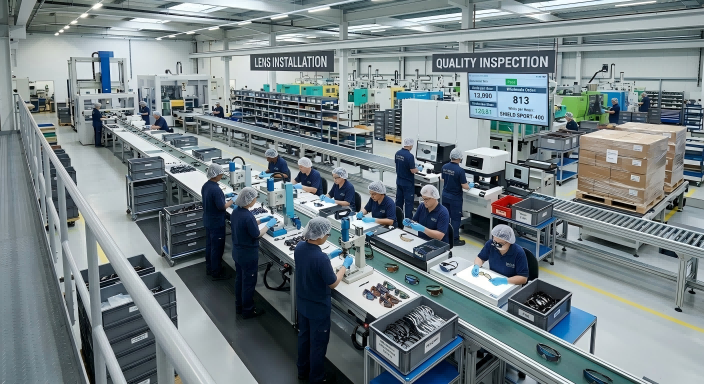
With the steel molds locked into the injection machines, mass production officially begins. Technicians inject the molten TR90 or Polycarbonate into the molds under extreme pressure, paying careful attention to the cooling cycles to prevent warping. Once the raw frames cool, the finishing team meticulously polishes the plastic to achieve a perfect, high-end luster.
The assembly department then installs the durable metal hinges, snaps the massive UV400 shield lenses securely into the front rims, and applies your custom brand logo to the wide temple arms using precision pad printing or laser engraving.
Step 5: Final Inspection and Freight Logistics
Before the factory boxes your bulk order, every single pair passes through a rigorous Quality Assurance checkpoint. Inspectors manually verify the hinge tension, check the massive lenses for microscopic scratches, and confirm that the frame colors perfectly match your approved prototype. Finally, the logistics team packages the sunglasses according to your exact retail specifications and arranges direct freight shipping from our Thailand or Wenzhou facilities directly to your international distribution centers in Mexico, Europe, or the United States.
Conclusion
Wrap-around sunglasses and massive shield frames are no longer a fringe athletic experiment; they are a highly profitable, foundational pillar of the modern fast-fashion and accessories market. Their unique aerodynamic structure, combined with their unparalleled ability to drive impulse purchases on the retail floor, makes them a mandatory inclusion for any department store or international supermarket chain looking to maximize revenue in 2026.
By understanding the vital market shifts—such as the massive consumer demand for lightweight transparent frames and striking Tortoise patterns—you can curate an inventory that immediately captures consumer attention. Furthermore, by sourcing your collections through a dedicated, high-capacity shield sunglasses manufacturer who understands the exact science of injecting highly curved molds, you secure the production scale and quality consistency required to dominate the competitive retail landscape.
At Zhantai Glasses, we engineer our production lines specifically to meet the rigorous demands of large-scale B2B retail. With our deep manufacturing heritage, our strategic Thailand facility offering seamless global logistics, and our commitment to flawless execution at an MOQ of 1200 units per style, we provide the exact manufacturing power your brand needs to succeed.