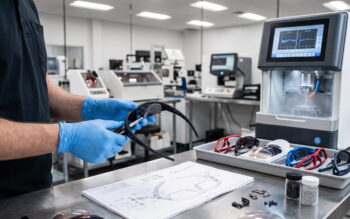
For decades, the optical industry treated clip-on sunglasses as a clunky, unfashionable afterthought. Consumers associated them with the heavy, scratching metal prongs of the 1990s—functional, perhaps, but certainly not stylish.
Today, that narrative has completely flipped. Advances in injection molding, ultra-strong neodymium magnets, and lightweight polymer engineering have transformed clip-on sunglasses into one of the most profitable, fast-growing categories in the B2B optical market.
Optical brands now realize that consumers who wear prescription (RX) glasses desperately want a seamless sun-protection solution. They do not always want to pay for a dedicated pair of high-index prescription sunglasses, and they often dislike the slow reaction time of photochromic (transition) lenses. Modern, seamlessly integrated clip-on sunglasses solve this exact consumer pain point.
At Wenzhou Zhantai Glasses Co., Ltd., we have spent years engineering and perfecting the manufacturing processes required to build these complex two-piece systems. Designing a standard sunglass frame is straightforward; engineering an optical frame and a sunglass clip that lock together flawlessly requires extreme precision. Today, we take you onto the factory floor to explain exactly how we manufacture premium clip-on sunglasses, what materials you should specify, and how to avoid the most common OEM production failures.
The Evolution of the Mechanism: Hooks vs. Magnets
If you want to add clip-on sunglasses to your brand’s catalog, your first decision dictates the entire engineering process: How will the clip attach to the base frame? We manufacture two primary systems.
The Traditional Mechanical Hook (The Vintage Approach)
Many premium acetate optical brands still request mechanical clips. We manufacture a thin, separate metal chassis (usually stainless steel or memory metal) that features four tiny prongs covered in protective silicone or shrink-wrap tubing. The wearer manually stretches this metal chassis over the front of their thick acetate optical frame. We typically reserve this style for high-end, vintage-inspired collections. It offers a classic, intellectual aesthetic. However, it requires the consumer to use two hands to attach the clip, and if the factory fails to coat the metal prongs properly, the clip will eventually scratch the expensive acetate base frame.
The Magnetic Integration System (The Modern Standard)
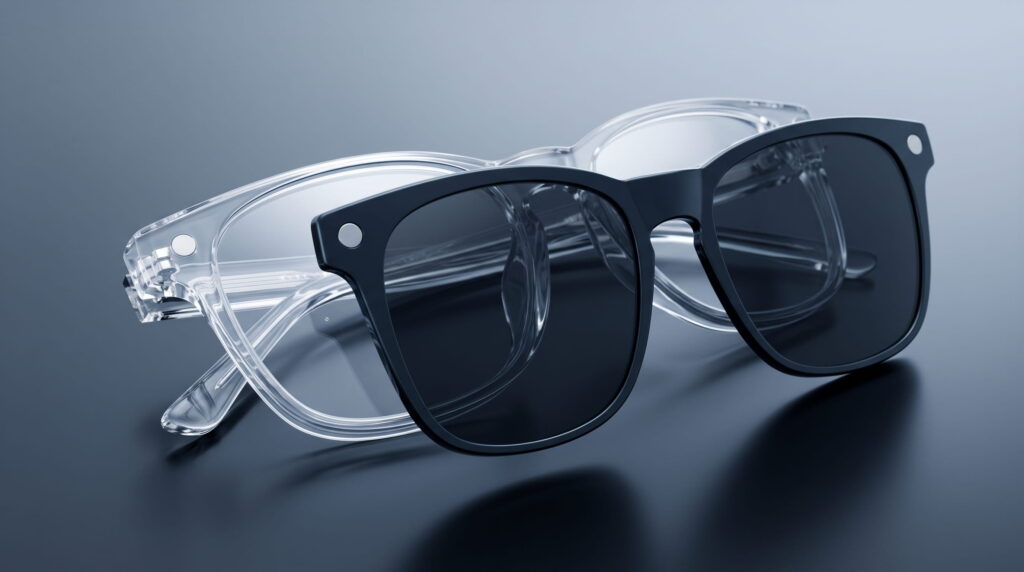
This is the current industry gold standard. We embed tiny, ultra-strong magnets directly into the front chassis of the optical frame, and matching magnets into the corners of the sunglass clip. When the consumer brings the clip near their face, the magnetic fields catch, and the clip forcefully snaps into perfect optical alignment in a fraction of a second. The wearer can attach or remove the lenses with one hand while driving. Because there are no mechanical hooks stretching over the frame, the final product looks exactly like a standard, sleek pair of sunglasses.
Engineering the Perfect Fit: The Secret of the Base Curve
The most difficult challenge in manufacturing clip-on sunglasses is the gap. If you look at a poorly manufactured magnetic clip-on from a side angle, you will see a massive, ugly gap between the clear prescription lens and the dark sunglass lens. Light bounces into this gap, causing terrible internal reflections that blind the wearer.
Eliminating this gap requires absolute mastery of the “Base Curve.”
The base curve dictates the physical curvature of the lens and the frame chassis. If the optical frame uses a flat 4-base curve, but the factory cuts the sunglass clip using a more wrapped 6-base curve, the two pieces will rock against each other and never sit flush.
At Zhantai, our CAD engineers design the optical frame and the sunglass clip simultaneously in the same 3D digital workspace. We match the base curves perfectly. Furthermore, we must calculate the exact thickness of the high-index prescription lenses the consumer will eventually install. We design a micro-millimeter tolerance into the magnetic clip housing to ensure the dark sunglass lenses float just above the clear optical lenses—close enough to eliminate the gap, but far enough away to ensure they never rub together and scratch.
Material Selection: The Battle Against Weight
When a customer wears clip-on sunglasses, they are effectively wearing two frames on their nose. If you use the wrong materials, the glasses become unbearably heavy, causing headaches and leaving deep red indentations on the wearer’s nose bridge.
To succeed in this category, B2B buyers must prioritize ultra-lightweight materials.
Ultem (PEI)
Ultem is an aerospace-grade polymer that dominates the premium clip-on market. It is significantly lighter than standard acetate, highly heat-resistant, and possesses incredible flexibility. When we injection-mold the base optical frame and the matching clip out of Ultem, the combined weight often feels lighter than a single traditional acetate frame.
TR90 (Nylon)
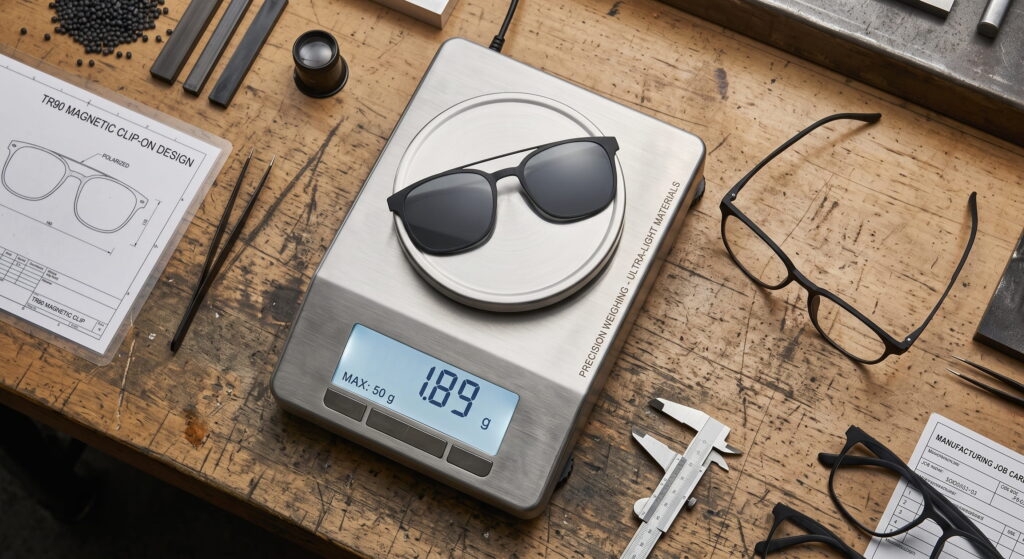
TR90 remains the workhorse of the industry. It offers exceptional flexibility and shape memory. We frequently recommend TR90 for athletic or lifestyle magnetic clip-ons. It allows us to mold extremely thin, subtle sunglass clips that do not add visual bulk to the base frame.
Titanium
For luxury brands, we machine both the optical chassis and the magnetic clip out of pure titanium. Titanium provides the highest strength-to-weight ratio available. A titanium magnetic clip-on system projects premium executive authority while remaining feather-light on the face.
Embedding the Magnets: Precision CNC vs. Injection Molding
If you choose a magnetic system, the factory must install the magnets flawlessly. We source N52-grade neodymium magnets, which are currently the strongest permanent commercial magnets available. We must ensure the clip stays locked onto the frame even if the wearer turns their head rapidly or goes for a run.
Factories use two different techniques to install these magnets:
-
Post-Process CNC Insertion: We inject or carve the frame first. Then, a multi-axis CNC machine drills a microscopic hole into the outer corners of the frame. A technician manually glues the silver magnet into the hole. This leaves the silver magnet visibly exposed on the front of the frame. Many brands like this aesthetic because it highlights the magnetic technology.
-
Over-Molding (Hidden Magnets): For a cleaner, stealthier look, we place the magnets directly inside the injection steel mold. We shoot the liquid TR90 or Ultem plastic around the magnet. The magnet is completely buried inside the plastic frame. This requires highly advanced tooling, but it results in a beautiful, seamless finish where the magnetic mechanism is completely invisible to the naked eye.
Lens Technology for the Sunglass Clip
The lenses you specify for the clip are just as important as the frame material. Because the clip sits in front of another lens, optical clarity is paramount.
We heavily advise our B2B clients to specify 1.0mm or 1.1mm TAC Polarized lenses for their clip-ons. TAC (Tri Acetate Cellulose) lenses are incredibly thin and lightweight, which keeps the total weight of the frame down. More importantly, polarization is a massive selling feature for prescription wearers who struggle with road glare while driving.
Furthermore, you must instruct your factory to apply a backside Anti-Reflective (AR) coating to the sunglass clip lens. Because the clip sits slightly in front of the clear optical lens, light can bounce between the two layers of plastic. A backside AR coating on the dark lens absorbs this bouncing light, completely eliminating the distracting internal reflections that plague cheap clip-on products.
Quality Control (QC): Preventing the Magnet Disaster
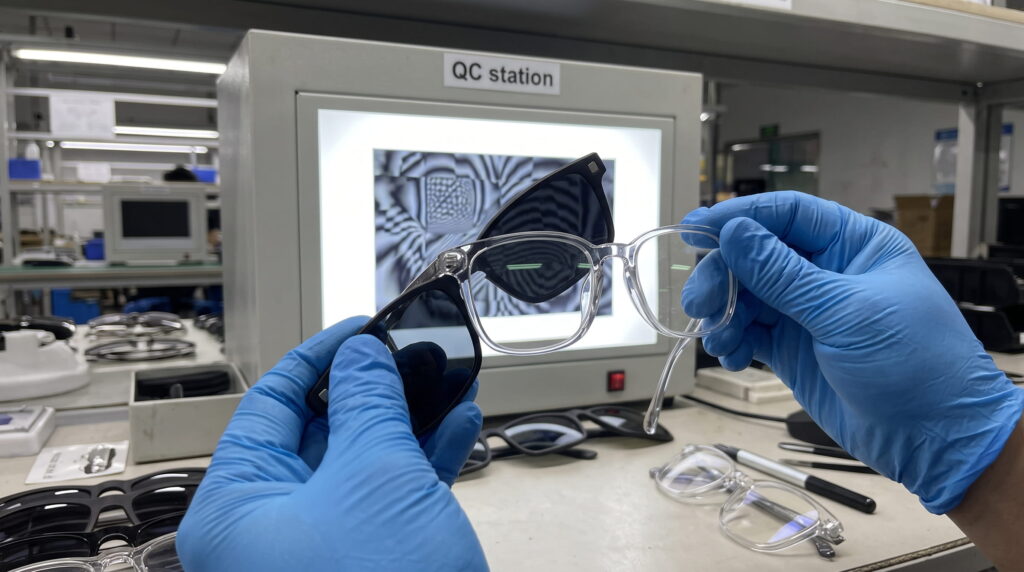
Manufacturing a two-piece system doubles the potential for production errors. Our Quality Control teams run a highly specialized, separate testing protocol specifically for clip-on sunglasses.
When sourcing these products, you must verify that your manufacturer checks for the “Polarity Flip.”
Magnets have a positive and a negative pole. During bulk assembly, a tired factory worker might accidentally glue a magnet into the clip upside down. Instead of attracting the clip to the frame, the magnet will aggressively repel it. If this slips past QC, your retail customer will open the box, try to attach the clip, and watch it fly right off the frame.
At Zhantai, we implement strict magnetic polarity testing stations on our assembly lines. We physically test the magnetic snap of every single unit before it goes into the master shipping carton. We also conduct drop tests to ensure the magnets do not dislodge from the plastic housing upon impact.
Conclusion: A Highly Profitable Addition to Your Catalog
Integrating clip-on sunglasses into your brand’s optical lineup is no longer a niche strategy; it is a required offering for modern eyewear consumers. By providing an ultra-lightweight, magnetically seamless solution, you capture the highly profitable demographic of prescription wearers who demand versatility without compromising their style.
However, executing this product requires a manufacturing partner who understands the complex geometry of base curves, the precise tolerances of N52 magnets, and the critical importance of backside AR coatings. When you source your clip-on collections strategically, focusing on high-grade Ultem or TR90 materials and flawless magnetic integration, you deliver an engineering marvel that your customers will wear every single day.