Millions of people who wear corrective eyeglasses step outside every single day and make a terrible choice. They either take off their eyeglasses and put on standard sunglasses—sacrificing their sharp vision for sun protection—or they keep their eyeglasses on and squint painfully through blinding sunlight.
A surprising number of consumers still believe this is a necessary compromise. They simply do not know that a perfect, all-in-one solution exists.
Polarized prescription sunglasses represent one of the most significant quality-of-life upgrades in the optical industry. They combine the exact medical correction of your daily eyeglasses with the advanced glare-blocking technology used by offshore fishermen and professional drivers.
As optical manufacturing experts, we want to demystify this technology. This guide dives deep into the fascinating physics of polarization, explains how factories integrate complex prescriptions into tinted lenses, and highlights why spreading awareness about polarized prescription sunglasses can revolutionize how people experience the outdoors.
The Physics of Glare: Why Standard Sunglasses Fail
To understand why polarized lenses are so revolutionary, we must first understand the enemy: glare.
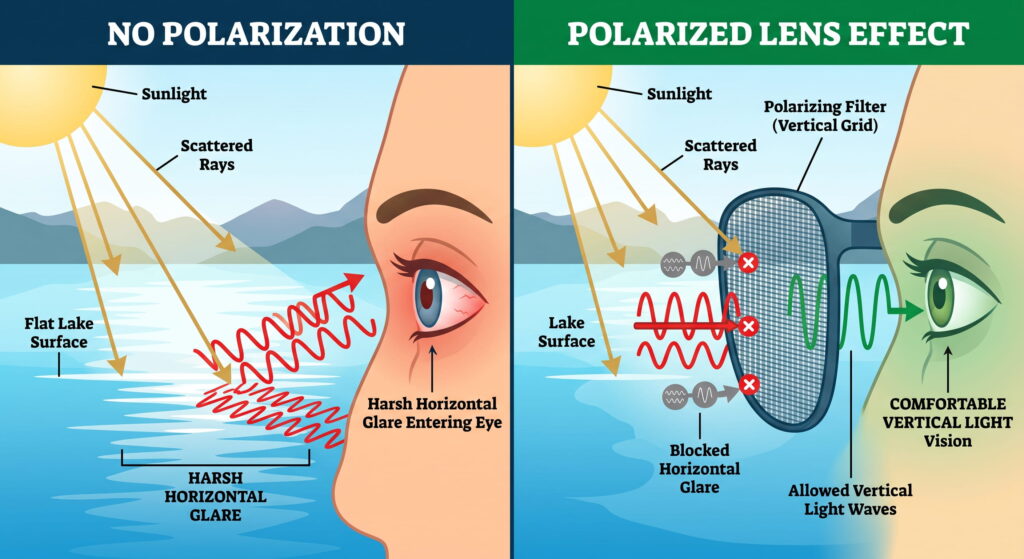
When sunlight travels from the sun to the earth, the light waves scatter and vibrate in every possible direction—up, down, left, right, and diagonally. This is “unpolarized” light. However, when this scattered sunlight strikes a flat, reflective surface—such as a wet highway, the hood of a car, a calm lake, or a snowfield—the physics change dramatically.
The surface absorbs the vertical light waves but reflects the horizontal light waves directly into your eyes. This concentrated beam of horizontal light is what we call “glare.” It is harsh, blinding, and causes immediate eye strain and visual fatigue.
If you wear a standard pair of tinted sunglasses (even prescription ones without a polarized filter), the lenses merely darken the entire environment. They reduce the overall brightness, but they do absolutely nothing to filter out that concentrated horizontal glare. You are still dealing with the blinding reflection; it is just slightly darker.
The Principle of Polarization: The “Venetian Blind” Effect
How do polarized prescription sunglasses defeat this blinding horizontal light? The secret lies in a microscopic layer of chemistry.
During the manufacturing process, engineers use a specialized chemical film made of polyvinyl alcohol (PVA). They treat this film with iodine crystals. Next, they stretch the PVA film aggressively. This stretching process forces the iodine molecules to align themselves in perfect, microscopic parallel chains.
You can visualize this stretched chemical film as a set of microscopic Venetian blinds hanging in a window.
When we position this film inside a sunglass lens, we align these “blinds” vertically. Because the molecular chains run vertically, they allow vertical light waves (the ambient light that helps you see colors and shapes clearly) to pass right through to your eye. However, when that harsh, horizontal glare bounces off the road and hits the lens, the vertical “blinds” physically block it.
The result is magical. The blinding reflection off the water or the highway completely vanishes, leaving you with a crystal-clear, high-contrast view of your environment.
The Engineering Miracle: Marrying Polarization with Prescriptions
For a long time, consumers believed they could only buy polarized lenses off the rack without a prescription. Integrating a precise medical prescription with a delicate, microscopic chemical film is an incredible manufacturing challenge.
You cannot simply stick a polarizing film onto the outside of a finished prescription lens. Daily wear, cleaning, and scratching would destroy the film in a matter of weeks. Instead, modern optical laboratories use a sophisticated “wafer” integration process.
-
The Sandwich Technique: We take the delicate PVA polarizing film and sandwich it between two ultra-thin layers of optical-grade plastic, creating a durable protective wafer.
-
Cast Molding: We place this wafer into a glass lens mold. We then pour liquid monomer (the raw optical plastic) into the mold, completely encapsulating the polarized wafer.
-
Curing and Sealing: As we bake the mold, the liquid plastic hardens and bonds permanently with the wafer. The polarizing film is now safely trapped inside the core of a solid lens blank, protected from the outside world forever.
-
Digital Surfacing: Finally, we take this polarized blank to a multi-axis CNC machine. A diamond-tipped tool carves the patient’s specific prescription (nearsightedness, farsightedness, or astigmatism) directly into the back surface of the lens. Because we grind the prescription into the back, we never disturb the polarizing film suspended near the front.
Breaking the Myths: High Prescriptions and Curved Frames
Many consumers do not know about polarized prescription sunglasses because they assume their specific vision problems disqualify them from wearing sunglasses. We need to break these outdated myths.
Myth 1: “My prescription is too strong; the lenses will be too thick.”
In the past, adding a strong prescription (-5.00 or higher) to a polarized lens resulted in a thick, heavy piece of plastic that looked terrible in a stylish sunglass frame. Today, chemical engineers have developed High-Index polarized materials (like 1.60 and 1.67 index plastics). These dense materials bend light much more efficiently, allowing laboratories to carve strong prescriptions into incredibly thin, lightweight, and cosmetically beautiful lenses.
Myth 2: “I can’t get my prescription in wrap-around sports frames.”
Sports sunglasses curve heavily around the face to block wind and peripheral light. If you put a standard prescription lens into a highly curved frame, the severe angle distorts the light, causing a “prism effect” that makes the wearer dizzy and nauseous.
We solve this using Freeform Digital Surfacing. Our software calculates the exact curvature of the sports frame, the tilt of the wearer’s face, and the distance from the lens to their eye. The CNC machine then recalculates the prescription at every single millimeter across the lens, actively compensating for the severe curve. This digital technology guarantees distortion-free vision, allowing cyclists and runners to wear aggressive, aerodynamic polarized prescription sunglasses.

Why the Anti-Reflective (AR) Coating is Mandatory
When we manufacture these advanced lenses, we must apply one final, critical component: the backside Anti-Reflective (AR) coating.
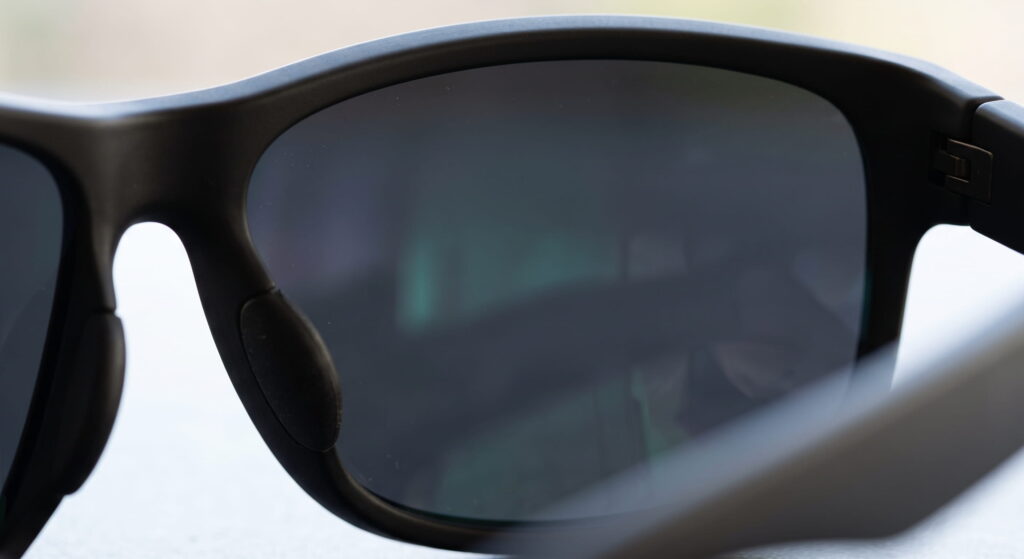
Because polarized lenses are very dark, they act like mirrors. When sunlight hits the back of the lens (from behind the wearer’s head), the light reflects off the inside of the dark plastic and bounces straight into the wearer’s eye. You end up seeing a distracting reflection of your own cheekbone or eyebrow.
Applying an AR coating in a vacuum chamber to the back surface of the lens absorbs this bouncing light. It eliminates internal reflections completely, ensuring the wearer enjoys the absolute maximum clarity that the polarizing film provides.
Raising Awareness: The Optical Industry’s Responsibility
Despite the incredible leap in visual comfort, a massive awareness gap still exists. Millions of people struggle with clip-on attachments, magnetic overlays, or oversized “fit-over” goggles simply because nobody told them that polarized prescription sunglasses are accessible, customizable, and stylish.
Optical retailers, eye doctors, and lifestyle brands must actively educate the consumer. When a customer complains about getting headaches while driving in the sun, we must explain the Venetian blind principle. When a fisherman complains about not being able to tie a knot or see the fish beneath the surface because of glare, we must show them how a polarized prescription lens penetrates the water’s surface.
Conclusion: A Vision Revolution
You no longer have to choose between seeing the world clearly and protecting your eyes from the sun. Polarized prescription sunglasses are not just a luxury accessory; they are a vital piece of safety equipment and a massive upgrade to your daily visual comfort.
By leveraging advanced wafer integration, high-index materials, and digital freeform surfacing, modern optical manufacturing has perfected this technology. Whether you are navigating a wet highway during a morning commute, hiking a snowy mountain trail, or simply reading a book by the pool, these engineered lenses eliminate the blinding glare and deliver the world in perfect, high-contrast clarity. Spread the word—glare-free, 20/20 vision in the sun is finally a reality for everyone.