Women sunglasses sell consistently when buyers combine a recognizable frame shape, comfortable fit, reliable production quality, and a factory cost that supports the target retail price. Trend value matters, but it should not overpower wearability or reorder potential. For B2B buyers, the best collection is not the most experimental one. It is the collection that looks current, fits the intended customer, survives mass production, and leaves enough margin after freight, packaging, duties, marketing, and returns.
Key Takeaways
- Build most of the collection around proven shapes, then use colors, lenses, and temple details to create seasonal freshness.
- Approve fit through measurements and wear tests, not product photos or renderings alone.
- Choose materials according to sales channel and retail price, because PC, acetate, metal, and TR90 create different cost and quality profiles.
- Work backward from the target retail price to define a realistic factory cost, specification, MOQ, and packaging plan.
What Makes Women Sunglasses Commercially Successful?
Commercial women sunglasses generate repeatable sell-through because they balance visual appeal with broad wearability, stable quality, and realistic pricing.
A frame can look impressive in a sample room and still perform poorly after launch. In our factory experience, this usually happens for one of four reasons: the shape is too extreme, the fit is too narrow, the color is difficult to match, or the product cost leaves no room for retail promotion.
The relationship between women and sunglasses is also more varied than one fashion trend suggests. Some customers want a safe daily accessory. Others want a strong social-media product. A buyer therefore needs a collection structure, not a single “winning” frame.
Commercially viable women’s sunglasses usually share these characteristics:
- A clear target age group and sales channel
- A recognizable silhouette with one or two distinctive details
- A frame width and bridge design suitable for the target market
- Stable lens and frame colors that can be reordered
- A product cost that protects margin after all landed expenses
- A specification the factory can repeat consistently in bulk
A useful starting point is a 70/20/10 collection structure:
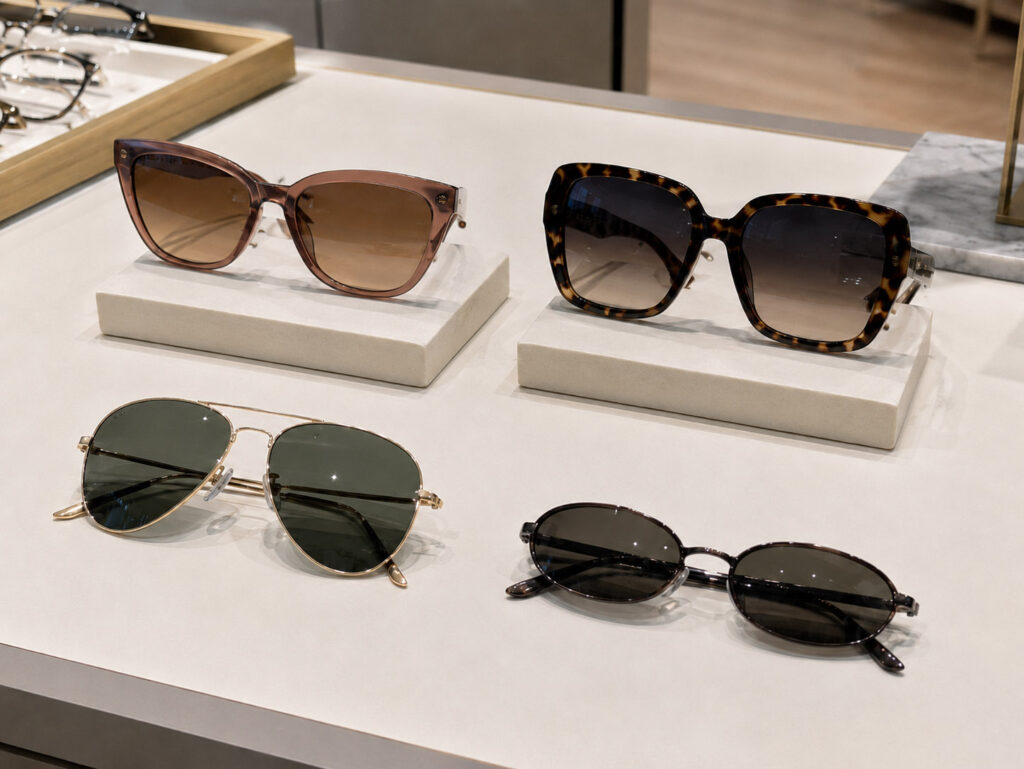
- 70% proven commercial shapes, such as soft cat-eye, square, oversized rectangle, and classic aviator
- 20% updated classics, using transparent colors, gradient lenses, or new temple details
- 10% experimental designs, such as narrow geometric or highly exaggerated frames
This approach gives the collection enough freshness to attract attention without making the entire order dependent on one short trend cycle.
Which Women Sunglasses Styles Have the Best Sales Potential?
Cat-Eye Frames
-
A soft upward corner works for broad everyday collections.
-
A sharp cat-eye suits younger or fashion-led channels.
-
An oversized cat-eye gives stronger shelf impact but requires careful weight control.
Square and Oversized Rectangle Frames
Women’s square sunglasses are easy to merchandise because they work in wholesale, online, boutique, and optical channels. A broad front creates strong visual presence, while a softened corner makes the design easier to wear.
The main risks are excessive width, cheek contact, and front-heavy balance. Oversized designs should be checked on real wearers, especially when thick temples or decorative metal parts are added.
Aviator Frames
Women’s aviator sunglasses can serve both classic and fashion collections.
- Metal aviators offer a refined, familiar look.
- PC aviators feel more casual and support glossy spray finishes.
- Thick plastic aviators create stronger fashion impact.
- Gradient lenses soften the appearance and often photograph well.
For a deeper category analysis, see Zhantai’s guide to Women’s Aviator Sunglasses.
Oval, Round, and Narrow Frames
Women’s oval and narrow sunglasses can attract younger fashion customers, but they should normally remain a smaller part of the first order. The more exaggerated the lens shape or frame width, the more dependent the product becomes on a specific trend, face shape, and marketing style.
How Should B2B Buyers Evaluate Fit?
Women sunglasses fit correctly when the frame remains stable, avoids cheek contact, distributes weight evenly, and matches the target customer’s face width and bridge structure.
Many sourcing problems begin when buyers approve a design by appearance alone. A front-view image cannot show temple pressure, slipping, bridge support, or whether the lens touches the cheek during movement.
Key Measurements to Confirm
-
Total frame width
-
Lens width and lens height
-
Bridge width
-
Temple length
-
Front curvature
-
Frame weight
-
Temple opening angle
Practical Wear-Test Checklist
Before approving the design for bulk production, test the sample in this order:
- Place the frame on several wearers from the target market.
- Confirm that the front sits level.
- Check whether the frame slides when the wearer looks down.
- Confirm that the lenses or lower rim do not touch the cheeks.
- Evaluate temple pressure behind the ears.
- Check whether the nose support remains comfortable after extended wear.
- Confirm that the frame stays balanced during normal movement.
For women, sunglasses are often worn with makeup, so cheek clearance and nose support deserve special attention. Oversized lenses can look excellent in photography but create complaints when the lower rim rests on the face.
Which Materials Work Best for Women Sunglasses?
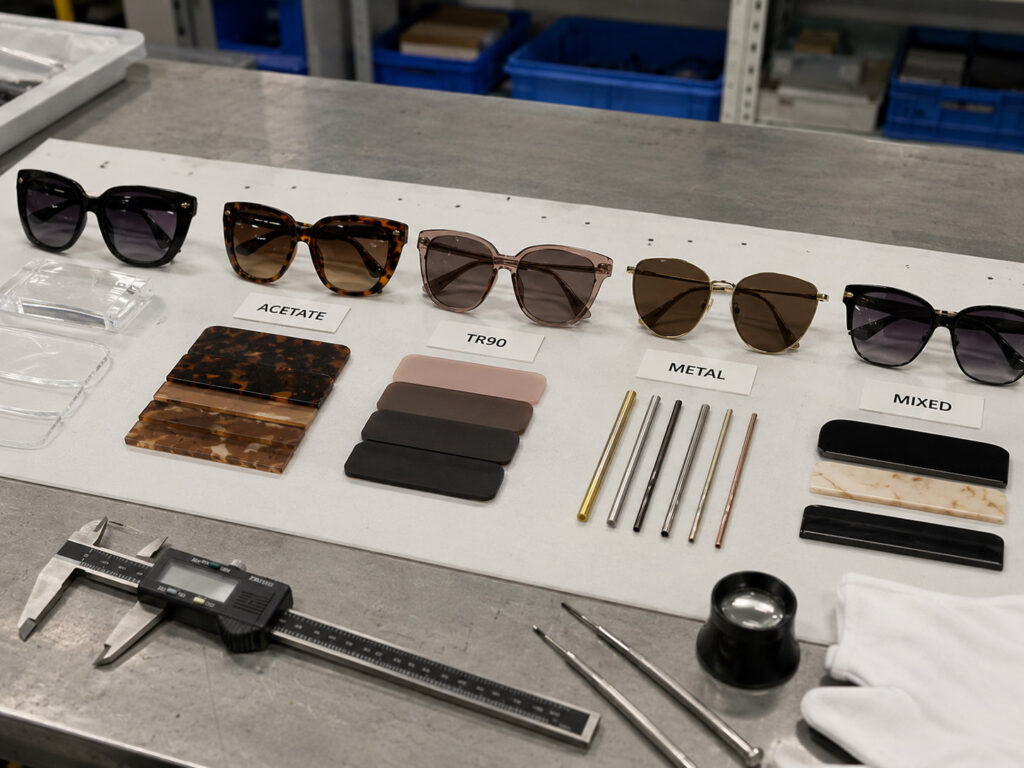
The best material for women sunglasses depends on the target price, desired appearance, production volume, and sales channel rather than one universal quality ranking.
Zhantai works across injection PC and TR, metal, acetate, and other eyewear materials, allowing buyers to match product architecture to different market positions.
| Frame Material | Relative Factory Cost | Main Advantages | Main Limitations | Best-Fit Channels | Typical Positioning |
| PC | Low to medium | Competitive cost, scalable output, broad color and spray-finish options | Surface defects, shrinkage, and deformation require control | Wholesale, online, supermarket | High cost-performance fashion |
| Acetate | Medium to high | Rich color depth, polished texture, premium hand feel | More labor, material waste, and longer processing | Optical, boutique, independent brand | Mid-to-premium |
| Metal | Medium to high | Refined appearance, slim structures, adjustable nose-pad options | Plating, welding, soldering, and alignment risks | Optical, fashion brand, classic retail | Refined or classic |
| TR90 | Medium | Lightweight, flexible, comfortable for extended wear | Less premium surface depth than acetate | Optical, active lifestyle, daily wear | Comfort-focused |
| Mixed material | Medium to high | Strong design differentiation and premium detailing | More components and tighter assembly tolerances | Brand, boutique, online fashion | Design-led |
PC for Volume and Fashion Programs
PC women’s sunglasses are often the most practical choice for high-volume programs. The material supports bold shapes, transparent colors, tortoise effects, glossy spray finishes, and competitive pricing.
However, buyers should not judge PC quality only by the first sample. Bulk control must cover surface dust, paint coverage, color difference, frame deformation, and lens-fitting stress.
Acetate for Texture and Premium Perception
Acetate women’s sunglasses provide deeper patterns, stronger color layering, and a polished surface that supports a higher perceived value. They work well for optical stores, boutiques, and brand collections where customers can see and feel the product.
The trade-off is higher material and processing cost. Thick acetate fronts can also become heavy, so the design must balance visual volume with comfort.
Metal for Refined and Adjustable Designs
Metal women’s sunglasses suit aviator, rimless-inspired, oval, and lightweight fashion shapes. Adjustable nose pads can improve fit flexibility, but they also add components that require inspection.
Key risk points include:
- Plating consistency
- Welding strength
- Solder cleanliness
- Screw security
- Temple alignment
- Nose-pad symmetry
TR90 and Mixed-Material Options
TR90 women’s sunglasses are useful when lightweight comfort is the main selling point. Mixed-material frames can create a more distinctive brand look, but they introduce more tolerance and color-matching work.
Which Lens and Color Options Improve Sell-Through?
Women sunglasses sell more reliably when lens and frame colors support the product’s channel, price point, and intended use instead of following color trends blindly.
Gradient Lenses
Gradient lenses are a strong option for fashion-focused women’s sunglasses because the darker upper area creates sun coverage while the lighter lower area softens the visual effect. Smoke gradient, brown gradient, tea gradient, and ocean gradient can all work when the transition is smooth and consistent.
The factory should check:
- Gradient position
- Shade consistency between left and right lenses
- Batch-to-batch color difference
- Lens curvature
- Edge quality after cutting
- Stress after fitting
Solid and Polarized Lenses
Solid smoke, brown, green, and black remain safer choices for classic women’s sunglasses. Polarized lenses can add functional value for driving, travel, and outdoor programs, but the upgrade should match the intended retail price.
UV protection should be treated as a basic product requirement, with testing and labeling aligned to the destination market. Zhantai product pages list examples of international test standards used for sunglasses programs.
A Practical Three-Color Plan
For women sunglasses in a first order, we generally recommend:
- Safe color: black or tortoise
- Fashion-neutral color: transparent tea, champagne, crystal, or clear brown
- Seasonal highlight: pink, blue, green, burgundy, or another market-specific shade
This structure protects volume while still giving the collection a visual story. Too many colors fragment the order, complicate production, and create slow-moving inventory.
How Does Quality Affect Sales and Reorders?
Quality affects women sunglasses profitability through return rates, review scores, launch timing, and the buyer’s confidence in placing repeat orders.
A small cosmetic issue may look minor inside a carton, but it becomes a commercial problem when hundreds of consumers see the same defect. This is why the approved sample must be converted into written production standards.
| Quality Item | Sample Approval Check | Bulk Production Risk | Recommended Control |
| Frame color | Match approved reference | Batch variation | Signed color standard and production comparison |
| Surface finish | Check gloss, paint, polishing, and defects | Dust, scratches, uneven coating | In-line checks plus final inspection |
| Lens color | Approve shade and gradient | Left-right or batch mismatch | Approved lens reference and incoming inspection |
| Frame symmetry | Confirm level fit | Warping and uneven temples | Alignment jig and symmetry inspection |
| Hinge function | Test opening resistance | Loose screws or inconsistent torque | Screw-torque and cycle checks |
| Logo placement | Approve size and position | Misalignment or weak adhesion | Position fixture and adhesion test |
| Packaging | Confirm protection and presentation | Scratches or shipping damage | Packing standard and drop-risk review |
Common Defects to Watch
In this category, the most common commercial defects include:
- Uneven glossy coating
- Visible dust or paint particles
- Poor tortoise-pattern consistency
- Lens gaps or stress marks
- Uneven gradient lenses
- Twisted fronts
- Misaligned temples
- Loose hinge screws
- Incorrect logo position
- Scratches caused during packaging
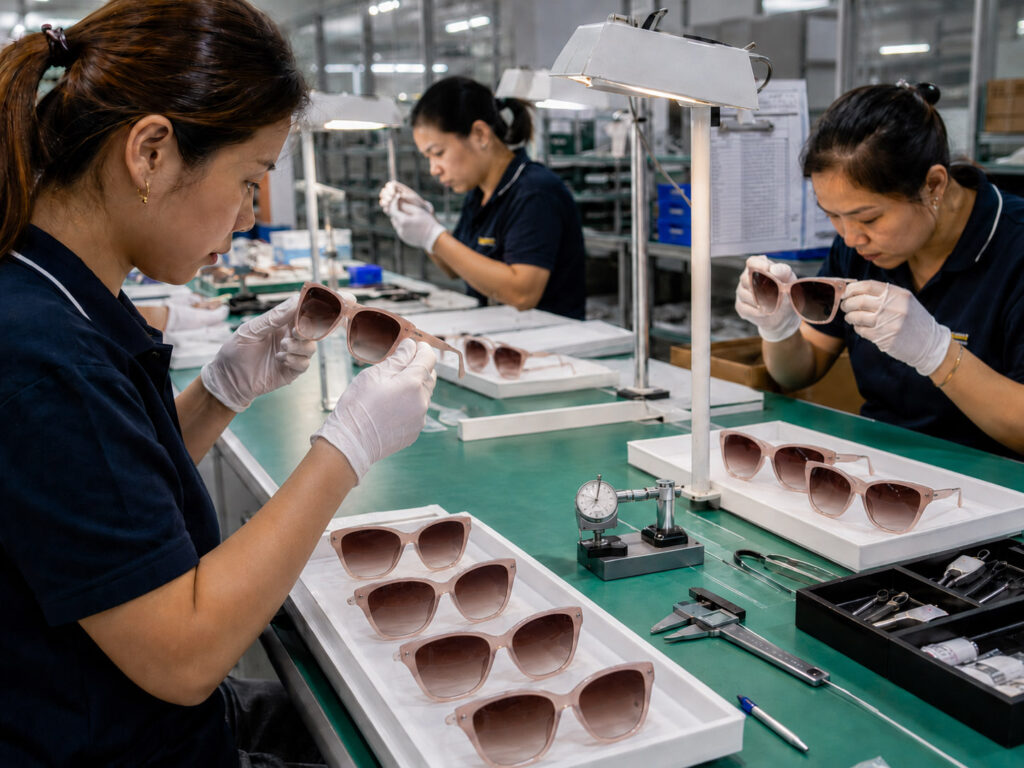
A reliable quality plan checks incoming materials, in-line production, final assembly, and packed goods. Zhantai describes a multi-level quality system and dedicated quality-management structure on its Quality Management page.
How Should Buyers Balance Factory Cost and Retail Value?
Buyers should set the factory cost for women sunglasses by working backward from the target retail price and total landed cost, not by choosing the lowest quotation first.
The unit price is only one part of profitability. A buyer also needs to account for freight, duties, packaging, warehousing, platform fees, distributor margin, marketing, discounts, returns, and quality claims.
| Cost Component | Main Cost Drivers | Practical Cost-Control Method | Risk of Over-Cutting |
| Frame material | Grade, weight, thickness, waste | Match material to channel | Weak structure or poor finish |
| Mold and tooling | New mold, revisions, complexity | Use an existing platform where suitable | Lower differentiation |
| Lens | Material, coating, polarization, gradient | Choose proven lens combinations | Reduced function or inconsistent appearance |
| Surface treatment | Painting, plating, polishing | Simplify finish combinations | Lower perceived value |
| Hardware | Hinges, screws, decorations | Standardize reliable components | Durability problems |
| Logo | Printing, laser, badge, metal insert | Choose one suitable process | Weak branding or poor adhesion |
| Packaging | Pouch, case, box, labels | Match packaging to channel | Product damage or weak presentation |
| QC | Inspection level and testing | Define defect standards early | Returns, disputes, and rework |
Protect Essential Specifications
Essential specifications normally include:
- Stable frame construction
- Consistent lens fitting
- Appropriate UV performance
- Reliable hinges and screws
- Acceptable color tolerance
- Protective packaging
Optional upgrades may include polarized lenses, premium acetate, special gradients, custom metal decorations, branded cases, and retail boxes.
The lowest quote can become the highest total cost when it creates rework, delayed shipment, inconsistent color, poor reviews, or replacement claims. High cost-performance means controlling cost without removing the features that protect sell-through.
How Do MOQ and Color Planning Affect Factory Cost?
MOQ affects women sunglasses cost because material purchasing, color setup, lens batches, line changeovers, logo processes, and packaging all need minimum efficient quantities.
For Zhantai’s large-scale OEM/ODM programs, the standard MOQ is generally 1,200 pieces per model across three to four colors, while specific trial-order or customization arrangements can be discussed by project.
MOQ should be planned as part of the assortment strategy:
- Select the target sales channel.
- Define the expected retail and landed price.
- Choose a proven frame architecture.
- Allocate the highest quantity to the safest color.
- Use one fashion-neutral color for variety.
- Limit the seasonal highlight color.
- Confirm whether MOQ applies per model, color, lens, or component.
- Approve the sample, color standard, logo drawing, and packaging before bulk production.
Existing molds are useful when speed and market testing matter. New tooling becomes commercially justified when the buyer needs a distinct fit, repeat-order platform, or recognizable brand identity.
How Should Buyers Build a Collection by Sales Channel?
Women sunglasses should be selected differently for online stores, optical shops, wholesalers, supermarkets, and independent fashion brands because each channel rewards different product attributes.
Online Fashion Stores
Women’s sunglasses sold online need immediate visual impact and clear fit information.
Prioritize:
- Photo-friendly silhouettes
- Transparent and gradient colors
- Strong front-view details
- Accurate dimensions
- Lightweight construction
- Packaging that survives parcel delivery
Optical Shops
Optical women sunglasses require stronger fit, finishing, and perceived quality.
Prioritize:
- Adjustable or carefully engineered fit
- Acetate or refined metal options
- Consistent polishing and plating
- Comfortable weight
- Better product documentation
Wholesalers and Distributors
Wholesale women sunglasses need broad acceptance, stable pricing, and reorder capability.
Prioritize:
- Proven shapes
- Safe colors
- Competitive factory cost
- Standardized components
- Reliable production repeatability
Supermarkets and Promotional Programs
High-volume women sunglasses need simple, durable, and efficient specifications.
Prioritize:
- Injection frames
- Stable lenses
- Controlled decorations
- Efficient packaging
- Clear inspection standards
Independent Brands
Brand-led women sunglasses need enough differentiation to support identity without creating unnecessary production risk.
A buyer can combine existing molds with custom colors, lenses, logos, temple details, and packaging. Zhantai’s women’s boutique sourcing guide provides another practical framework for balancing core styles and seasonal pieces.
What Is the Best Factory-First Development Workflow?
-
Define the buyer profile. Confirm region, age group, channel, price band, and style direction.
-
Set the target cost. Work backward from the retail price and full landed-cost structure.
-
Choose the frame platform. Decide shape, material, dimensions, hinge, and fit.
-
Plan the lens. Confirm material, color, gradient, polarization, and testing requirements.
-
Select colors. Use safe, fashion-neutral, and seasonal allocations.
-
Choose customization. Confirm logo method, temple detail, decoration, and packaging.
-
Develop samples. Review appearance, fit, weight, finish, and function.
-
Freeze standards. Sign off color references, drawings, lens specifications, and defect criteria.
-
Control bulk production. Inspect incoming materials, key processes, assembly, and final goods.
-
Prepare reorders. Record the final specification and monitor sell-through by model and color.
Why Work with Zhantai on Women Sunglasses OEM/ODM?
Zhantai supports women sunglasses projects by combining direct production control with OEM/ODM development, export communication, and project coordination.
As an integrated industry-and-trade company, we can connect the buyer’s commercial brief directly with materials, tooling, lens selection, color development, logo application, packaging, production, and QC. This structure helps reduce the common gap between a sales promise and what the factory can actually repeat.
Our practical development sequence is:
- Target sales channel
- Target retail and factory price
- Shape and material
- Fit measurements
- Color grouping
- Lens specification
- Logo and packaging
- MOQ allocation
- Sample approval
- Bulk quality control
This is especially important for women sunglasses because small changes in curve, weight, color, or lens gradient can materially change the final customer experience.
FAQ About Women Sunglasses Sourcing
What Are the Safest Women Sunglasses Shapes for a First B2B Collection?
Should Buyers Choose PC or Acetate for Women Sunglasses?
Can Women Sunglasses Use Custom Frame Colors and Gradient Lenses?
Does the Lowest Factory Quote Produce the Best Margin?
Conclusion: Build Women Sunglasses for Sell-Through, Not Samples
The best women sunglasses collection is designed for the customer, the sales channel, and mass production at the same time.
A strong collection does not chase every trend. It uses proven shapes, controlled colors, realistic fit, stable materials, clear QC standards, and a factory cost that supports the buyer’s business model. That is how women sunglasses move from an attractive sample to a profitable, repeatable product program.
Ready to develop your next collection? Request Zhantai’s latest product catalog, send us your target price and sales channel, or ask for a customized OEM/ODM quotation. Contact the Zhantai factory team to discuss frame selection, colors, lenses, packaging, MOQ, sampling, and bulk production.