Beyond the Shade: The Ultimate Guide to Choosing Sports Sunglasses Lenses
When athletes gear up for a race, a ride, or a climb, they obsess over the weight of their shoes, the aerodynamics of their helmets, and the breathability of their apparel. Yet, when it comes to eyewear, many simply pick the darkest pair they can find.
Treating your eyewear as a generic accessory is a massive missed opportunity. The right sports sunglasses lenses act as a critical piece of performance equipment. By manipulating light, specific lens colors can enhance contrast, eliminate blinding glare, reveal hidden obstacles, and drastically reduce eye fatigue.
Whether you are a trail runner navigating shifting shadows or an offshore angler staring at glaring water, you need a lens tailored to your environment. Here is your comprehensive guide to selecting the perfect lenses, from decoding Visible Light Transmission (VLT) to mastering the color wheel.
The Foundation—Understanding VLT (Visible Light Transmission)
Before you even look at lens colors, you must understand how much light the lens actually lets in. This measurement is called Visible Light Transmission (VLT), expressed as a percentage.
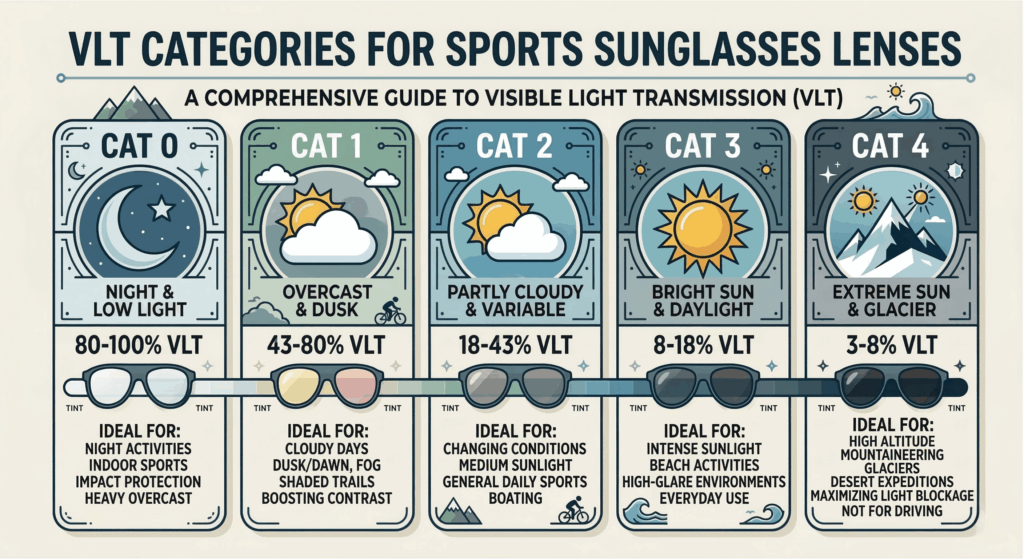
A VLT of 100% means all light passes through (a clear lens). A VLT of 10% means only 10% of the light reaches your eye (a very dark lens). The eyewear industry categorizes sports sunglasses lenses into five distinct levels:
The VLT Category System
-
Category 0 (80% – 100% VLT): * Appearance: Clear or very faint yellow.
-
Purpose: Strictly for physical protection against wind, dust, and insects.
-
Best Scenarios: Night cycling, indoor velodrome racing, or running in dense, dark forests.
-
-
Category 1 (43% – 80% VLT): * Appearance: Light yellow, pale rose, or orange.
-
Purpose: To enhance visibility in low-light conditions.
-
Best Scenarios: Overcast days, thick fog, dawn/dusk workouts, or heavily shaded mountain bike trails.
-
-
Category 2 (18% – 43% VLT): * Appearance: Medium tints (copper, light brown, rose).
-
Purpose: The “all-rounder” lens for shifting weather.
-
Best Scenarios: Days with mixed clouds and sun, golfing, or late afternoon road cycling.
-
-
Category 3 (8% – 18% VLT): * Appearance: Dark grey, dark brown, or heavy mirror finishes.
-
Purpose: Protection against bright, unfiltered sunlight.
-
Best Scenarios: Midday road running, offshore fishing, beach volleyball, and general bright-weather sports.
-
-
Category 4 (3% – 8% VLT): * Appearance: Exceptionally dark.
-
Purpose: Extreme environments with blinding, omnidirectional light.
-
Best Scenarios: High-altitude mountaineering and glacier traversing. (Note: Category 4 lenses are illegal and highly dangerous for driving).
-
The Color Wheel—How Tint Alters Perception
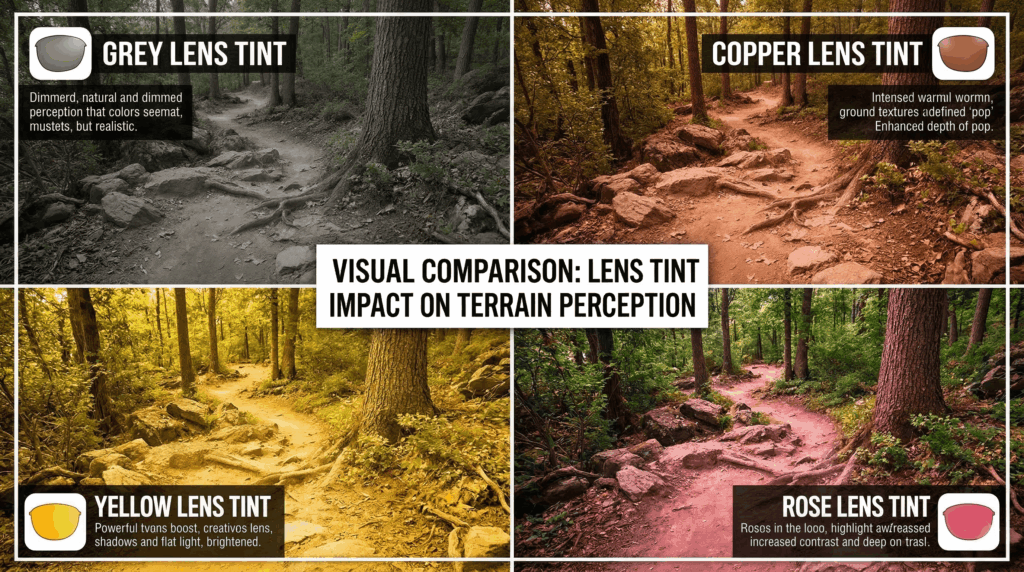
Once you have selected the appropriate VLT for your lighting conditions, you must choose the base tint. Different colors filter different wavelengths of light on the visual spectrum.
Here is how the specific base colors of your sports sunglasses lenses will impact your athletic performance.
-
Grey and Black: True Color & Anti-Fatigue
Grey is a neutral filter. It reduces the overall brightness of the environment evenly across the color spectrum without distorting natural colors.
-
The Science: By preventing color distortion, your brain spends less energy processing what you see, significantly reducing eye strain over long periods.
-
Best For: Long-distance road cycling, open-water sailing, and general outdoor training in bright, consistent sunlight.
-
Brown, Copper, and Amber: The Contrast Kings
Warm-toned lenses are arguably the most popular choice for dynamic terrain. They work by absorbing blue light—the wavelength responsible for atmospheric haze and visual “fuzziness.”
-
The Science: By cutting out blue light, warm tints drastically sharpen visual acuity and depth perception. Textures on the ground become highly defined.
-
Best For: Trail running, mountain biking, and golf (making it easier to read the breaks on a green). They are also the standard for shallow-water fishing, allowing anglers to spot fish against the riverbed.
-
Yellow and Gold: Low-Light Illuminators
When the sun hides, yellow lenses step up. Like copper, they filter out blue light, but they allow a much higher percentage of total light to pass through (higher VLT).
-
The Science: Yellow tints trick the eyes into perceiving the environment as brighter than it actually is, creating immense contrast in “flat” lighting.
-
Best For: Skiing in a whiteout, mountain biking through dense canopy cover, and shooting sports. They ensure you can still spot dangerous ruts and roots when shadows disappear.
-
Rose and Red: Speed & Precision
Rose-tinted lenses offer incredible contrast against green and blue backgrounds (like trees and the sky).
-
The Science: They enhance visual depth while soothing the eyes, making it easier to track fast-moving objects.
-
Best For: Road cycling (spotting cracks in the grey asphalt against roadside greenery) and downhill skiing.
-
Green: The Hybrid Optimizer
Green lenses transmit all colors evenly while slightly dimming the overall glare. They offer the true-color benefits of grey lenses alongside the contrast-enhancing benefits of brown lenses.
-
The Science: The human eye is most sensitive to green light, meaning these lenses are incredibly soothing and provide excellent visual sharpness.
-
Best For: Tennis, baseball, and everyday athleisure wear.
Advanced Lens Treatments
The base color and VLT are the core of your sports sunglasses lenses, but advanced chemical coatings take performance to the professional level.
-
Polarization: The Glare Assassin
Light naturally scatters in all directions. However, when light hits a flat, shiny surface (like asphalt, water, or snow), it reflects horizontally. This creates a blinding, concentrated beam known as glare.
-
How it works: Polarized lenses contain a microscopic chemical film aligned vertically, acting like a Venetian blind. It allows vertical light through but completely blocks horizontal glare.
-
When to use it: Mandatory for water sports, fishing, and driving.
-
When to avoid it: Some downhill skiers and road cyclists avoid polarization because they need to see the horizontal glare reflecting off icy patches or oil slicks to avoid crashing.
-
Photochromic Lenses: The Shape-Shifters
If your sport takes you through rapidly changing environments—like a marathon that starts in the dark and ends in midday sun—carrying multiple lenses is impossible.
-
How it works: Photochromic lenses contain molecules that react to UV light. In the shade, they remain nearly clear (Category 1). When exposed to direct UV rays, the molecules shift, darkening the lens to a Category 3 grey or brown in a matter of seconds.
-
The Advantage: One pair of glasses for the entire day.
-
Mirror Coatings (Flash Coatings)
A mirror coating is a highly reflective film applied to the outside of the lens.
-
How it works: It reflects 10% to 60% of the light before it even enters the tinted lens. This allows you to wear a lighter base tint (like a rose or amber) for contrast, while still getting the high-glare protection of a dark lens.
-
The Advantage: Perfect for high-altitude sports, snow sports, and intense summer cycling.
Putting It Together (Scenario Cheat Sheet)
Still unsure which combination is right for you? Match your sport to these professional setups:
-
Road Cycling (Bright Sun): Choose a Rose or Copper lens with a Blue/Red Mirror coating. This provides high contrast against the asphalt while the mirror deflects intense overhead sun.
-
Trail Running (Variable Light): Choose a Photochromic Brown lens. It will adapt as you weave in and out of the forest canopy while keeping ground textures sharp.
-
Offshore/Deep Sea Fishing: Choose a Polarized Grey lens with a Blue Mirror. The grey keeps colors natural over long hours, the polarization kills the ocean glare, and the mirror blocks maximum light.
-
Mountain Biking (Overcast/Dense Woods): Choose a Category 1 Yellow lens. It will artificially brighten the dark woods and help you spot roots and rocks instantly.
Conclusion
Your vision dictates your reaction time, your balance, and your safety. By understanding the science behind VLT, the psychology of color tints, and the physics of polarization, you can transform your sports sunglasses lenses from a simple accessory into a vital competitive advantage. Do not settle for the standard dark grey lens if your environment demands high-definition contrast.