In the highly saturated eyewear market, consumer preferences shift rapidly between extreme aesthetics and practical functionality. However, one specific optical style consistently bridges the gap between high fashion and everyday utility: the gradient lens.
For decades, gradient lens sunglasses have dominated retail shelves, worn by everyone from runway models to daily commuters. For international supermarkets, fast-fashion brands, and boutique labels, stocking this specific lens style is not just a passing trend; it is a fundamental driver of seasonal revenue. Consumers love them because they look inherently glamorous and offer a highly functional wearing experience.
However, achieving that perfect, seamless fade from dark to light requires absolute precision on the factory floor. Uneven tints or harsh transition lines will instantly ruin the perceived value of the product. Choosing the right tinted lens sunglasses manufacturer dictates the optical clarity, visual appeal, and ultimate profitability of your entire collection.
This comprehensive guide explores the functional mechanics of gradient tints, breaks down the dominant aesthetic color trends for 2026, and provides a deep dive into the complex manufacturing processes required to execute high-volume B2B orders flawlessly.

What Are Gradient Lens Sunglasses?
Before we explore manufacturing, we must define exactly what makes this lens style so universally popular and functionally superior in specific scenarios.
Gradient lens sunglasses feature a tint that is dark at the top of the lens and gradually fades to a lighter tint—or becomes completely clear—at the bottom.
The Functional Advantage
When a consumer wears a solid dark lens, they block intense sunlight, but they also severely restrict their ability to see in lower-light areas. Gradient lenses solve this problem perfectly.
-
Overhead Protection: The dark top section of the lens effectively blocks harsh overhead sunlight and intense glare from the sky.
-
Lower Visibility: The lighter bottom section allows the wearer to look downward without vision restriction.
This specific design makes them the absolute best choice for driving. A driver can look through the top of the lens to block the sun, and glance down through the lighter bottom section to read their dashboard instruments or smartphone clearly. Similarly, they are ideal for reading a book on the beach or dining on a sunny patio.
The Psychological Appeal
Aesthetically, gradient lenses offer a unique psychological benefit. Because the bottom of the lens is lighter, the wearer’s eyes remain partially visible to others. This creates a more approachable, engaging look compared to the “total blackout” effect of a solid mirror lens. It provides a luxurious, soft aesthetic that effortlessly elevates any casual outfit.
Tint Categories: Understanding VLT in Gradients
When you place a bulk order with a tinted lens sunglasses manufacturer, you cannot simply ask for a “gradient lens.” You must specify the exact Visible Light Transmission (VLT) categories you want to bridge.
VLT measures the percentage of ambient light that passes through the lens to the eye. Standard sunglasses usually fall into one specific category (e.g., Category 3 for bright sun). However, gradient lens sunglasses span multiple categories across the same piece of material.
Common Gradient VLT Configurations
-
The Standard Fashion Gradient (Cat 3 to Cat 1): This is the most popular retail configuration. The top of the lens features a Category 3 tint (allowing only 8% to 18% of light through), providing excellent protection against bright midday sun. The tint fades smoothly down to a Category 1 at the bottom (allowing 43% to 80% of light through), ensuring the wearer can read their phone without removing their glasses.
-
The Overcast / City Gradient (Cat 2 to Cat 0): Designed for cloudy days or urban environments where sunlight is less intense. The top is a medium Category 2 tint, fading to a completely clear (Category 0) bottom. This is highly popular in fast-fashion lines aimed at consumers who wear sunglasses primarily as a styling accessory indoors or during the evening.
-
The Double Gradient (Bi-Gradient): A specialized technical lens. It features a dark tint at the top (to block the sun) and a dark tint at the bottom (to block glare reflecting off sand, water, or snow), leaving a lighter horizontal band in the precise center for forward vision.
When designing your collection, you must match the VLT gradient to your target demographic’s lifestyle.
Design Options and 2026 Color Trends
The beauty of a gradient lens lies in its immense customization potential. A skilled tinted lens sunglasses manufacturer can produce almost any color combination imaginable. To drive high-volume sales in 2026, buyers must pair the right lens tints with trending frame materials.
Classic Tints: Grey and Brown
-
Grey Gradients: Grey provides the most neutral color perception. It reduces brightness without distorting the natural colors of the environment. Grey gradients pair beautifully with sleek, modern metallic frames or bold, black architectural shapes.
-
Brown and Amber Gradients: Brown lenses absorb blue light, which significantly increases contrast and depth perception. This makes everything look warmer and sharper. A brown gradient lens serves as the ultimate pairing for a classic Tortoise frame, creating a rich, cohesive, luxury aesthetic that appeals to a wide age demographic.
Fashion Tints: Vibrant and Two-Tone
-
Rose and Purple Gradients: These colors offer excellent contrast against green and blue backgrounds, making them comfortable for outdoor wear. Aesthetically, a rose gradient provides a soft, vintage 1970s feel that remains highly popular in festival fashion.
-
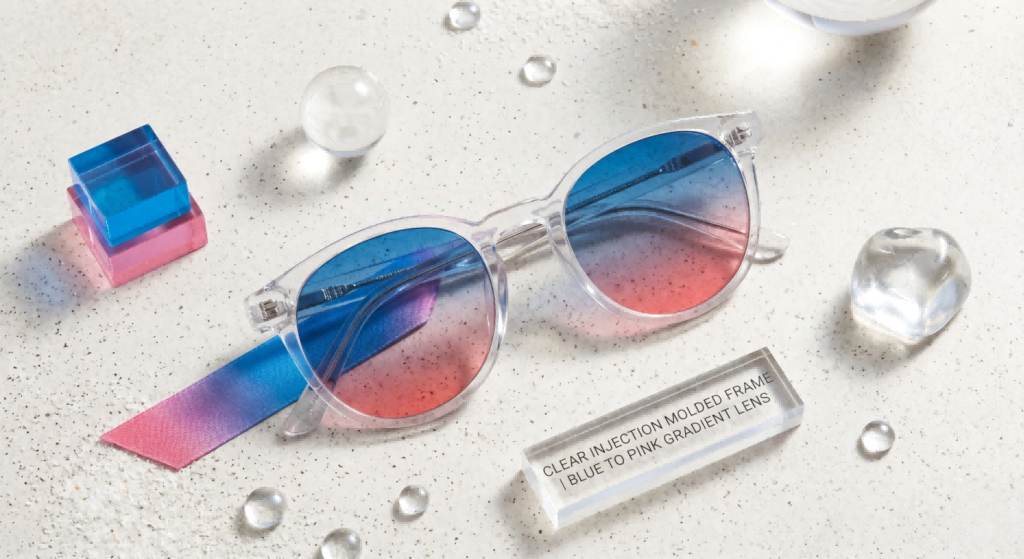
Two-Tone (Bicolor) Gradients: Instead of fading to clear, the lens fades from one distinct color to another—for example, from deep blue at the top to bright yellow at the bottom. This requires advanced manufacturing techniques but results in a highly striking, statement piece that stops shoppers in their tracks.
The 2026 Frame Pairing Strategy: Clear and Transparent
To maximize the visual impact of your gradient lenses, frame selection is critical. In 2026, consumers aggressively demand lightweight, visually airy aesthetics.
Pairing a rich, colorful gradient lens with a high-gloss clear or transparent injection-molded TR90 frame creates a stunning contrast. The transparent frame catches the light, while the gradient lens draws all the attention to the wearer’s eyes. For retail buyers, stocking transparent frames with varied gradient lenses dramatically reduces inventory risk, as these styles match effortlessly with any seasonal clothing palette.
The Manufacturing Process: How We Tint the Lenses
Understanding the manufacturing process allows procurement directors to evaluate supplier quality effectively. Creating flawless gradient lens sunglasses is part science and part art. It requires rigorous temperature control and precise timing.
As a premier tinted lens sunglasses manufacturer, we primarily utilize Polycarbonate (PC) and CR-39 lenses for our gradient collections. Here is the exact process our engineers follow on the factory floor.
Step 1: The Tinting Solution and Temperature Control
Our technicians prepare deep vats of specialized optical dye. The temperature of this liquid is absolutely critical. If the dye is too cold, the lens will not absorb the color. If it is too hot, the plastic substrate can warp or degrade. We maintain the tinting vats at a highly regulated, constant temperature to ensure the chemical pores of the lens open evenly.
Step 2: The Precision Dipping Process
Unlike solid color lenses, which technicians fully submerge into the dye, gradient lenses require a controlled, mechanical dipping process. We attach the raw, clear lenses to an automated, computer-controlled mechanical arm. This arm slowly lowers the lenses into the heated dye vat upside down (the top of the lens enters the liquid first).
Step 3: Timing the Fade
The secret to a seamless gradient lies in the withdrawal speed. The mechanical arm slowly pulls the lens out of the dye. The top of the lens remains submerged in the dye the longest, absorbing the maximum amount of color to achieve the dark Category 3 tint. The bottom of the lens spends the least amount of time in the liquid, resulting in a very light tint or remaining completely clear. By controlling the exact millimeter-per-second speed of the mechanical arm, our engineers dictate the exact harshness or smoothness of the gradient transition.
Step 4: Neutralizing and Hard-Coating
Once the lens achieves the perfect gradient fade, technicians immediately transfer it to a neutralizing bath. This stops the chemical tinting process and locks the color into the material. Finally, because the tint sits near the surface of the lens, we apply a clear, scratch-resistant hard coat over the entire surface to protect the gradient from daily wear and tear.
Quality Control: Ensuring Flawless Execution
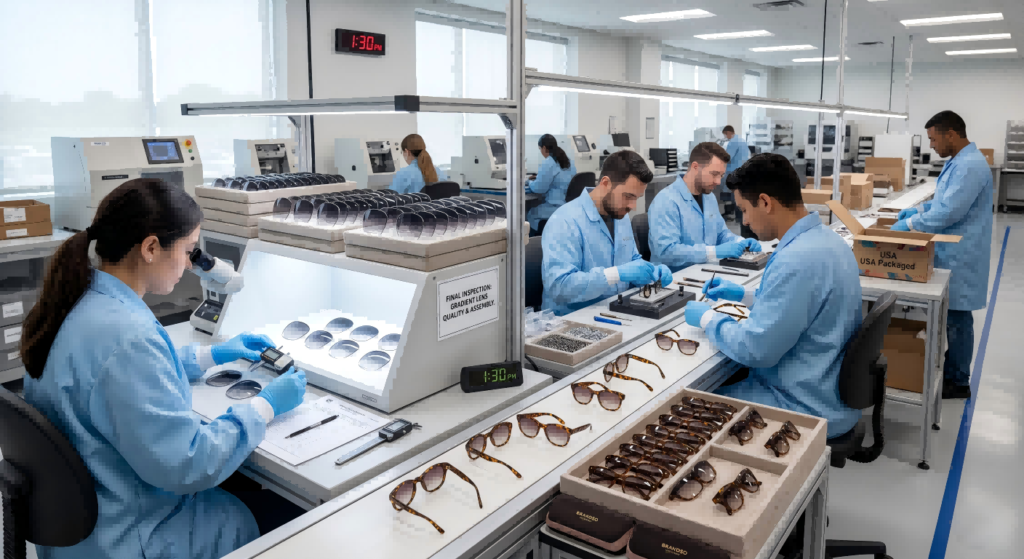
When you order thousands of units for an international supermarket rollout, you cannot afford inconsistent batches. Gradient lenses magnify manufacturing errors. If the gradient line is crooked, or if the left lens fades faster than the right lens, the consumer will immediately return the product.
Your tinted lens sunglasses manufacturer must enforce uncompromising Quality Control (QC) protocols.
Symmetrical Matching
Our QC inspectors manually examine every single pair of lenses against a stark white, backlit optical board. They verify that the gradient transition line sits at the exact same horizontal axis on both the left and right lenses. Even a one-millimeter discrepancy will cause the wearer to look cross-eyed or unbalanced.
Transition Smoothness
A low-quality gradient lens often features a “step” or a harsh line where the dark tint suddenly stops and the light tint begins. This creates severe optical distortion for the wearer. We rigorously inspect the transition zone to guarantee a perfectly smooth, invisible fade that allows the human eye to shift vision paths without strain.
Functional Safety: UV400 and Drop-Ball Testing
A beautiful gradient means nothing if it fails safety standards. We verify that the entire lens—even the completely clear bottom section—blocks 100% of UVA and UVB radiation. Furthermore, our Polycarbonate lenses undergo strict drop-ball impact testing, ensuring they provide genuine shatter-resistant protection for active consumers.
Sourcing Strategy: The OEM/ODM Advantage
Executing a high-volume custom order requires a highly organized workflow and a resilient supply chain. Relying on a manufacturer confined to a single geographic location exposes your retail operation to shipping delays and regional export tariffs.
At Zhantai Glasses, we engineer our production lines to meet the rigorous demands of large-scale B2B retail. We guide our brand partners seamlessly from the initial concept to mass production, offering unique strategic advantages.
High-Volume Scalability (The MOQ Standard)
Retail success relies on economies of scale. To secure the aggressive unit pricing required to dominate the fast-fashion and supermarket sectors, your manufacturer must operate high-capacity production lines.
We optimize our injection molding machines, automated tinting vats, and assembly lines to support massive output. To guarantee this production efficiency and protect your profit margins, we operate with a strict Minimum Order Quantity (MOQ) of 1200 units per style. This volume ensures that the setup costs for your custom molds and specific dye formulations spread out effectively, delivering the best possible Return on Investment (ROI).
Strategic Global Logistics (Wenzhou & Thailand Synergy)
We mitigate international trade risks through diversified production hubs. By operating our headquarters in Wenzhou—the historic heart of optical manufacturing—alongside a state-of-the-art facility in Thailand, we provide our global clients with immense strategic flexibility.
This dual-hub approach allows international brands to bypass specific regional export tariffs. It also streamlines direct freight shipping. Whether you need your gradient lens sunglasses delivered to a distribution center in Mexico, Europe, or the United States, our Thailand facility ensures a rapid, legally compliant, and cost-effective logistics route.
Conclusion
Gradient lens sunglasses remain a foundational pillar of the global accessories market. Their unparalleled combination of functional overhead sun protection and luxurious aesthetic appeal makes them a mandatory inclusion for any fast-fashion brand, department store, or international supermarket chain looking to maximize seasonal revenue in 2026.
By understanding the technical nuances of VLT categories and aligning your designs with major consumer trends—such as the massive demand for lightweight transparent frames and rich Tortoise patterns—you can curate an inventory that immediately captures consumer attention and drives impulse purchases.
More importantly, by sourcing your collections through a dedicated, high-capacity tinted lens sunglasses manufacturer who understands the exact science of precision dip-dyeing and stringent optical quality control, you secure the production scale required to dominate the competitive retail landscape.
We combine deep manufacturing heritage with advanced global logistics. With our commitment to flawless execution at an MOQ of 1200 units per style, we provide the exact manufacturing power your brand needs to succeed. Contact our OEM team today to discuss your upcoming high-volume eyewear projects and discover how we can bring your next iconic gradient collection to life.