If you read our foundational guide on “What Are Mirrored Sunglasses,” you already understand the consumer appeal of these striking lenses. They offer ultimate privacy, drastically reduce glare in extreme environments, and provide a bold, fashion-forward aesthetic that dominates both the sports and luxury eyewear markets.
But what actually happens behind the closed doors of a high-tech eyewear factory to create that flawless, highly reflective surface?
For B2B wholesale buyers, product developers, and brand owners, understanding the mirror coating sunglasses manufacturing process is the key to designing better products, controlling your supply chain costs, and guaranteeing optical quality. You are not just buying a colored lens; you are purchasing highly engineered nanotechnology.
In this comprehensive guide, we step onto the factory floor to explore the advanced vacuum deposition processes, the physics behind REVO colors, and the exact customization options you need to build a market-leading sunglass collection.
The Physics of Reflection: Mirror Coating vs. AR Coating
To understand how we manufacture mirrored lenses, you must first understand their relationship with Anti-Reflective (AR) coatings. Surprisingly, factories use the exact same multi-million-dollar machinery to create both, but they manipulate the physics in completely opposite directions.
AR coatings utilize destructive interference. Optical engineers calculate the thickness of the coating layers to cancel out light waves, allowing maximum light to pass through the lens and eliminating reflections.
Mirror coatings, on the other hand, utilize constructive interference. We design the coating stack so that the reflected light waves align perfectly and amplify each other. Instead of letting the light pass through, the lens forcefully bounces specific wavelengths (like harsh blue or bright red light) back into the environment. This optical engineering not only looks incredible but also significantly reduces the amount of solar energy and heat reaching the wearer’s eyes.
The Vacuum Evaporation Deposition Process
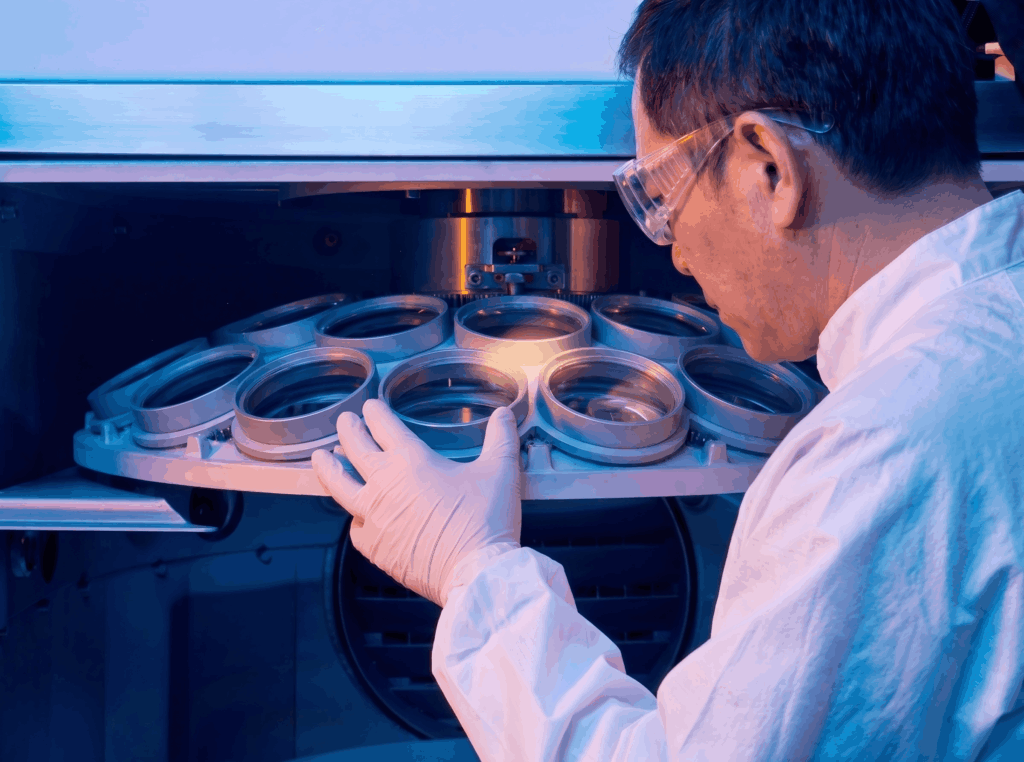
You cannot dip or spray a true optical mirror coating onto a lens. The mirror coating sunglasses manufacturing process requires an extreme environment: the vacuum deposition chamber.
Here is exactly how our technicians execute this highly controlled Physical Vapor Deposition (PVD) process:
-
Ultra-Sonic Purification: We subject the base lenses (often tinted polycarbonate, nylon, or TAC polarized lenses) to a rigorous ultrasonic cleaning process. A single microscopic dust particle will cause the mirror coating to fail and peel.
-
Loading the Planetary Dome: Technicians mount the clean lenses onto a large, curved metal rack called a planetary dome.
-
Creating the Vacuum: We place the loaded dome into a heavy stainless-steel chamber and pump out the air. We must create a deep vacuum so the coating vapor can travel in perfectly straight lines without colliding with oxygen or nitrogen molecules.
-
Electron Beam Vaporization: At the bottom of the chamber, an electron gun fires a high-energy beam into a crucible holding solid blocks of metal oxides (like Titanium Dioxide and Silicon Dioxide).
-
Condensation: The extreme heat vaporizes the metal oxides. The gas rises through the vacuum and condenses evenly onto the spinning lenses above, creating a microscopic, hard, and perfectly uniform reflective film.
REVO Colored Mirrors: The Science of Structural Color
When buyers ask for highly vibrant, multi-colored mirrored lenses, they usually request “REVO” lenses. NASA originally developed this technology to protect satellite portholes from cosmic radiation, and it represents the pinnacle of modern mirror coating sunglasses manufacturing.
The most fascinating aspect of a REVO mirror is that the factory uses absolutely zero dye or pigment to create the color.
Instead, we create “structural color”—the same physics that gives a peacock feather or a butterfly wing its iridescent shimmer. Inside the vacuum chamber, we apply alternating microscopic layers of high-index materials (Titanium Dioxide – TiO2) and low-index materials (Silicon Dioxide – SiO2).
By precisely controlling the thickness of these alternating layers down to the nanometer, we dictate exactly which wavelengths of light the lens will reflect.
-
Want an Ice Blue mirror? We program the machine to stack the layers so they amplify and reflect blue wavelengths while transmitting others.
-
Want a Fiery Red/Orange mirror? We change the layer thickness to amplify the red spectrum.
Because the color comes from the physical structure of the metal oxides rather than a chemical dye, true REVO mirror coatings never fade in the sun.
Flash Mirror vs. Full Mirror: Aesthetic and Functional Choices
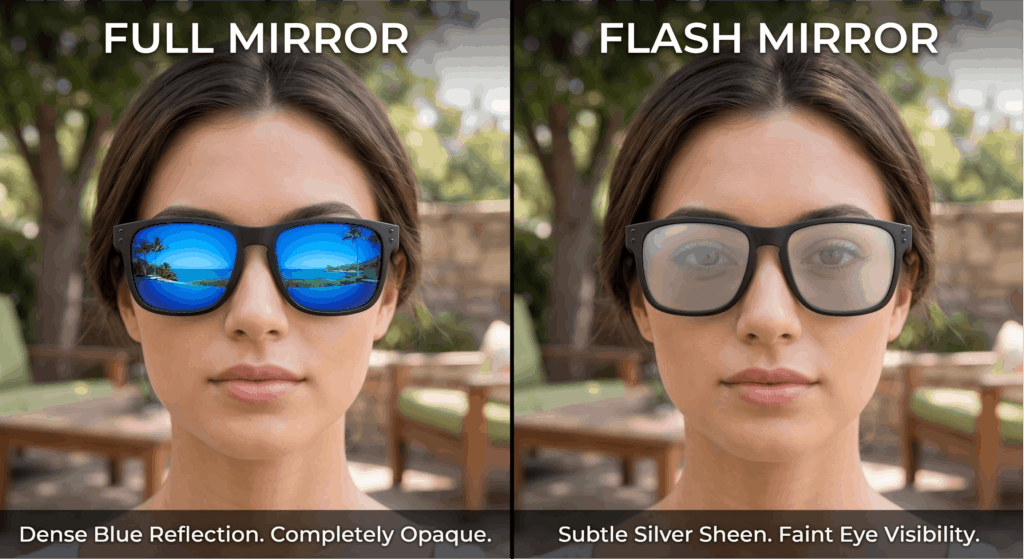
When you submit an OEM order to your eyewear factory, you must specify the density of the mirror. We generally categorize these into two distinct styles: Full Mirrors and Flash Mirrors.
The Full Mirror (Solid Mirror)
This is the classic, impenetrable look. We apply a dense, highly concentrated stack of reflective layers. A full mirror bounces back a massive amount of light, completely hiding the wearer’s eyes from the outside world. Brands utilize full mirrors heavily in extreme sports eyewear—like snowboarding goggles and offshore fishing sunglasses—because they provide maximum protection against intense, blinding glare.
The Flash Mirror (Half-Mirror)
For fashion and lifestyle brands, a full mirror can sometimes look too aggressive or sporty. The solution is the Flash Mirror. To create this, our technicians reduce the number of coating layers and adjust the evaporation time. The result is a semi-transparent, highly sophisticated reflective sheen. When a person wears a flash mirror, you can catch the striking metallic color when the light hits it, but you can still faintly see their eyes through the lens. It bridges the gap between high fashion and high performance.
Controlling VLT: Transmission Ratios and Filter Categories
As an eyewear buyer, you must ensure your products meet international safety standards for Visible Light Transmission (VLT). VLT measures the percentage of light that successfully passes through the lens to the eye.
The final VLT of a mirrored sunglass is a mathematical combination of the base lens tint and the mirror coating density.
A mirror coating naturally darkens the wearer’s view because it physically bounces light away. If you start with a dark grey base lens (CAT 3, allowing 12% light transmission) and add a heavy Full Mirror, the coating might reflect an additional 5% to 10% of the light. This could push the final product into a CAT 4 classification (allowing less than 8% transmission).
While CAT 4 lenses are excellent for high-altitude mountaineering, they are illegal for driving in most countries. A professional factory carefully balances the semi-transparent/semi-reflective ratio. If you want a heavy mirror for driving sunglasses, we will use a lighter base tint (like a CAT 2) so that when we apply the dense mirror coating, the final product lands perfectly in the safe, versatile CAT 3 range.
Rigorous Quality Control Standards
Because mirror coating sunglasses manufacturing involves applying rigid metal oxides to flexible plastic lenses, poor manufacturing quickly leads to disastrous peeling and cracking. A premium factory implements aggressive Quality Control (QC) tests to guarantee durability.
-
The Cross-Hatch Adhesion Test: Our QC inspectors use a precision blade to cut a grid directly into the mirrored surface. We press high-adhesion industrial tape over the grid and rip it off rapidly. If any flakes of the mirror coating stick to the tape, we scrap the entire batch.
-
The Steel Wool Abrasion Test: Mirrors show scratches much more easily than standard tinted lenses. We test the coating’s hardness by rubbing the lens with standardized steel wool under a specific weight. We ensure the protective hard-coat applied over the mirror withstands daily wear and tear.
-
Thermal Shock and Saltwater Boiling: We subject the lenses to rapid temperature shifts (from freezing to boiling saltwater) to ensure the coating stack does not delaminate or crack when exposed to extreme environmental conditions.
OEM Customization: Pushing the Boundaries of Design
When you partner with an advanced manufacturing facility, you unlock incredible design flexibility. We can customize the mirror coating process to create unique, flagship products for your brand.
-
Custom Color Matching: We do not just offer standard blue or silver. By fine-tuning the vacuum evaporation parameters, we can create bespoke colors—from Rose Gold and Champagne to deep Violet and Emerald Green—allowing you to match the lenses perfectly to your frame colors.
-
Gradient Mirrors: This is a highly complex, premium aesthetic. Instead of a solid color, the mirror is dense at the top of the lens (to block overhead sun) and fades to a clear or very light flash at the bottom (to allow easy reading of a phone or car dashboard). We achieve this by using specialized mechanical masks and baffles inside the vacuum chamber that carefully block the metal vapor as it rises, creating a flawless, fading transition.
-
Duo-Tone Mirrors: Using similar masking techniques, we can apply two distinct REVO colors to the same lens, creating a striking sunset effect (e.g., fading from fiery orange at the top to deep purple at the bottom).

Conclusion: Partnering for Optical Excellence
Mirrored sunglasses are far more than a fashion statement; they are a testament to advanced material science and precision engineering. The mirror coating sunglasses manufacturing process requires massive industrial investment, clinical cleanrooms, and an expert understanding of thin-film optical physics.
When you source mirrored eyewear, do not just ask the factory for a color. Ask them about their vacuum deposition capabilities, their adhesion testing protocols, and how they manage VLT ratios. By understanding the intricate layers of TiO2 and SiO2, and the critical differences between a flash and full mirror, you can confidently build a product line that delivers the striking aesthetics your customers want, alongside the uncompromised durability and optical clarity they deserve.