When consumers put on a premium pair of sunglasses, they expect absolute visual clarity, reduced glare, and comfort under harsh sunlight. While polarized lenses handle horizontal glare from water or roads, they do not stop light from reflecting off the back surface of the lens directly into the wearer’s eyes. This is where an anti-reflective coating on sunglasses (AR coating) becomes absolutely essential.
For B2B eyewear buyers, brand owners, and product managers, specifying AR coatings is a critical decision that directly impacts product performance and unit cost. But what exactly happens inside the factory to create these microscopic layers of clarity?
At Wenzhou Zhantai Glasses Co., Ltd., we manage advanced optical coating lines designed to meet top-tier global standards. This comprehensive guide takes you straight to the factory floor, breaking down the physics of AR coatings, the complex vacuum deposition manufacturing process, and how you can optimize your OEM orders for the best balance of performance and price.
The Physics of Clarity: How AR Coating Works
To understand the manufacturing process, you must first understand the physics. Anti-reflective coatings do not “absorb” light; they use a principle called optical destructive interference.
When light hits a standard sunglass lens, about 4% to 8% of that light reflects off the surface. If you add an AR coating, the factory applies an incredibly thin, transparent film over the lens. The thickness of this film is calculated to be exactly one-quarter of the wavelength of the light we want to cancel out.
When light waves strike the coated lens, some light reflects off the top of the AR film, and some reflects off the actual lens surface underneath. Because the film is exactly a quarter-wavelength thick, these two reflected light waves travel slightly different distances and fall out of phase with each other. They collide, cancel each other out (destructive interference), and force the light to pass through the lens rather than bouncing back into the wearer’s eye.
The Vacuum Deposition Process: Inside the Chamber
Applying an anti-reflective coating on sunglasses is not like painting a frame. You cannot spray or dip the lenses. We must apply layers that are only nanometers thick. To achieve this, we use a highly advanced process called Physical Vapor Deposition (PVD) via electron-beam evaporation.
Here is the step-by-step factory process:
-
Ultrasonic Cleaning: Before coating, the lenses undergo a rigorous, multi-stage ultrasonic bath in ultra-pure water and specialized detergents. Even a single microscopic speck of dust or a fingerprint will ruin the entire coating batch.
-
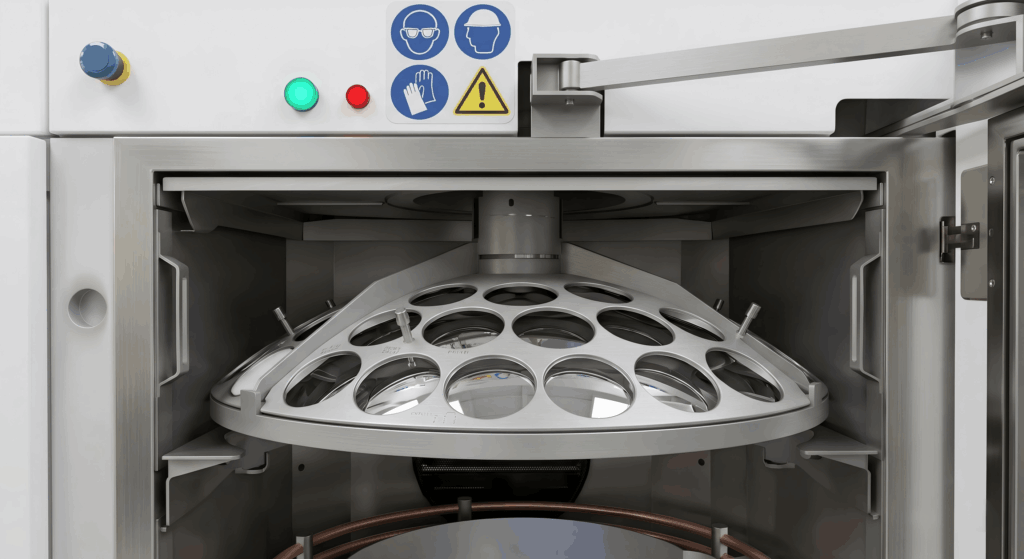
Loading the Dome: Technicians carefully load the clean lenses onto a large, curved metal rack known as a “planetary dome.”
-
Drawing the Vacuum: We place the loaded dome inside a heavy steel coating machine and seal the door. The machine pumps out all the air, creating a deep vacuum environment. A vacuum is required so the coating materials can travel in straight lines without colliding with air molecules.
-
Electron-Beam Evaporation: At the bottom of the vacuum chamber sits a crucible containing the coating materials (usually rare earth metals and oxides). The machine fires a high-energy electron beam directly at these materials.
-
Vaporization and Deposition: The intense heat from the electron beam vaporizes the materials into a gas. This gas rises through the vacuum and condenses evenly onto the spinning lenses above, forming a perfectly uniform, microscopic hard layer.
Designing the Multi-Layer Coating Stack
A modern AR coating is never just one single layer. Different wavelengths of light (red, green, blue) require different coating thicknesses to cancel them out effectively.
To achieve a broadband anti-reflective effect that works across the entire visible light spectrum, our optical engineers design a “coating stack.” This stack consists of multiple alternating layers of high-index and low-index materials:
-
Silicon Dioxide (SiO2): Often used as the low refractive index material.
-
Titanium Dioxide (TiO2): Frequently used as the high refractive index material to bend light effectively.
-
Magnesium Fluoride (MgF2): A classic, incredibly durable material that provides excellent anti-reflective properties and forms the backbone of many premium stacks.
By applying 5 to 7 alternating microscopic layers of these materials, we ensure the lenses block out distracting reflections completely. This precise engineering is also what gives AR-coated lenses their subtle residual color—typically a faint green, blue, or purple hue that you see when tilting the glasses under a light. Furthermore, we can tweak this stack to specifically target and block harmful high-energy blue light or UV rays from reaching the eye.
Functional Top-Coats: Beyond Anti-Reflective
The rare-earth oxides used in the AR stack are incredibly clear, but they are physically porous. If you touch an unprotected AR coating, the oils from your skin will seep into the microscopic pores, smudging the lens permanently and ruining the anti-reflective effect.
To solve this, a premium anti-reflective coating on sunglasses always includes specialized functional top-coats applied immediately after the AR stack inside the vacuum chamber:
-
The Oleophobic Layer: This “anti-smudge” layer repels skin oils and cosmetics, making it remarkably easy to wipe the lenses clean with a simple microfiber cloth.
-
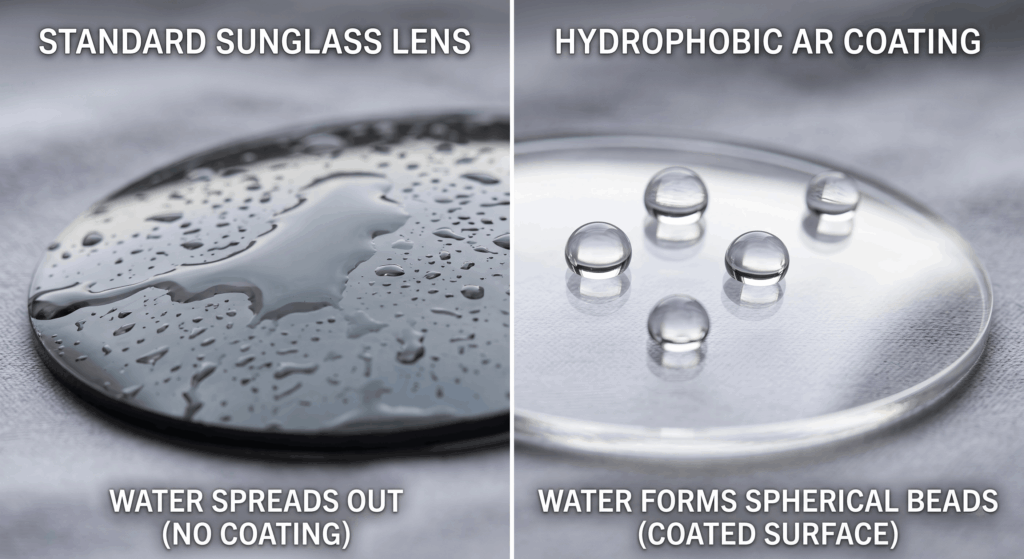
The Hydrophobic Layer: We apply advanced fluoropolymer coatings that lower the surface tension of the lens. Water cannot spread out; instead, it beads up into perfect spheres and rolls right off. This is critical for sports sunglasses and fishing eyewear.
-
The Anti-Scratch (Hard) Coat: Before the AR layers are even applied, we usually dip the raw lenses in a thermally cured siloxane hard coat to prevent the soft base plastic from scratching during daily use.
Quality Control: Stress-Testing the Coating
Before a batch of coated lenses leaves the factory, they must survive rigorous Quality Control (QC) protocols to ensure the AR stack will not peel, crack, or degrade over time.
-
The Adhesion Test (Cross-Hatch Test): We take a sample lens and use a razor blade to cut a grid pattern deep into the coating. We then apply specialized, high-adhesion industrial tape directly over the grid and rip it off violently. If any tiny squares of the AR coating peel away with the tape, the entire production batch is rejected and stripped.
-
The Severe Abrasion Test: We mount the lens in a mechanical testing machine and rub the surface with steel wool or an abrasive eraser pad under a specified weight (e.g., 1kg) for hundreds of cycles. The coating must maintain its integrity and optical clarity without exposing the base lens.
-
Boiling Water Test: We submerge the lenses in boiling saltwater for several minutes to test for thermal stability and ensure the layers do not delaminate under extreme environmental shifts.
OEM Customization: Balancing Cost and Performance
When you partner with a high-capacity OEM like Zhantai, you have the flexibility to customize your coating stack based on your target retail price and demographic.
Every additional layer added to the vacuum deposition cycle increases the time the lenses spend inside the machine, which directly impacts your unit cost.
-
Standard Option: A basic 3-layer back-surface AR coating is highly cost-effective and perfect for mid-tier lifestyle sunglasses, eliminating the most annoying rear reflections.
-
Premium Option: A 7-layer double-sided AR coating featuring advanced hydrophobic and oleophobic top-coats represents the pinnacle of luxury. This is the standard you must choose if you are competing with top European sports and fashion brands.
When requesting quotes, always specify whether you need a back-side only AR coating (standard for dark sunglasses) or a double-sided AR coating (ideal for clear optical frames or light-tinted fashion lenses).
Common Defects and Factory Solutions
Not all AR coatings are created equal. If you source from a factory cutting corners, you will likely encounter these severe defects:
-
Crazing (Micro-cracking): This looks like a tiny spiderweb of cracks across the lens. It happens when the factory applies the hard coating and the AR coating with drastically different thermal expansion rates. When the lens gets hot (like sitting in a car dashboard), the layers expand at different speeds, ripping the AR coating apart. We prevent this by perfectly matching the thermal coefficients of all our applied materials.
-
Coating Peeling: If the AR layers start flaking off the edges of the lens, the factory failed at Step 1: Ultrasonic Cleaning. Even microscopic grease prevents the vacuum vapors from bonding to the lens.
Conclusion: Securing Your Supply Chain
Specifying an anti-reflective coating on sunglasses is the most effective way to elevate the perceived value and actual performance of your eyewear brand. However, this microscopic technology requires massive industrial investment, clinical cleanrooms, and expert engineering to execute flawlessly.
By understanding the vacuum deposition process and knowing the right questions to ask about functional top-coats and adhesion testing, B2B buyers can confidently navigate the sourcing landscape. Partner with a manufacturer equipped with top-tier vacuum chambers and strict QC protocols, and you will ensure your sunglasses deliver the crystal-clear, durable performance your customers expect.