For years, many optical brands treated sun protection and vision correction as two completely separate product categories. You sold standard eyeglasses for daily wear, and you sold “plano” (non-prescription) sunglasses for the beach. However, modern consumer demand has completely shattered that divide.
Today’s eyewear consumer demands a frictionless experience. They want the sharp, precise medical correction of their daily optical frames seamlessly combined with the dark, stylish UV protection of a luxury sunglass. Consequently, offering high-quality prescription sunglasses is no longer an optional upsell for eyewear brands; it is a fundamental requirement for market survival.
However, transforming a stylish sunglass design into a functional medical device requires intense manufacturing precision. You cannot simply squeeze a thick, curved prescription lens into a cheap, injection-molded plastic frame and expect it to hold.
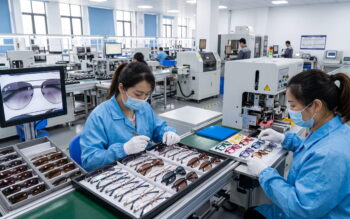
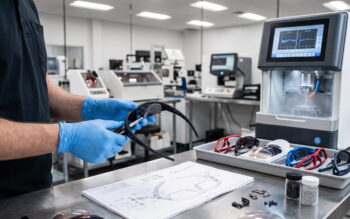
At Wenzhou Zhantai Glasses Co., Ltd., we engineer frames specifically designed to handle complex optical integration. In this comprehensive B2B guide, we take you onto the factory floor to reveal exactly how we manufacture premium prescription sunglasses, from engineering “RX-ready” frame chassis to the exact chemistry of lens tinting and digital surfacing.
Engineering the Chassis: What Makes a Frame “RX-Ready”?
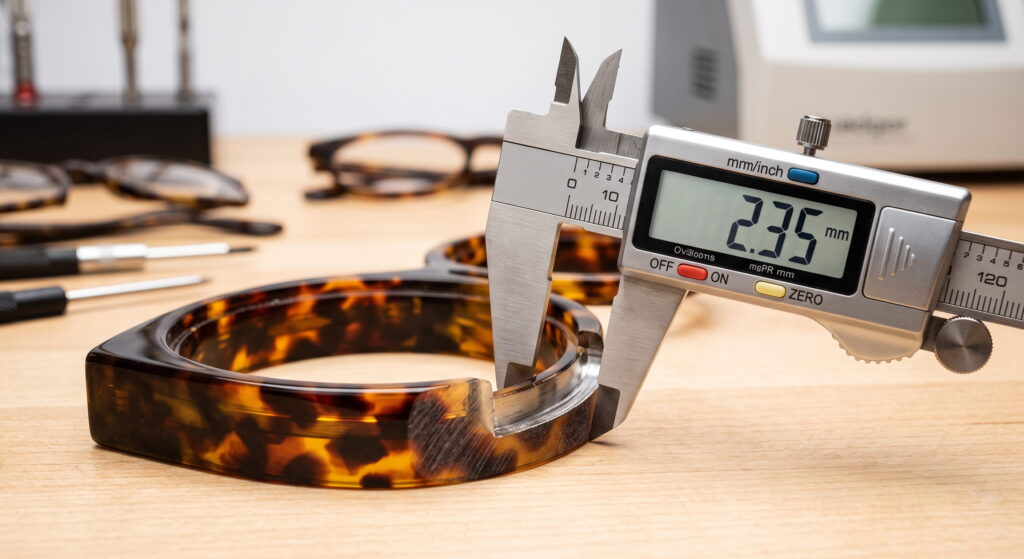
The biggest mistake new eyewear brands make is assuming every sunglass frame can hold a prescription. When you design prescription sunglasses, the factory must engineer the frame chassis—specifically the lens groove—to accommodate a medical lens.
Standard plano sunglasses utilize a shallow “V-groove” because the factory installs thin, uniform 1.8mm nylon or polycarbonate lenses. Prescription lenses behave entirely differently. Depending on the patient’s specific vision correction, a lens might be incredibly thick at the edges (for nearsightedness) or thick in the dead center (for farsightedness).
To build a true RX-ready sunglass frame, our engineers implement three strict structural rules:
-
Deeper Lens Bevels: We cut the internal V-groove deeper and wider using multi-axis CNC machines. This ensures the frame firmly grips the thicker edges of a high-power prescription lens without the lens popping out when the wearer drops the glasses.
-
Thermal Adjustability: We highly recommend using premium Cellulose Acetate for prescription sunglasses. Opticians must heat the frame to insert the prescription lens and bend the temples to fit the patient’s skull. Acetate softens beautifully under heat. If you try to force a thick prescription lens into a cheap, rigid TR90 or PC frame, the plastic will often snap in the optician’s hands.
-
Robust Barrel Hinges: A prescription lens adds significant physical weight to the front of the frame. We anchor heavy-duty 5-barrel or 7-barrel metal hinges deep into the acetate chassis to prevent the frame from sagging or warping under the added weight.
Lens Material Selection: Balancing Weight and Clarity
Once we engineer the perfect frame, we must select the correct raw lens blank. When a B2B buyer specifies prescription sunglasses, the base material dictates the final aesthetic and wearer comfort.
-
CR-39 (Standard Optical Plastic): CR-39 is the traditional workhorse of the optical industry. It provides exceptionally high optical clarity (low distortion) and absorbs liquid dye beautifully during the tinting process. However, CR-39 is thick. We only recommend it for mild to moderate prescriptions.
-
Polycarbonate: Polycarbonate provides extreme impact resistance. We mandate this material for pediatric sunglasses and rimless or semi-rimless frames, as standard plastics will chip or crack when the CNC machine drills holes into them. However, polycarbonate resists liquid dye, making it slightly harder to achieve dark, rich sunglass colors.
-
High-Index Plastics (1.60 and 1.67): For customers with severe vision correction, high-index materials are the absolute standard. These dense polymers bend light efficiently, allowing our technicians to carve a strong prescription into a remarkably thin piece of plastic. Using high-index materials ensures that a strong prescription lens stays hidden entirely inside the frame rim, preserving the sleek aesthetic of the sunglasses.
The Art and Chemistry of Lens Tinting
How do we transform a perfectly clear prescription lens into a dark, stylish sunglass lens? Unlike polarized lenses (which use a suspended chemical film), standard prescription sunglasses achieve their color through a fascinating thermal dye process.
Walk into the tinting department of our optical laboratory, and you will see rows of stainless-steel vats filled with heated, liquid optical dyes.
Solid Tints
To create a solid black, grey, or green lens (like the classic G-15 aviator color), our technicians place the clear, surfaced prescription lenses into a specialized holding rack. We submerge the rack completely into a vat of dye heated to approximately 93°C (200°F). The heat opens the microscopic pores of the optical plastic, allowing the dye to physically seep into the matrix of the lens. The longer we leave the lens in the vat, the darker the final tint becomes.
Gradient Tints (The Ombré Effect)
Fashion brands frequently request gradient lenses—dark at the top to block overhead sunlight, fading to clear at the bottom to allow the wearer to read their phone easily. To achieve this flawless fade, we do not dip the lenses by hand. We mount the prescription lenses onto a computer-controlled mechanical arm. The arm lowers the entire lens into the dye bath and then slowly, mathematically pulls the lens upward. The top of the lens spends twenty minutes submerged in the dye, while the bottom spends only a few seconds, creating a perfect, seamless color gradient.
Digital Surfacing: Conquering the Base Curve
The most technically demanding phase of manufacturing prescription sunglasses involves cutting the actual medical prescription into the lens blank.
Fashion and sports sunglasses frequently utilize a “wrapped” design. They curve around the face to block peripheral wind and sunlight, utilizing a steep 6-base or 8-base curve. If you take a standard, flat optical prescription and carve it directly into a highly curved sunglass lens, you ruin the optics. The steep angle forces the light to bend incorrectly before it hits the eye, creating an unwanted “prism effect.” The wearer will feel instantly dizzy and nauseous.
To solve this, our laboratory uses Freeform Digital Surfacing. Before the diamond cutting tool touches the plastic, our software builds a 3D model of the wearer’s face and the specific sunglass frame. We calculate the wrap angle and the pantoscopic tilt (the angle the frame tilts toward the cheeks). The multi-axis CNC generator then maps thousands of individual points across the back of the lens. It actively recalculates the prescription at every single millimeter, compensating for the aggressive curve of the sunglass frame.
This digital wizardry guarantees that the wearer enjoys crisp, distortion-free vision whether they are looking dead ahead or glancing through the extreme edges of a wrapped aviator frame.
Mandatory Functional Coatings
A tinted piece of plastic is not a finished product. To deliver premium prescription sunglasses that survive daily wear and tear, we apply a suite of advanced chemical coatings in our vacuum deposition chambers.
-
100% UV Protection: This is a critical factory detail—simply dying a lens dark black does not block Ultraviolet rays. If you wear dark lenses without UV protection, your pupils dilate in the dark, allowing massive amounts of dangerous, invisible UV radiation directly into your retina. We must apply a specific, invisible UV400 chemical coating to every prescription lens before it leaves the factory, guaranteeing complete protection from UVA and UVB rays.
-
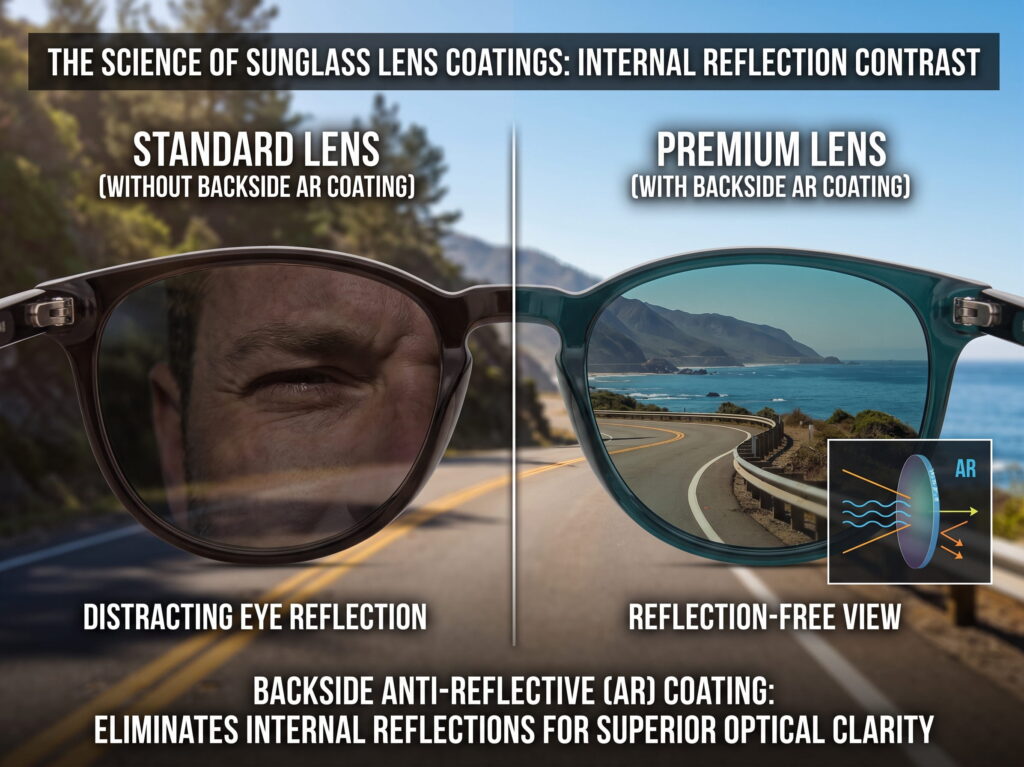
Backside Anti-Reflective (AR) Coating: When you wear dark sunglasses, sunlight entering from behind your head bounces off the inside of the dark lens and reflects directly into your eyes. We apply an AR coating specifically to the back surface of the prescription lens. This microscopic layer absorbs the bouncing light, completely eliminating distracting internal reflections and preventing the wearer from seeing a reflection of their own eyelashes.
-
Thermally Cured Hard Coat: To prevent the lenses from scratching when the consumer inevitably throws them into a beach bag, we dip the lenses in a siloxane hard coat and bake them in thermal ovens, creating a tough, scratch-resistant outer shell.
Strict Quality Control (QC) and CNC Edging
The final step in manufacturing prescription sunglasses is mounting the finished lens into the frame. This step requires absolute mechanical perfection.
We scan the inside of the acetate frame using a digital tracer. We send this exact digital shape to a 5-axis CNC edging machine. The edger cuts the round prescription lens into the precise shape of the frame, carving a sharp V-bevel along the edge of the lens.
Our technicians then heat the acetate frame until it becomes pliable and carefully pop the prescription lenses into the grooves. As the frame cools, it shrinks slightly, locking the lenses in with a vice-like grip.
Finally, our QC inspectors place the finished sunglasses into a digital lensometer. They verify that the optical center of the prescription perfectly matches the wearer’s Pupillary Distance (PD). If the optical center is misaligned by even two millimeters during the edging process, the glasses will cause severe eye strain, and we must reject the entire unit.
Conclusion: Partnering for Optical Perfection
Manufacturing high-quality prescription sunglasses is the ultimate test of a factory’s capabilities. It forces the manufacturer to bridge the gap between high-fashion frame aesthetics and rigorous, medical-grade optical engineering.
By understanding the vital importance of deep V-grooves, high-index materials, digital freeform surfacing, and backside AR coatings, B2B buyers can drastically elevate the quality of their eyewear catalogs. When you partner with a sophisticated manufacturing facility like Zhantai, you eliminate the guesswork. You gain a manufacturing partner capable of building robust, RX-ready frames and integrating flawless, custom-tinted prescription lenses, delivering a product that offers your customers the ultimate combination of medical clarity and uncompromising style.