In the fast-paced world of international eyewear sourcing, the materials you choose dictate your brand’s market positioning, your production costs, and ultimately, your customer’s satisfaction. As global fashion trends lean heavily into the “athleisure” aesthetic and consumers demand all-day comfort, one material consistently outperforms the rest for sports frames, children’s eyewear, and ultra-lightweight optical lines: Nylon.
For B2B buyers, product managers, and international retail chains, understanding the mechanical advantages of nylon glasses frames—and how they perform on the assembly line—is crucial. Let’s dive deep into why high-performance nylon has become an industry staple and what you need to look for when partnering with a reliable nylon eyewear manufacturer to scale your next collection.
What Exactly Are Nylon Glasses Frames?
When the average consumer hears “plastic glasses,” they often imagine the brittle, easily breakable frames found in budget discount bins. However, the nylon used in professional eyewear manufacturing is vastly different. It is an advanced, highly modified polyamide polymer.
While early nylon frames appeared in the 1940s primarily for protective and military goggles, today’s optical market relies heavily on a specific, premium variant of nylon known as TR-90 (or Grilamid TR). Developed by Swiss chemical engineers, TR-90 is a thermoplastic material that boasts incredible shape memory. It represents a massive technological leap over traditional injection-molded plastics like Polycarbonate (PC) or basic Polypropylene (PP), eliminating the brittleness that plagued older plastic frames.
The End-User Benefit: Why Consumers Love Nylon
A successful eyewear collection must solve the wearer’s daily pain points. Nylon glasses frames excel in the consumer market because they address the two most common complaints about eyeglasses: weight and fragility.
Unmatched Lightweight Comfort
If a wearer keeps their glasses on for 10 to 14 hours a day, every single gram matters. Heavy frames dig into the bridge of the nose, leave deep red indentations, and cause soreness behind the ears.
Nylon is exceptionally light. With a specific gravity usually hovering around 1.0 to 1.14 g/cm³, nylon frames weigh significantly less than traditional acetate (which sits around 1.3 g/cm³) and are dramatically lighter than metal alloys. This ultra-lightweight property creates a “barely there” wearing experience. For active consumers—whether they are running marathons, cycling, or just chasing toddlers—the reduced weight ensures the frames do not slip down the nose when the wearer sweats.
High Flexibility and “Shape Memory”
Traditional materials struggle with extreme bending. Metal hinges warp, and standard plastic snaps under pressure. TR-90 nylon, however, possesses remarkable elasticity and shape memory.
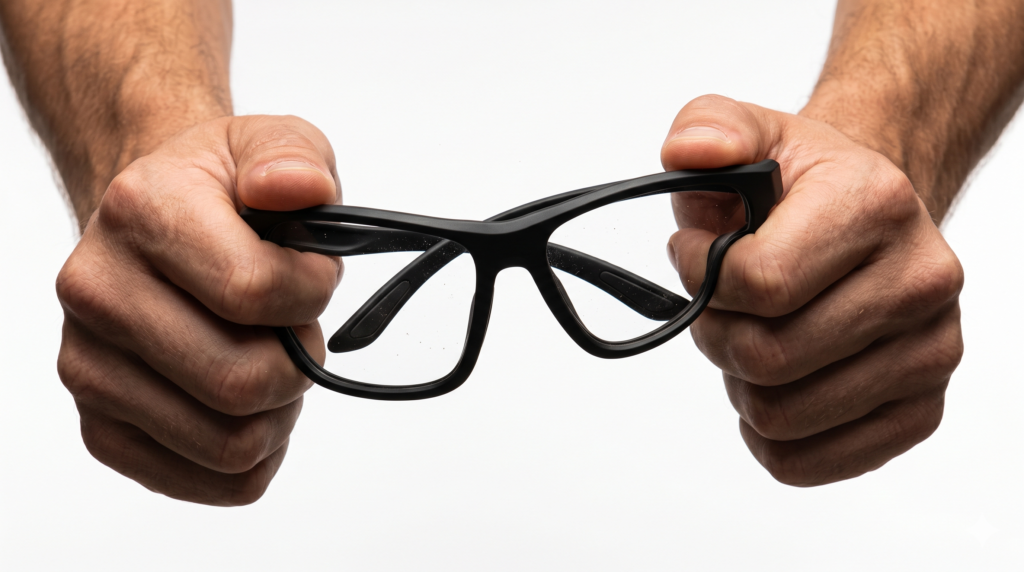
You can bend the temples of a high-quality nylon frame drastically, and the moment you release the pressure, the frame instantly snaps back to its original engineered shape. This flexibility provides a custom-feeling fit that gently hugs the wearer’s face without pinching the temples. Furthermore, this extreme durability makes nylon the undisputed champion for children’s eyewear and high-impact sports goggles. They absorb kinetic energy rather than shattering, protecting the wearer’s eyes from sharp plastic shards.
The Manufacturer’s Perspective: A “Factory-Friendly” Material
While consumers love the feel of nylon, B2B buyers and product developers love how it scales. A primary reason international supermarkets and fast-fashion brands rely on this material is its “factory-friendly” nature. When you work with an experienced nylon eyewear manufacturer, you unlock significant supply chain efficiencies.
High-Speed Injection Molding
Unlike premium acetate frames, which require weeks of cold manufacturing—including CNC routing, tumbling, and meticulous hand-polishing—factories produce nylon frames using advanced thermal injection molding.
Workers heat nylon pellets until they melt, inject the liquid polymer into high-precision steel molds under massive pressure, and cool them in seconds. This automated process allows a factory to churn out thousands of identical frames with virtually zero dimensional variance. When an international client orders 50,000 units for a seasonal rollout, injection-molded nylon guarantees that the first frame looks exactly like the last.
Cost-Efficiency and Low Waste
Because the process relies on molds, the initial setup cost involves engineering the steel tooling. However, once the factory completes the mold, the unit cost drops drastically. Furthermore, the injection molding process generates very little waste. Factories can often recycle and re-pelletize the sprues and runners (the excess material from the mold channels), keeping raw material costs low and improving the sustainability profile of the production run.
Aesthetic Versatility: From Clear to Tortoise
Early iterations of nylon suffered from a dull, purely utilitarian appearance. Today, the aesthetic possibilities are nearly limitless, allowing brands to cater to high-fashion crowds just as easily as the sporting goods sector.
Nylon accepts surface treatments exceptionally well. A top-tier nylon eyewear manufacturer can apply various finishes directly to the molded frame:
-
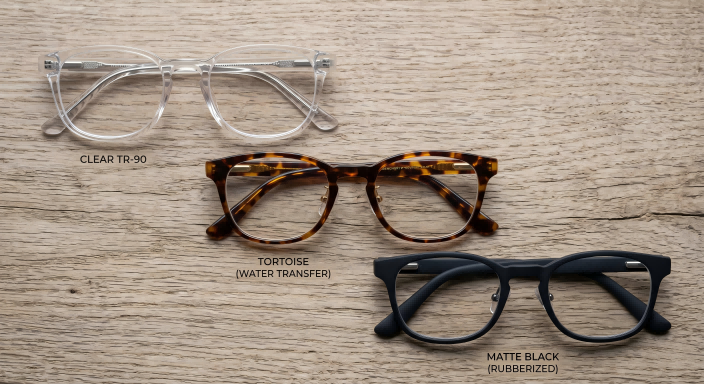
Clear Finishes: Modern buyers heavily favor the minimalist look. Factories can produce completely Clear frames that look sharp, modern, and hygienic, replacing the dated “translucent” terminology of the past.
-
Classic Patterns: Through advanced water-transfer printing, factories can apply rich, complex patterns to nylon. Brands can easily offer a timeless Tortoise pattern that looks just as deep and sophisticated as expensive handmade acetate.
-
Tactile Coatings: Factories frequently apply a specialized rubberized spray painting to nylon frames. This gives the glasses a soft-touch, premium matte feel that resists fingerprints and provides extra grip during sweaty workouts.
Material Comparison: Nylon vs. Acetate vs. Metal
To help wholesale purchasers make informed sourcing decisions, here is how nylon stacks up against the other industry heavyweights:
| Feature | Nylon (TR-90) | Acetate | Metal (Stainless Steel) |
| Weight | Extremely Light | Heavy | Moderate to Light |
| Durability / Flexibility | Excellent; bends and returns to shape. | Brittle under pressure; warps in high heat. | Strong, but bends permanently if forced. |
| Skin Allergies | 100% Hypoallergenic | Hypoallergenic | Dependent on the alloy / plating. |
| Production Speed | Very Fast (Injection Molding) | Slow (Handmade / CNC) | Moderate (Welding / Plating) |
| Unit Cost at Scale | Highly Cost-Effective | Premium / Expensive | Moderate |
For brands building a collection around affordability, speed-to-market, and functional durability, nylon clearly wins the comparison.
Sourcing Smart: Choosing the Right Nylon Eyewear Manufacturer
Selecting the right material is only step one; executing the production requires a capable factory partner. If you are sourcing for an established brand, look for a nylon eyewear manufacturer that demonstrates the following capabilities:
Precision Tooling and Mold Design
The secret to a perfect nylon frame lies in the steel mold. If a factory uses cheap, low-precision tooling, the final glasses will suffer from visible “flash” (excess plastic along the seams), rough edges, and stiff hinges. Ask potential suppliers about their internal CNC mold-making capabilities. A great factory will guide you through the 3D CAD design process to ensure the mold yields a flawless surface finish.
High-Quality Raw Materials
Not all nylon pellets are created equal. Some budget factories mix virgin nylon with excessive amounts of recycled scrap plastic to cut costs, which instantly ruins the frame’s flexibility and makes it prone to snapping. Ensure your manufacturing partner uses premium, imported TR-90 raw materials from reputable chemical suppliers (such as EMS in Switzerland) to guarantee the memory-shape performance your customers expect.
Strict Boundary Management
A professional eyewear factory focuses exclusively on eyewear. Avoid suppliers who split their injection molding machines between glasses frames and unrelated industrial products. A dedicated eyewear manufacturer understands the optical alignment, hinge friction, and ergonomic nuances required to make a frame wearable, not just a shaped piece of plastic.
Conclusion
The evolution of nylon glasses frames has transformed the optical industry, bridging the gap between high-performance athletic wear and everyday fashion. By leveraging the extreme flexibility, hypoallergenic safety, and lightweight comfort of TR-90, brands can deliver products that consumers genuinely love to wear.
For B2B buyers, the material offers a highly scalable, factory-friendly solution that keeps unit costs manageable without sacrificing quality. By partnering with a dedicated, precision-focused nylon eyewear manufacturer, you can streamline your supply chain and bring durable, trend-forward eyewear to market faster than ever before.