The “Invisible” Nose Pad: Unveiling the Science Behind One-Piece Cycling Sunglasses
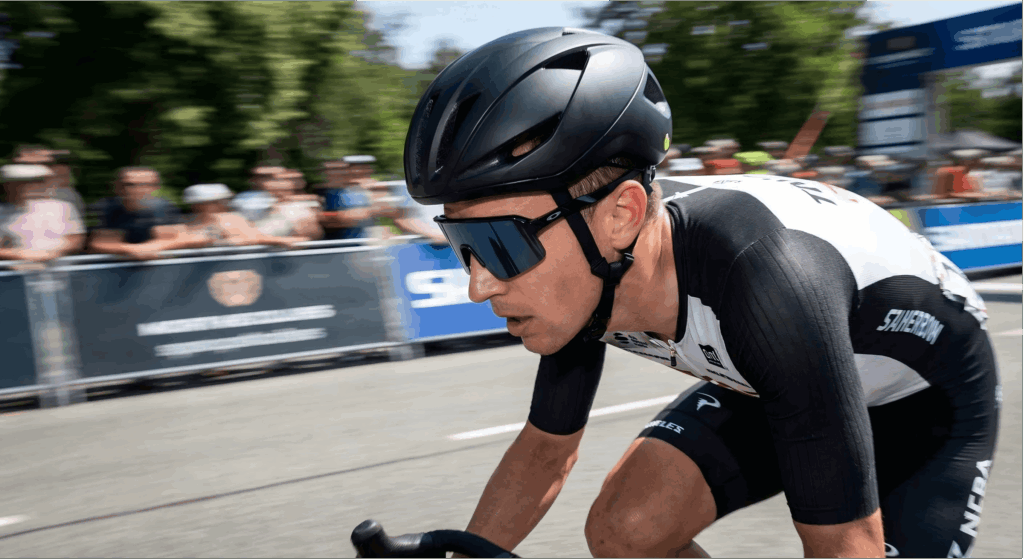
If you watch any professional cycling race today, you will immediately notice a dominant trend: the riders are wearing massive, futuristic eyewear that looks more like a ski goggle than traditional sunglasses. From a distance, these giant visors appear to float on the face, leading to a common question among cycling enthusiasts: Why do professional cycling sunglasses have no nose pads?
First, let’s gently correct a common optical illusion. These high-performance glasses do have nose pads—they just aren’t the traditional, bulky metal wires or plastic bridges you see on everyday eyewear. Instead, the nose piece is stealthily integrated behind a massive one-piece shield lens (also known as a monolens).
This shift away from dual-lens frames isn’t just a fashion statement. It is a calculated engineering choice designed to maximize speed, safety, and vision. Here is a deep dive into the aerodynamic and optical advantages of the one-piece shield lens in professional cycling.
The Optical Advantage: Eliminating the “Dead Zone”
The most significant flaw of traditional, dual-lens sunglasses in cycling is the frame itself.
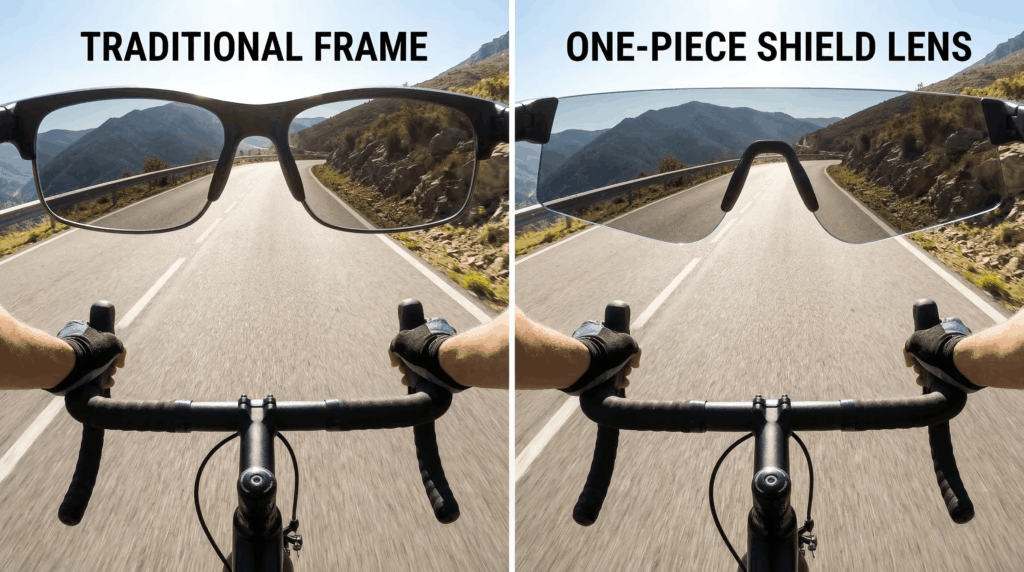
When you ride a road bike, particularly when you are in the “drops” (leaning low over the handlebars for speed), your head is tilted downward, but your eyes must look upward to see the road ahead.
The Problem with Traditional Frames
If you wear normal sunglasses in this aggressive posture, your line of sight goes directly into the upper rim of the frame or the central nose bridge. This creates a dangerous “dead zone” or blind spot right in the center of your vision.
The One-Piece Solution
A frameless cycling sunglass or a one-piece shield lens completely removes the central bridge and the upper rim. By extending a single, uninterrupted sheet of polycarbonate across the entire face, cyclists gain an infinite, unobstructed field of vision. Whether looking over their shoulder for an attack or staring down a steep descent, there is no plastic frame blocking the view.
Aerodynamics: Slicing Through the Wind
In cycling, aerodynamic drag is the ultimate enemy. When speeds exceed 40 kilometers per hour, most of a cyclist’s energy is expended solely on overcoming air resistance.
Aerodynamic cycling eyewear functions exactly like the windshield of a sports car.
A traditional dual-lens frame has ridges, gaps, and a protruding central bridge. These structural interruptions create micro-turbulences and vortexes as air hits the face, adding drag.
A one-piece shield lens offers a continuous, smooth surface. The air hits the curved center of the lens and slips cleanly around the sides of the rider’s head. By hiding the nose pad behind the lens and extending the glass to the temples, manufacturers drastically reduce aerodynamic drag.
The “Micro-Climate” and Windshield Effect
Cycling exposes the eyes to a relentless assault of wind, dust, insects, and road spray. A continuous shield lens provides a vastly superior physical barrier compared to two smaller lenses.
Total Coverage: The oversized nature of the one-piece lens wraps tightly around the cheekbones and up to the eyebrow line, preventing wind from sneaking under or over the glasses.
Tear Prevention: By sealing off the eye area, the shield prevents high-speed wind from drying out the cornea, which causes excessive, vision-blurring tearing.
Fog Management: Because the shield sits further off the face and utilizes hidden nose bumpers, engineers can laser-cut precise ventilation holes at the top or bottom of the single lens. This creates a controlled airflow that prevents fogging on long, sweaty climbs without blasting the eyes with wind.
Weight Distribution: Lighter and Faster
It might seem counterintuitive that a massive piece of glass is lighter than smaller glasses, but the secret lies in the frame structure (or lack thereof).
By relying on the structural integrity of a single, thick polycarbonate or Trivex lens, manufacturers can eliminate the heavy plastic or metal rims that usually encircle the lenses. The lens itself becomes the frame. The temple arms and the hidden, minimalist rubber nose grip are attached directly to the lens. This minimalist, frameless cycling sunglass approach shaves off crucial grams, ensuring the glasses don’t slide down the rider’s face during intense, bumpy, and sweaty efforts.
Summary: The Evolution of Speed
The shift to the one-piece shield lens is a perfect example of form following function. What looks like a bold fashion choice is actually the result of rigorous wind-tunnel testing and optical engineering.
| Feature | Traditional Dual-Lens Glasses | One-Piece Shield Lenses |
| Field of Vision | Restricted by central bridge and top rim | 100% Unobstructed panoramic view |
| Aerodynamics | Creates turbulence at the bridge | Smooth, uninterrupted airflow |
| Debris Protection | Vulnerable at the center and edges | Maximum “windshield” coverage |
| Weight Structure | Requires heavy rims to hold lenses | Lens acts as its own lightweight frame |
Next time you see a rider wearing glasses that seem to have no nose pads, you’ll know the truth: the hardware is hidden, and the massive shield is doing the heavy lifting to keep them fast, safe, and focused on the finish line.