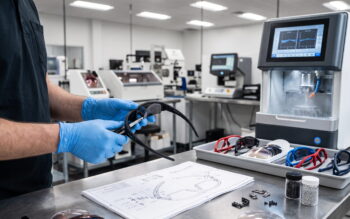
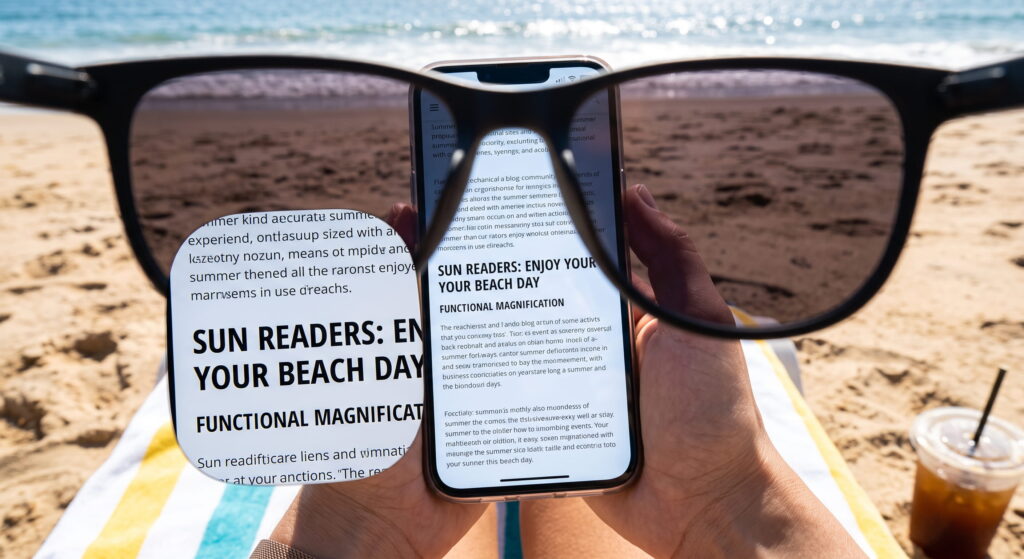
Every summer, millions of consumers face the exact same frustrating scenario. They lounge by the pool or sit at an outdoor cafe, enjoying the warm weather in their stylish fashion sunglasses. Then, their phone buzzes, or they try to read a menu. Instantly, they must take off their expensive sunglasses and squint, or swap them out for a pair of clear reading glasses, leaving their eyes completely unprotected from the blinding glare.
For decades, the optical industry ignored this massive demographic of presbyopic consumers (people who need help seeing close-up objects). Today, smart eyewear brands recognize that this consumer pain point represents a highly profitable market gap. By adding premium reading sunglasses (also known as sun readers) to your catalog, you capture an affluent, older demographic that aggressively seeks out convenience and refuses to compromise on style.
However, manufacturing reading sunglasses requires a completely different engineering approach than building standard tinted lenses. You are combining a medical magnifying device with high-performance sun protection.
At Wenzhou Zhantai Glasses Co., Ltd., we engineer and manufacture millions of specialized lenses every year. In this comprehensive B2B factory guide, I am going to pull back the curtain on our production lines. We will explore the three distinct architectures of sun readers, the complex digital surfacing required to build them, and the strict quality control protocols you must demand from your manufacturing partner.
The Three Architectures of Reading Sunglasses
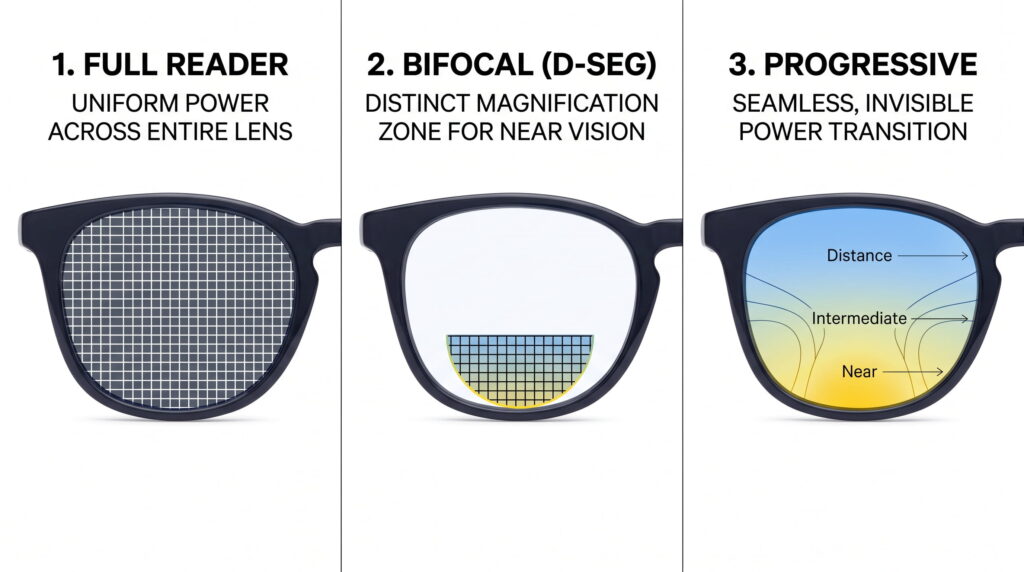
When you initiate an OEM order for reading sunglasses, you must first define the lens architecture. We manufacture three completely different styles, each serving a specific retail price point and consumer need.
The Full-Lens Reader
This is the simplest and most cost-effective architecture. We apply the magnification power (e.g., +1.50, +2.00, +2.50) across the entire surface of the dark sunglass lens.
-
The Use Case: These are strictly for stationary reading at the beach or by the pool.
-
The Drawback: The wearer cannot look up and walk around, as the distance vision will be completely blurred and cause immediate dizziness.
The Lined Bifocal (The D-Segment)
This represents the traditional workhorse of the sun reader market. The top 75% of the lens features zero magnification (plano), allowing the wearer to drive, walk, and view the horizon normally. The bottom 25% of the lens features a visible “D-shaped” magnifying segment specifically for reading dashboards, phones, and books.
-
The Use Case: Highly versatile for driving, fishing, and active outdoor lifestyles.
-
The Manufacturing Reality: We cast-mold these lenses in bulk. The line is physically visible on the front or back of the lens, which some modern fashion consumers find aesthetically outdated.
The Invisible Progressive Sun Lens
This is the pinnacle of modern optical engineering and the most profitable category for luxury brands. The lens provides a seamless, invisible transition. The top offers clear distance vision, the middle transitions for intermediate viewing (like a car dashboard), and the bottom provides full reading magnification.
-
The Use Case: The ultimate “leave-them-on-all-day” solution. The lenses look exactly like standard high-end fashion sunglasses because the magnification zones are completely invisible to the naked eye.
Factory Floor: How We Manufacture Sun Readers
Building these specialized lenses requires advanced laboratory equipment. The manufacturing process changes drastically depending on whether you order standard bifocals or premium progressives.
Injection and Cast Molding (For Bifocals)
For high-volume, cost-effective lined bifocal reading sunglasses, we utilize cast molding. We design precision glass molds that already feature the “D-segment” cavity carved into the bottom section. We pour liquid optical monomer (typically Polycarbonate or CR-39) into the mold and cure it in a thermal oven. The lens hardens with the reading segment permanently formed into the physical structure of the plastic. Because we mold the power directly into the lens blank, we can produce these rapidly at a highly competitive wholesale price.
Freeform Digital Surfacing (For Progressives)
You cannot injection-mold a high-quality progressive lens. We must carve the invisible power corridor using custom software and multi-axis robotics.
-
We start with a thick, semi-finished “puck” of optical plastic (often high-index 1.60 or 1.67 material).
-
Our engineers input the specific frame dimensions, the target reading power (+2.00), and the base curve of the sunglass chassis into our digital surfacing software.
-
A 5-axis CNC diamond-cutting generator maps thousands of individual coordinate points across the back surface of the puck.
-
The diamond tool carves the exact, seamless gradient curve into the plastic. It actively compensates for the wrap angle of the sunglass frame, ensuring the wearer does not experience a distorted “swim effect” when they move their eyes from left to right.
The Chemistry of Tinting and Coating
Once we carve the magnifying power into the lens, we must transform it into a high-performance sunglass. This step introduces unique chemical challenges.
Overcoming Tinting Variances
If we take a standard full-lens reader made of CR-39 and dip it into a hot dye vat, the lens will absorb the color. However, because a reading lens is physically thicker in the center (to create the magnification), standard dip-tinting often results in a lens that looks visibly darker in the middle and lighter at the edges.
To solve this for premium reading sunglasses, our factory utilizes specialized tinting gradients and color-matched polycarbonate films. For our highest-end progressive sun readers, we often apply the tint directly into the hard-coat layer or utilize polarized wafers suspended inside the lens, ensuring a perfectly uniform, rich color regardless of the lens thickness.
The Mandatory Backside AR Coating
When a consumer wears reading sunglasses, they spend a significant amount of time looking down (at a book or a phone). When you look down outdoors, sunlight shines directly over your shoulder, hits the inside of your dark sunglass lens, and bounces straight into your eye.
To prevent this blinding internal reflection, we apply a premium Anti-Reflective (AR) coating exclusively to the back surface of the lens inside our vacuum deposition chambers. This microscopic coating absorbs the bouncing light, eliminating glare and dramatically reducing eye strain during long reading sessions on the beach.
Frame Engineering: Why Fit Dictates Function
You cannot simply take a fast-fashion frame off the shelf and slap a progressive reading lens into it. The frame architecture dictates whether the reading sunglasses actually work.
When our engineers at Zhantai design an RX-ready frame for sun readers, we focus intensely on two ergonomic metrics:
-
Pantoscopic Tilt: This is the angle at which the bottom of the frame tilts inward toward the wearer’s cheeks. For reading lenses to function correctly, the frame must possess a healthy pantoscopic tilt (usually between 8 and 12 degrees). This tilt naturally aligns the bottom reading zone with the eye’s downward gaze when reading a book. If the frame sits perfectly flat (0 degrees), the wearer has to awkwardly push their chin into their chest to find the reading magnification.
-
Adjustability: We strongly advise B2B buyers to select Cellulose Acetate or flexible memory metals for their sun reader collections. Acetate softens beautifully when an optician heats it. This allows the retailer to bend the temples and adjust the nose pads, ensuring the reading segment aligns perfectly with the unique anatomy of the customer’s face.
Strict Quality Control (QC): Verifying the Segment Height
Manufacturing a standard sunglass requires checking for scratches and verifying UV400 protection. Manufacturing reading sunglasses requires a clinical level of optical quality control.
The most critical step in our assembly line is verifying the Segment Height (Seg Height). When we cut the round lens blank to fit inside your specific sunglass frame, we must position the reading zone perfectly.
-
If we mount the reading segment too high, the magnification zone will block the wearer’s distance vision. They will feel dizzy and unable to drive safely.
-
If we mount the reading segment too low, the wearer will have to physically lift the sunglasses off their nose just to read their phone.
Our QC inspectors use digital lensometers to map the exact optical center and verify the precise millimeter height of the reading segment before the glasses ever go into the master shipping carton. We guarantee that the magnification corridor sits exactly where it belongs, providing a frictionless visual experience.
The B2B Sourcing Strategy: Elevating Your AOV
Why should an eyewear brand navigate the complexities of sourcing reading sunglasses? The answer lies in consumer demographics and Average Order Value (AOV).
The global population is aging. Millions of Gen X and Baby Boomer consumers suffer from presbyopia. They possess high disposable income and they care deeply about their aesthetic appearance. They do not want to buy cheap, ugly reading glasses from a pharmacy spinner rack.
When you offer a line of beautifully crafted, acetate progressive sun readers, you offer a premium lifestyle solution. You can command a significantly higher retail price for a progressive sun reader than you can for a standard polarized sunglass, drastically increasing your brand’s profit margins.
Furthermore, you create immense brand loyalty. When a customer finds a pair of sunglasses that allows them to read a poolside menu and drive a car without ever taking the frames off, they will return to your brand year after year.
Conclusion: Partner with Optical Specialists
Successfully launching a line of reading sunglasses requires a manufacturing partner who understands both high-fashion frame engineering and clinical optical precision.
You cannot trust this complex product category to a generic plastic-injection factory. You must work with a facility equipped with 5-axis digital surfacing generators, vacuum coating chambers for backside AR application, and strict optical QC protocols.
At Wenzhou Zhantai Glasses Co., Ltd., we merge premium frame architecture with advanced lens technology. We understand the precise mathematics of pantoscopic tilt and the chemistry of uniform tinting over high-index materials. By partnering with a true optical manufacturer, you guarantee that your brand delivers a flawless, distortion-free product that perfectly solves the outdoor reading dilemma for your most valuable customers.