Sourcing eyewear globally offers incredible opportunities for profit, but the complex web of international trade regulations can quickly erode those margins if you aren’t prepared. For B2B buyers, brand owners, and procurement managers, understanding your exact tax liability is just as critical as negotiating the initial factory unit price.
In 2026, the landscape of eyewear import duties remains highly dynamic. Trade policies, particularly between the US and China, continue to evolve, directly impacting the landed cost of every pair of sunglasses you import. A single classification error or a misunderstanding of current tariffs can turn a profitable container load into a financial liability.
This comprehensive guide breaks down everything you need to know about eyewear import duties and sunglasses tariffs in 2026. We will explore the critical HS Code classifications, compare international duty rates, analyze the impact of Section 301, and show you exactly how to calculate your true landed cost.
Demystifying HS Code 9004.10: The Universal Classification
The foundation of all international trade is the Harmonized System (HS) code. Before you can calculate any duties, you must correctly classify your product.
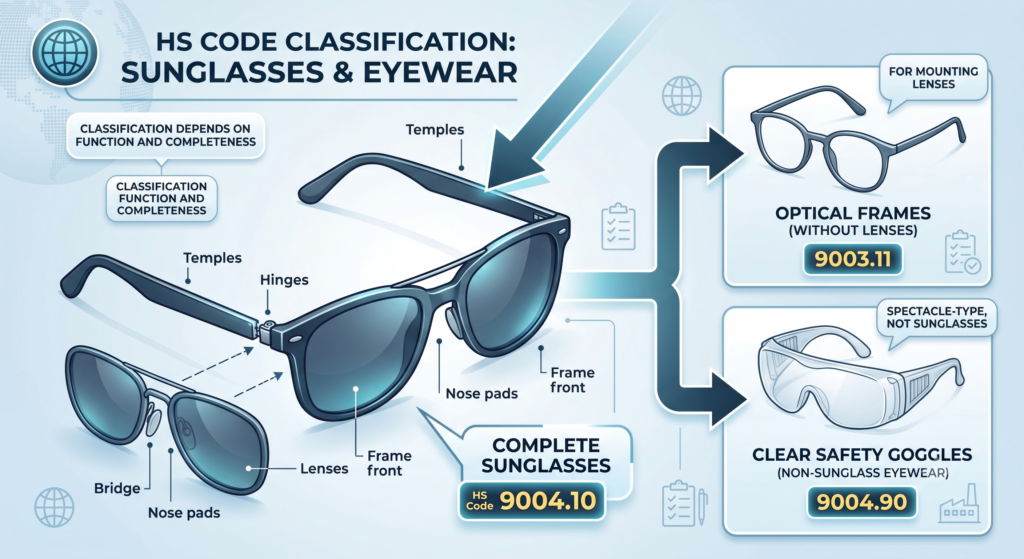
For sunglasses, the global standard is HS Code 9004.10.
Unlike clothing or footwear, which customs authorities classify based on the material (e.g., cotton vs. polyester), eyewear classification depends on its function. All sunglasses—whether they feature cheap injection-molded plastic frames, premium cellulose acetate, or high-end titanium—fall under this specific subheading because their primary function is to protect the eyes from solar radiation.
-
Chapter 90: Optical, photographic, cinematographic, measuring, checking, precision, medical or surgical instruments and apparatus; parts and accessories thereof.
-
Heading 9004: Spectacles, goggles and the like, corrective, protective or other.
-
Subheading 9004.10: Sunglasses.
Common Classification Errors and Compliance Risks
Many first-time importers assume that if they buy an acetate sunglass frame without the tinted lenses, it still falls under 9004.10. This is a costly mistake.
-
Frames without lenses are classified under 9003 (e.g., 9003.11 for plastic frames).
-
Safety goggles (even if tinted) often fall under 9004.90.
-
Blue-light blocking glasses (non-corrective, non-solar) are also frequently grouped under 9004.90.
Using the wrong code can lead to customs audits, shipment delays, and substantial financial penalties. Always ensure your commercial invoice clearly states “HS Code 9004.10 – Sunglasses” for finished, sun-protective eyewear.
2026 International Tariff Comparison for Sunglasses
The duty you pay depends entirely on where your goods are manufactured (Country of Origin) and where they are being delivered. Here is the current 2026 breakdown for sunglasses tariffs imported from China (the world’s largest eyewear manufacturer) to major global markets:
| Destination Market | Base MFN Duty Rate | Additional Surcharges (China Origin) | Total Estimated Duty Rate |
| United States | 2.00% | 7.5% (Sec. 301) + 10% (Sec. 122)* | ~19.5% (Varies by active exclusions) |
| European Union | 2.90% | None | 2.90% |
| United Kingdom | 0.00% | None | 0.00% |
| Australia | 5.00% | None (0% if using CHAFTA/ChAFTA) | 5.0% (or 0%) |
| Japan | 0.00% | None | 0.00% |
*Note: The US trade environment is exceptionally fluid in 2026. The 2% base rate (Most Favored Nation – MFN) applies globally. However, imports from China currently face a 7.5% Section 301 tariff on List 4A goods (which includes 9004.10). Additionally, the recently implemented Section 122 reciprocal surcharge adds another 10% through mid-2026, creating a highly volatile tax burden.
The Impact of Section 301 on US Importers
For US-based eyewear brands, Section 301 tariffs remain the largest hurdle in supply chain profitability. Originally implemented in 2018 and maintained through 2026, these tariffs specifically target Chinese imports.
When you import sunglasses under HS 9004.10.00.00 from China, you do not just pay the 2% base rate. You must add the 7.5% Section 301 penalty, and currently, the temporary 10% Section 122 reciprocal tariff.
Strategic Alternatives for B2B Buyers
How do savvy buyers mitigate these heavy eyewear import duties?
-
Seek Tariff Exclusions: The US Trade Representative (USTR) periodically grants exclusions for specific medical or protective items. While difficult to secure for fashion sunglasses, you must monitor the Federal Register for any changes.
-
Absorb and Reposition: Many luxury brands choose to absorb the cost, maintaining Chinese production to access the unmatched expertise of Wenzhou’s acetate factories. They offset the tariff by increasing their retail price slightly and leaning heavily into premium branding.
-
Alternative Sourcing (The “China Plus One” Strategy): Some brands diversify by moving basic injection-molded production (like PC frames) to Southeast Asia (Vietnam or Cambodia). However, be warned: these regions often lack the specialized tooling and skilled labor required for high-end acetate or titanium eyewear, making China the only viable option for premium goods despite the tariffs.
Calculating Your True Landed Cost
Your factory quote is only the beginning. The “Landed Cost” is the total price of a product once it arrives at your warehouse door. If you do not calculate this accurately, you will incorrectly price your retail goods and destroy your margins.
The Landed Cost Formula:
Total Landed Cost = (Factory Unit Price * Quantity) + International Freight + Shipping Insurance + Import Duties + Customs Clearance Fees + Domestic DeliveryA Real-World 2026 US Import Example:
Imagine you are importing 1,200 pairs of premium acetate sunglasses from Wenzhou, China, to Los Angeles, USA.
-
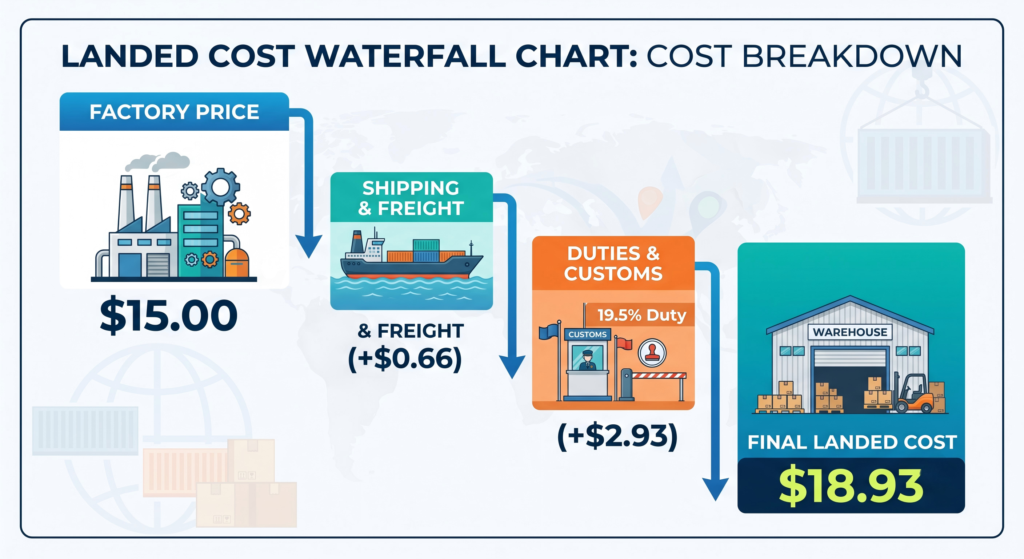
Factory Invoice (FOB Wenzhou): $15.00 per unit ($18,000 total)
-
Ocean Freight (LCL) & Insurance: $800
-
Customs Value: $18,000 (Note: Duties are calculated on the FOB value of the goods, not including freight)
-
Total US Duty Rate: 19.5% (2% Base + 7.5% Sec 301 + 10% Sec 122)
-
Duty Payment: $18,000 * 19.5% = $3,510
-
Customs Broker & Processing Fees: $150
-
Inland Delivery (Port to Warehouse): $250
Total Landed Cost Calculation:
$18,000 (Goods) + $800 (Freight) + $3,510 (Duties) + $150 (Fees) + $250 (Inland) = $22,710
Your true landed cost per unit is $18.93 (an increase of $3.93 over the factory quote). You must base your retail pricing strategy on this $18.93 figure, not the initial $15.00 factory quote.
Incoterms: FOB vs. CIF vs. DDP Sourcing Strategies
When negotiating with your eyewear manufacturer, the Incoterm you choose dictates who is responsible for paying freight, insurance, and those crucial eyewear import duties.
FOB (Free On Board)
-
How it works: The factory pays to get the goods onto the ship in China. You pay for the ocean freight, insurance, and all import duties when it arrives.
-
The Strategy: This is the preferred method for experienced buyers. It gives you total control over your freight rates and ensures you know exactly how much duty you are paying to customs.
CIF (Cost, Insurance, and Freight)
-
How it works: The factory pays the ocean freight and basic insurance to get the goods to your port. You still pay the import duties upon arrival.
-
The Strategy: Often a trap for new buyers. The factory controls the shipping agent, and hidden “destination fees” frequently appear when the goods arrive at your port. Avoid CIF if possible.
DDP (Delivered Duty Paid)
-
How it works: The factory handles everything. They pay the freight, handle the customs clearance, and pay all import duties. The goods arrive directly at your door.
-
The Strategy: The easiest option, but the most expensive. The factory will heavily inflate the shipping quote to protect themselves against fluctuating 2026 tariff rates. Use DDP only for small, urgent air shipments where convenience outweighs cost.
Conclusion: Master the Math Before You Buy
Successfully managing an international eyewear brand requires more than selecting trendy frame shapes. You must master the math of global logistics.
By understanding the HS Code 9004.10 classification, anticipating the aggressive 2026 US sunglasses tariffs, and meticulously calculating your landed costs, you protect your business from unexpected financial shocks. Work closely with a licensed customs broker and choose a transparent manufacturing partner who understands proper documentation. When you navigate the complexities of eyewear import duties proactively, you secure your profit margins and ensure a smooth, predictable supply chain.
Learn More