Launching a successful eyewear collection requires far more than a brilliant sketch on a notepad. Whether you run a rapidly expanding fast-fashion brand, a boutique eyewear label, or a large-scale supermarket chain, transitioning a design from a digital concept to a tangible, retail-ready product is a rigorous engineering journey.
Many new buyers make the catastrophic mistake of rushing straight into mass production to save time. Professional procurement directors know better. Validating your design through a physical custom sunglasses sample is the single most critical step in the entire manufacturing process. It protects your capital, ensures ergonomic comfort, and guarantees that your vision aligns perfectly with factory capabilities.
However, navigating overseas communication and technical manufacturing terms can feel overwhelming. This comprehensive guide demystifies the process. We will walk you through exactly how to prepare your designs, how engineers develop a sunglasses prototype China, and how to seamlessly transition your approved sample into high-volume mass production.
Step One: Prepare a Comprehensive Tech Pack
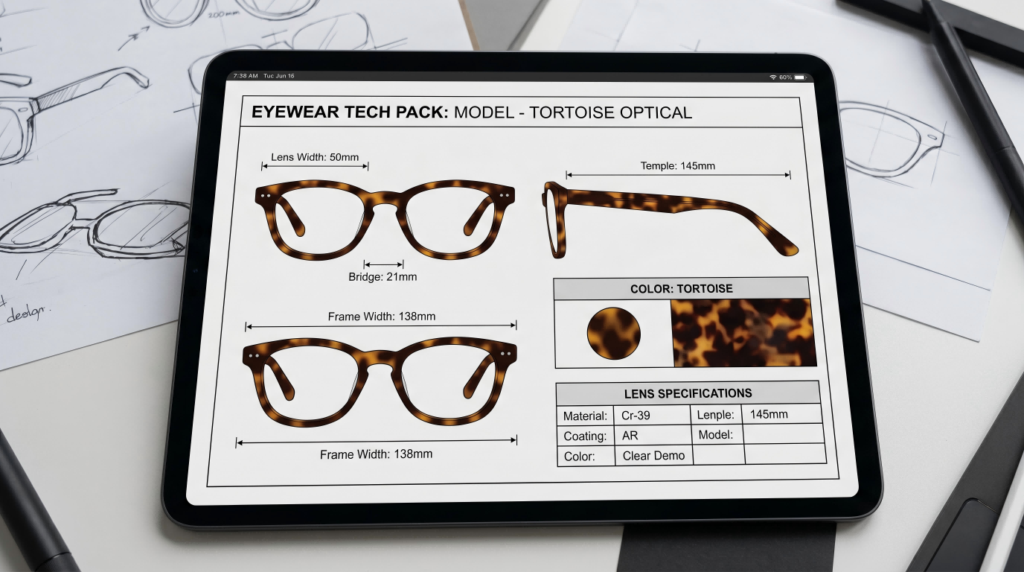
A premium manufacturing partner cannot guess what you want. Before a factory can produce a precise custom sunglasses sample, you must provide a detailed “Tech Pack.” This document serves as the absolute blueprint for your eyewear.
If your Tech Pack lacks detail, your prototype will require endless, costly revisions. A professional Tech Pack must include:
Precise Millimeter Dimensions
Do not rely on vague terms like “oversized” or “small.” You must define the exact millimeter measurements for the critical zones:
-
Lens Width: The horizontal diameter of one lens.
-
Bridge Width: The distance between the two lenses.
-
Temple Length: The measurement of the arm from the hinge to the tip.
-
Base Curve: Do you want a flat 4-base fashion frame, or an aggressive 8-base wrap-around sports profile?
Material Specifications
Your material choice dictates the weight, durability, and cost of your frames.
-
TR90: Specify this advanced Swiss-engineered polymer if you want extreme flexibility and lightweight comfort, perfect for sports or all-day wear.
-
Polycarbonate (PC): Choose this for high-impact resistance and vibrant, high-gloss finishes.
-
Metal: Specify stainless steel or titanium for ultra-thin, minimalist wire designs.
Exact Colorways and Finishes
Avoid ambiguous color names. Instead, provide exact Pantone color codes. In 2026, consumer demand heavily favors specific aesthetics. If you want a see-through frame, specify a Clear or Transparent finish. If you want a classic, luxury-inspired pattern, specify a rich Tortoise finish. State whether you want a matte or a high-gloss polish.
Lens Functionality
Specify the Visible Light Transmission (VLT) category (e.g., Category 3 for bright sun). Detail any specialized coatings, such as anti-reflective layers, polarization, or gradient tints.
Step Two: Finding the Right Manufacturing Hub
Location dictates expertise. When sourcing a sunglasses prototype China remains the undisputed global leader, but you must look at specific regions.
Wenzhou, China, stands as the premier manufacturing hub for high-quality eyewear. Factories in Wenzhou possess decades of institutional knowledge, specifically regarding injection molding and advanced polymer handling. When you partner with a manufacturer rooted in Wenzhou, you gain access to an entire ecosystem of raw material suppliers, hinge engineers, and lens technicians.
However, forward-thinking B2B buyers also look for manufacturers with diversified supply chains. Finding a partner that operates a Wenzhou headquarters alongside a dedicated Thailand factory offers immense strategic advantages. This dual-hub setup allows you to develop the prototype with expert Chinese engineers, and subsequently bypass specific export tariffs by routing mass production through Thailand—an incredibly valuable strategy for brands targeting the United States or expanding into the Mexican market.
Step Three: The 3D CAD Modeling Phase
Once you submit your Tech Pack to a qualified manufacturer, they do not immediately cut plastic. First, they translate your 2D drawings into a 3D digital reality.
Factory engineers use advanced software to create a 3D CAD (Computer-Aided Design) model of your frame. This digital file maps out the exact curvature, the hinge placement, and the lens grooves.
The factory will send you digital renderings of this CAD file. You must review these renderings meticulously. You can rotate the frame 360 degrees on your computer screen. Look closely at the thickness of the browline and the angle of the nose pads. Adjusting a digital file takes an engineer a few hours; adjusting a physical steel mold later will cost you thousands of dollars.
| Feature to Check | Digital CAD Phase | Physical Prototype Phase |
| Proportions | Highly accurate visual representation. | 1:1 scale representation. |
| Ergonomics/Fit | Cannot test fit. | Can test on a human face. |
| Weight | Calculated estimation. | Exact physical weight. |
| Hinge Functionality | Visual placement only. | Physical tension and snap-back test. |
Step Four: Engineering the Physical Prototype
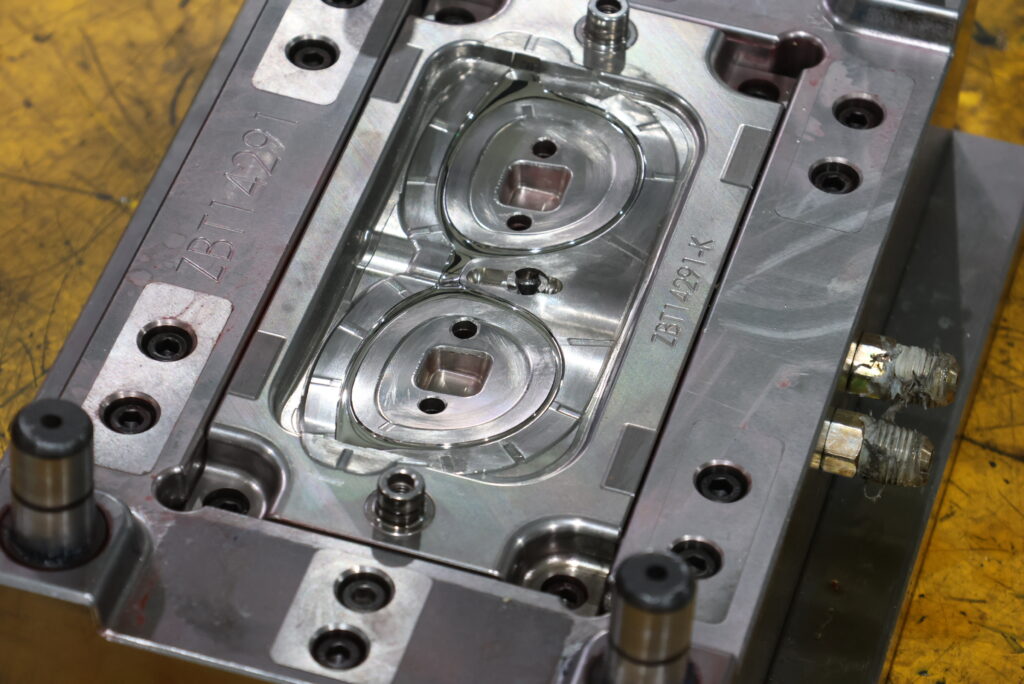
After you approve the 3D CAD digital file, the factory finally produces your physical sunglasses prototype China. Because cutting a steel injection mold for mass production costs thousands of dollars, factories use alternative, cost-effective methods to create this initial one-off sample.
CNC Machining
For the highest quality prototype, technicians use Computer Numerical Control (CNC) machines. The machine carves your exact frame shape out of a solid block of acetate or high-density plastic based on the CAD coordinates. This method produces a highly accurate, durable sample that closely mimics the final product’s weight and feel.
3D Printing (SLA/SLS)
Some factories use industrial 3D printers to rapid-prototype the frame. The printer builds the frame layer-by-layer using liquid resin or nylon powder. While 3D printing is incredibly fast and allows for rapid iteration, the resulting surface finish is often slightly rougher and more brittle than a CNC-machined or injection-molded frame.
The engineers then manually install the metal hinges and cut a sample lens to fit the frame. They package this custom sunglasses sample and ship it directly to your corporate headquarters via express air freight.

Step Five: Evaluating Your Custom Sunglasses Sample
The day your sample arrives is the most critical moment in your product development cycle. You must evaluate the prototype systematically. Do not just look at it in the mirror; test it rigorously.
The Ergonomic Fit Test
Put the glasses on and wear them for at least an hour.
-
Do the nose pads distribute the weight evenly, or do they dig into your skin?
-
Do the temple arms hug your skull comfortably, or do they pinch behind your ears?
-
Look down and shake your head quickly. Do the frames slide down your nose? If they slide, you must ask the factory to adjust the pantoscopic tilt or tighten the temple curve.
Structural Integrity and Hinge Tension
Open and close the temple arms repeatedly. The hinges should feel smooth and offer a reassuring “snap” when fully opened. If you requested spring hinges, test their flexibility. The frame should not creak or flex irregularly when you handle it.
Aesthetic and Color Verification
Examine the finish under natural sunlight. If you ordered a Transparent frame, ensure the polymer looks crystal clear, free of any cloudy impurities or micro-bubbles. If you ordered a Tortoise pattern, evaluate the depth and richness of the color variations. Verify that the factory applied your brand logo cleanly and precisely on the temple arms.
Important Note on Prototype Finishes
You must remember that a CNC-machined or 3D-printed prototype might lack the absolute high-gloss, flawless luster of a final injection-molded product. Injection molding forces molten plastic against highly polished steel, creating a perfect surface tension that CNC carving cannot perfectly replicate. You evaluate the prototype primarily for structure, fit, and proportions.
Step Six: Revisions and The “Golden Sample”
Rarely is the first prototype absolutely perfect. You might find that the frame looks slightly too wide on the face, or that the lenses need a darker gradient tint.
Compile a detailed feedback report. Take photographs of the sample pointing out exactly what needs changing. Send this report back to your factory. The engineers will tweak the CAD file and produce a second prototype.
You repeat this process until you hold a flawless frame in your hands. Once you approve a sample without any further changes, this specific frame becomes the “Golden Sample.” The factory will use this exact physical unit as the definitive benchmark for all mass production quality control.
Step Seven: Moving to High-Volume Mass Production
With the Golden Sample locked in, your brand is ready to scale. You officially sign off on the design, and the factory begins the heavy industrial work.
Cutting the Steel Injection Molds
The engineers take the final, approved CAD data and use it to carve the heavy steel injection molds. This tooling process takes precise engineering and represents the core investment in your new product line. These molds will endure extreme pressure to produce thousands of identical, flawless frames.
Minimum Order Quantities (MOQ)
Because engineering steel molds and setting up industrial injection machines requires significant labor and calibration, factories operate on volume. To deliver the aggressive, highly profitable unit costs that fast-fashion brands and supermarkets require, premium manufacturers enforce a strict Minimum Order Quantity (MOQ) of 1200 units per style. This scale guarantees production efficiency and protects your retail profit margins.
Injection, Assembly, and Global Logistics
The factory injects the molten TR90 or Polycarbonate into the new steel molds. After the raw frames cool, technicians polish them, install the hardware, and fit the UV400 lenses.
The Quality Control (QC) team then steps in. They pull frames randomly from the assembly line and compare them directly against your approved custom sunglasses sample. They verify the color matching, drop-test the lenses, and check the hinge tension.
Finally, the factory packages your bulk order according to your exact retail specifications. Utilizing a dual-hub supply chain, the factory arranges direct freight shipping from their Wenzhou or Thailand facilities directly to your international distribution centers.
Conclusion: Partnering for Precision
Ordering a sunglasses prototype China is the foundational step in building a profitable, high-turnover eyewear collection. By meticulously preparing your Tech Pack, carefully reviewing the 3D CAD files, and rigorously testing your physical custom sunglasses sample, you eliminate manufacturing risks and guarantee that your final product flawlessly matches your brand vision.
However, a prototype is only as good as the factory that scales it. You need a B2B partner who understands the exact science of injection molding and global logistics.
At Zhantai Glasses, we engineer our production lines to meet the rigorous demands of large-scale international retail. Rooted in deep Wenzhou manufacturing heritage, we guide our brand partners seamlessly from the initial sketch to the final Golden Sample. With our advanced TR90 capabilities, our strategic Thailand facility for tariff-efficient global shipping, and our commitment to flawless mass production at an MOQ of 1200 units, we provide the manufacturing power your brand needs to capture the 2026 market.
More Trends: